AI lets PE firms review a data room in days instead of weeks by ingesting the full document set at once, cross-referencing it, flagging mismatches and missing items, and returning a structured diligence summary with every figure cited to its source. Because data room review is the bottleneck between LOI and close, compressing it directly increases deal velocity and how many deals each analyst can carry.
This is for PE associates and VPs, real estate acquisitions teams, and M&A analysts responsible for processing a data room on a fixed deal timeline.
This is part of a series of articles about AI for Finance.
The Bottleneck: Hundreds of Documents on a Fixed Clock
A data room holds CIMs, financial models, historical financials, legal agreements, customer contracts, HR records, and IP documentation — often hundreds of files. Diligence typically runs a fixed 30–45 business days, six to eight weeks for full scope, and the reading is what dictates how fast you reach a confident bid and a clean close. Process it manually and a large data room consumes the window; against competing bidders who turn faster, slow diligence loses deals, and every deal a team is buried in is a deal it can't start.
Draft your first investment memo in minutes with AI
How AI Handles It
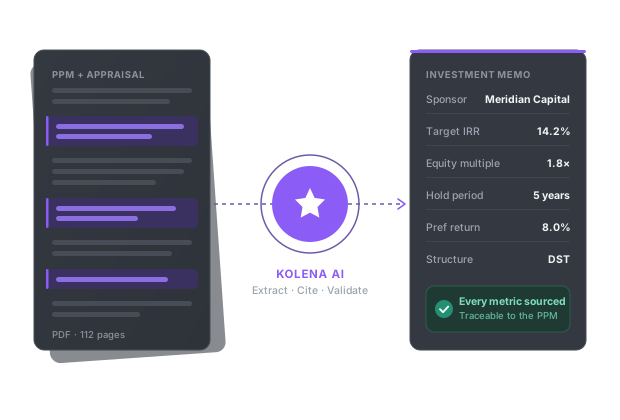
AI ingests the full data room and works across documents rather than one at a time. It cross-references — reconciling the model against the historical financials, the customer contracts against the revenue assumptions — flags assumption mismatches and missing items (an absent agreement, an unsigned contract, a figure that doesn't tie), and produces a structured diligence summary. Every figure links to its source document, so an analyst verifies rather than re-derives, and the IC sees sourced numbers.
| Factor | Manual data room review | AI-assisted review |
|---|---|---|
| Calendar time | Most of a 6–8 week window | Days |
| Cross-referencing | Document by document, late | Across the full set, up front |
| Missing-item detection | Depends on the reviewer | Flagged systematically |
| IC memo sourcing | Figures re-verified by hand | Every figure cited to its source |
| Confidentiality | Offshore review adds NDA/residency risk | Onshore, SOC 2 Type II, no training on your data |
One PE customer uses Kolena for data-room due diligence and deal analysis, reducing manual review time and improving consistency across investment reports.
The Confidentiality Angle
Data room documents are among the most sensitive a firm handles — unannounced deals, proprietary financials, NDA-bound terms. Routing them to an offshore review team introduces data-residency and NDA exposure that sellers and LPs increasingly scrutinize, and for some transactions it's simply not allowed. Onshore AI processing eliminates that exposure: the documents stay in your secure environment, the platform is SOC 2 Type II certified, and customer data is never used to train models. You get the speed of automation without widening the circle of who touches the deal.
What Changes — and Who Should Adopt It
Compressing diligence from weeks to days changes deal economics: faster close timelines, better-sourced IC memos, fewer post-close surprises, and more deals per analyst. Adopt it when you acquire at volume, when timelines are competitive, or when IC memos demand sourced figures. A buyer doing one small, simple deal a year with a tiny document set may manage manually. And AI doesn't replace specialist diligence providers — the QoE accountants and deal counsel still do their work; AI reads and structures the data room around them so your team moves faster and the investment judgment stays with the deal team.
Related articles: ai earnings call analysis and Banking Compliance Automation.
How Kolena Works
Kolena is an AI document automation platform built for PE and real estate acquisitions teams. The full data room — CIMs, models, historical financials, legal agreements, contracts — goes in; a structured diligence summary with flagged mismatches, missing items, and a sourced IC-memo draft comes out in days.
It reads any format inside your secure environment, cross-references the documents, and pushes structured output into your acquisition model and reporting stack, with every figure cited to its source. Every run produces a full audit trail: not just what was extracted, but the specific line, figure, or passage that justified each data point. SOC 2 Type II certified, onshore processing, no training on customer data.