What Is a Real Estate Investment Memo?
A real estate investment memo is an internal, data-driven decision document used by capital allocators to justify funding, evaluate risks, and synthesize underwriting assumptions before committing capital to a property.
The memo typically covers the property, location, purchase price, financing structure, operating assumptions, and business plan. It also presents financial metrics such as net operating income (NOI), capitalization rate, cash-on-cash return, internal rate of return (IRR), and equity multiple. These figures show how the investment may perform under the stated assumptions.
A useful investment memo also explains what could change the expected outcome. This includes risks such as higher vacancy, slower rent growth, unexpected capital expenses, changes in interest rates, or a lower sale price. Sensitivity and scenario analysis can show how these variables affect returns and help investors evaluate the range of possible outcomes.
Investment memo vs. offering memorandum (OM):
- Offering memorandum (OM): A broker-created marketing presentation designed to highlight upside and attract buyers.
- Investment memo: An objective internal document written for investment committees to audit risks, validate assumptions, and approve funds.
Essential components of a real estate investment memo:
- Executive summary: Identifies the asset, parties involved, and the explicit recommended action.
- Investment thesis: Explains the core strategy, value-creation plan, and market alignment.
- Market & demographic analysis: Details local growth, submarket absorption, and economic drivers.
- Comparable properties: Evaluates local rent and sale comps to prove projected revenue is realistic.
- Financial snapshot & underwriting: Translates spreadsheet models into a narrative explaining cash flow, rent growth, and exit pricing.
- Sponsor background: Profiles the managing partner and their track record of execution.
- Downside case & risks: Discloses major uncertainties, sensitivity scenarios, and potential total capital loss.
- Conflict disclosures: Outlines related parties, affiliate fees, and management arrangements.
Analyze your first offering memo in minutes with AI
Upload an offering memorandum and an AI agent extracts the key terms and figures you can review, edit, and export — no signup required.
No signup~2 minutesFree
Analyze your first offering memo in minutes with AI
Real Estate Investment Memo vs. Offering Memorandum
A real estate investment memo is an internal decision-making document. It evaluates whether a property meets an investor’s return targets, risk limits, and strategy. It usually includes underwriting assumptions, projected cash flows, financing terms, sensitivity analysis, key risks, and an investment recommendation.
An offering memorandum is primarily a marketing and disclosure document used to present a property to potential buyers or investors. It typically describes the asset, location, tenant mix, historical operating results, market conditions, and proposed transaction terms. The seller, broker, or sponsor usually prepares it to support the sale or capital-raising process.
The main difference is perspective. An offering memorandum explains the opportunity as presented by the seller or sponsor, while an investment memo tests that opportunity from the investor’s point of view. Investors often use data from the offering memorandum as an input, then verify the information and build their own assumptions before preparing the investment memo.
What Goes Into an Investment Memorandum for Real Estate
An investment memorandum for real estate follows a predictable structure, which is exactly why AI handles it so well. Nearly every institutional memo covers the same components, and each one maps back to a specific file sitting in the data room:
- Property and location overview: building size, year built, unit or floor mix, and submarket context, pulled from the offering memorandum.
- Tenant and lease summary: rent rates, lease terms, escalations, and renewal options, drawn from the lease abstracts.
- Verification and discrepancies: estoppel certifications checked line by line against the lease abstracts to confirm the terms are what the seller represented.
- Financial summary: in-place income, operating expenses, and forward projections taken from the financial spreadsheets.
- Risks and open questions: material risks, data gaps, and unresolved diligence items surfaced before the memo reaches the investment committee.
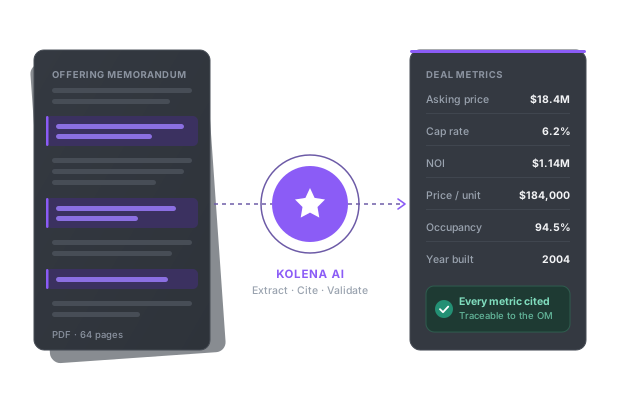
Because that format repeats from deal to deal, the agent you configure once becomes a reusable template. Point it at a new data room and it populates the same real estate investment memorandum structure, with every figure traceable back to a page in a source file, leaving your team to write the recommendation rather than assemble the document.
Essential Components of a Real Estate Investment Memo
Executive Summary
The executive summary gives decision-makers the key facts needed to understand the opportunity without reading the full memo first. It should identify the property, location, asset type, transaction size, sponsor, and other material parties. It should also summarize the proposed capital structure and expected investment period when those details affect the decision.
Most importantly, this section should state the recommended action explicitly. For example, it may recommend acquiring the property at a specified price, investing a defined amount of equity, or declining the opportunity. The supporting rationale should be brief and tied to the main return drivers and risks discussed later in the memo.
Investment Thesis
The investment thesis explains why the property is expected to generate an acceptable return. It should connect the asset's current condition with a specific strategy, such as increasing occupancy, renovating units, raising below-market rents, reducing operating costs, or repositioning the property for a different tenant base.
The thesis should also explain why the strategy fits current market conditions. This may include limited competing supply, population or employment growth, rent differences between the property and comparable assets, or demand for renovated space. Each claim should be supported by market data or underwriting assumptions that can be tested during due diligence.
Market & Demographic Analysis
The market analysis establishes the demand conditions surrounding the property. Relevant metrics can include population and household growth, employment trends, income levels, vacancy, new construction, rent growth, and transaction activity. The analysis should focus on the property's submarket rather than relying only on metropolitan-level averages.
It should also identify the economic drivers that could affect future performance. Major employers, transportation links, universities, infrastructure projects, and development pipelines can influence demand and absorption. Historical data provides context, but the memo should distinguish observed trends from assumptions about future growth.
Comparable Properties
Comparable properties provide evidence for assumptions about rent, occupancy, property value, and exit pricing. Rent comps should use properties that are similar in location, unit mix, condition, amenities, and tenant profile. Adjustments may be necessary when a comparable property is newer, better located, or offers materially different features.
Sale comps help establish a reasonable acquisition or exit valuation. The memo should compare metrics such as price per unit, price per square foot, capitalization rate, and transaction date. Rather than presenting averages alone, it should explain why specific comparables support or challenge the assumptions used in the underwriting.
Financial Snapshot & Underwriting
This section converts the financial model into a concise explanation of how the investment is expected to perform. It should summarize acquisition cost, financing, equity requirements, current and projected net operating income, capital expenditures, cash distributions, and relevant return metrics. The narrative should identify the assumptions that have the greatest effect on those results.
The memo should also explain how projected performance develops over the holding period. This includes assumptions for rent growth, occupancy, operating expenses, debt service, and renovation timing. Exit assumptions should specify the expected sale period and valuation method, including the exit capitalization rate or other pricing metric used to estimate proceeds.
Sponsor Background
The sponsor background describes the managing partner responsible for executing the business plan. It should cover relevant experience, assets under management, geographic and property-type expertise, organizational resources, and the sponsor's responsibilities in the proposed transaction. The goal is to show whether the team has experience with the work required by the investment thesis.
Track-record data should be specific enough to evaluate. Useful information includes realized and unrealized investments, purchase and sale dates, invested equity, realized returns, and performance relative to the original business plans. The memo should distinguish completed results from projections and note material investments that performed below expectations.
Downside Case & Risks
The downside analysis shows what happens when important assumptions do not hold. Common scenarios include slower rent growth, higher vacancy, delayed renovations, construction cost increases, higher interest rates, and a weaker exit valuation. Sensitivity tables can show how changes in these variables affect cash flow, debt coverage, and investor returns.
The section should also describe risks that cannot be captured fully by a model, such as regulatory changes, environmental issues, tenant concentration, refinancing constraints, or unexpected capital needs. Where applicable, the memo should state that investors can lose some or all of their invested capital rather than presenting downside projections as a guaranteed minimum outcome.
Conflict Disclosures
Conflict disclosures identify relationships that could affect how decisions are made or how transaction economics are allocated. The memo should disclose related-party transactions, affiliated property managers, construction companies, brokers, lenders, or other service providers connected to the sponsor or its principals.
The section should also explain fees and compensation paid to affiliates, including acquisition, asset management, property management, construction management, financing, disposition, or similar fees. It should describe how these arrangements are approved and whether pricing is compared with third-party alternatives, allowing investors to evaluate incentives alongside the investment economics.
Real Estate Investment Memo Template
A real estate investment memo template gives the investment team a standardized framework for converting underwriting, market research, due diligence, and financing information into an investment committee recommendation. Unlike an offering memorandum prepared to market a property, an internal investment memo is designed to test the deal and document why capital should—or should not—be committed.
The downloadable template provided here follows an institutional investment committee structure. It begins with the property, asset class, investment strategy, deal code, approval request, and memo status, followed by an executive summary and a table of headline deal terms. These include purchase price, total capitalization, going-in capitalization rate, stabilized yield on cost, loan amount and LTV, required equity, levered IRR, equity multiple, cash-on-cash return, and proposed holding period.
The remaining sections take the committee from the investment thesis through the underlying evidence:
- Property overview: Records physical and operational details such as asset type, year built, rentable area or unit count, occupancy, zoning, parking, major tenants, seller, and broker.
- Market and submarket analysis: Compares the subject property with its submarket and wider metro using occupancy, rents, rent growth, construction, absorption, comparable sales, and rent comparables.
- Business plan: Explains how value is expected to be created and lays out renovation, deferred maintenance, common-area improvements, contingencies, budgets, and timing.
- Financial analysis: Reconciles sources and uses and summarizes projected revenue, vacancy, operating expenses, NOI, reserves, debt service, cash flow, DSCR, and cash-on-cash returns over the holding period.
- Key assumptions and returns: Documents assumptions such as rent growth, expense growth, vacancy, exit cap rate, selling costs, and holding period, followed by levered and unlevered IRR, equity multiple, and profit.
- Sensitivity analysis: Tests how returns change when major assumptions move. The template uses a matrix of exit capitalization rates and annual rent growth to show their effect on levered IRR.
- Financing: Records the lender, loan amount, LTV/LTC, interest rate, amortization, prepayment provisions, covenants, and recourse.
- Risks and mitigants: Forces the team to identify risks—including rent softening, construction overruns, refinancing, tenant concentration, exit liquidity, and environmental or regulatory issues—and document how each risk is being addressed.
- Exit strategy and due diligence: Explains the intended sale, refinance, or recapitalization strategy and tracks items such as the property condition assessment, Phase I environmental report, title, zoning, lease audit, T12 financial review, insurance, appraisal, and legal review.
- Conditions and approval: Ends with outstanding conditions and a formal investment committee approval or decline record.
This structure is broadly consistent with how institutional real estate investors describe their own investment committee processes. Ladder Capital, for example, states in its SEC filings that prospective loan and real estate investments are documented in a comprehensive investment committee memorandum covering the investment itself, due diligence findings, identified risks, and mitigants. Canyon Partners Real Estate similarly describes incorporating its real estate due-diligence findings into the investment committee memo before investment committee review.
Real-World Real Estate Investment Memo Examples
Complete internal investment committee memos from major private real estate firms are rarely published because they contain confidential underwriting, pricing, negotiations, and investment recommendations. However, several credible public resources show either actual committee materials or the type of memo used by institutional investors:
Lehman Brothers / Archstone investment committee materials
Stanford hosts archived Lehman Brothers documents relating to the 2007 Archstone transaction. The records explicitly include an update committee memo, a previous committee memo, valuation materials, commitment documents, and the transaction term sheet. This is one of the closer publicly accessible examples of actual institutional real estate committee documentation.
View the Lehman Brothers Archstone investment committee memo
Wall Street Prep Multifamily Acquisition Case Study
Although this resource focuses primarily on the underwriting model rather than the finished memo, it provides a realistic multifamily acquisition case with historical financials, NOI analysis, exit capitalization assumptions, sale proceeds, and leveraged and unleveraged returns; the same calculations that feed directly into the financial analysis section of an investment memo.
View the Wall Street Prep multifamily acquisition case study
Pennsylvania PSERS Public Investment Memorandums
The Pennsylvania Public School Employees' Retirement System publishes a public version of the memo behind each private real estate commitment its board approves. A recent example covers LEM Multifamily Fund VII. It is organized into a recommendation overview, investment highlights, and investment considerations, followed by a letter from consultant Aksia explaining its due diligence on the sponsor, strategy, and market positioning. Because these are fund commitments rather than single-asset deals, they show how institutional investors underwrite a manager's track record and fit within the portfolio, not property-level cash flows.
View the PSERS LEM Multifamily Fund VII investment memo
Oregon Investment Council Real Estate Recommendations
The Oregon State Treasury posts full public meeting books for the Oregon Investment Council, which include written staff and consultant recommendations for real estate commitments. The March 2016 book contains a recommendation for Lone Star Real Estate Fund V for the state pension's real estate portfolio, along with a policy update that set goals such as reducing fund- and transaction-level leverage and focusing on durable income streams. This makes it useful for seeing how a single recommendation is framed against the investor's broader portfolio strategy.
View the Oregon Investment Council March 2016 meeting book
University of Michigan Board of Regents Property Acquisition Request
For a short, property-level example, public university boards publish the approval requests behind real estate purchases. A 2026 University of Michigan request covers the purchase of the former Concordia University campus in Ann Arbor. In about one page, it covers the background, the negotiated $60 million price, and a recommendation to buy that is conditioned on the environmental review and the rest of due diligence, plus the funding source. It isn't a full underwriting memo, but it shows the recommendation-and-conditions structure that closes most investment memos.
View the University of Michigan property acquisition request
These examples also illustrate an important distinction: there is no single mandatory investment memo format. Individual firms adjust the document to match their investment strategy and approval process. A value-add multifamily investor may emphasize renovation costs, rent premiums, and lease-up assumptions, while an office or industrial investor may devote more space to tenant credit, lease expirations, rollover exposure, and renewal assumptions.
Source Documents Used to Build a Real Estate Investment Memo
Several source documents are typically used to build an investment memo. The following table explains what data is taken from each document, and explains what is involved in processing this data manually. The following section explains how AI can help automate this process.
Document | Relevant Data | Extracting Data Manually | Key Considerations |
|---|---|---|---|
Offering Memorandums and Broker Packages | Property specifications, pricing guidance, tenant information, historical financials, market data, comparable transactions, photos, seller projections, lease expiration schedules, tenant profiles, and major lease terms. | Review the package to understand the seller’s investment thesis and enter key assumptions into the initial underwriting model. | Seller projections may be optimistic. Verify rents, occupancy, expenses, capital needs, and other key assumptions against leases, operating statements, third-party reports, and other source documents. |
Leases and Lease Abstracts | Base rent, rent escalations, commencement and expiration dates, renewal options, reimbursements, termination rights, tenant improvement obligations, percentage rent, exclusivity clauses, and co-tenancy provisions. | Use lease abstracts to input standardized lease data into the model for rent, reimbursements, rollover exposure, and leasing costs. | Abstracts are summaries, not contracts. Material provisions should be checked against executed leases and amendments. |
Estoppel Certificates | Tenant-confirmed rent, security deposits, lease dates, amendments, renewal options, landlord obligations, and default status. | Compare estoppels against lease abstracts and the rent roll to identify inconsistencies. | Differences may affect income, capital expenditures, or transaction risk. Estoppels can reveal unresolved obligations or rent discrepancies not shown in seller data. |
Rent Rolls and T-12 Operating Statements | Current occupancy, contractual rent, occupied area, lease dates, concessions, security deposits, delinquencies, revenue, and expenses. | Use the rent roll to calculate occupancy, average rent, tenant concentration, and lease expirations. Use the T-12 to review monthly revenue and expense trends. | Normalize results by removing nonrecurring items and adjusting expenses that may change after acquisition. Compare historical NOI with underwriting assumptions. |
Third-Party Reports: Appraisal, PCA, and Phase I | Appraised value, valuation assumptions, physical condition, immediate repairs, replacement reserves, environmental risks, and potential recognized environmental conditions. | Review reports and extract findings that affect value, capital expenditures, financing, environmental exposure, or transaction risk. | Findings may materially change underwriting assumptions. PCA issues can increase capex, and Phase I findings may require further investigation. |
How AI Automates Real Estate Investment Memo Preparation
Automation is a game-changer in the investment memo creation process. With modern AI automation solutions, users can set up automated connections to data sources, such as cloud storage or property management systems. This ensures that any new documents uploaded are automatically processed according to the established agent instructions.
This automation not only streamlines the workflow but also maintains consistency in the quality of the investment memos produced. As you continue to add new documents, the system updates and generates new reports, saving you valuable time and effort.
Key Facts Extraction for Investment Opportunities
Modern AI solutions can extract key facts from the documents uploaded. This feature allows investors to quickly gather essential data that informs their decision-making process. By simply instructing the AI in natural language, users can obtain vital metrics such as property name, location, building size, and occupancy rates.
For example, when tasked with extracting key facts for the Bayview office center, the AI generates a comprehensive table summarizing crucial information. This includes details like tenant mix and building features, all tailored to fit the context of an investment memo. The flexibility to customize these extractions ensures that you receive the most pertinent information for your specific needs.
Analyzing Rent Rates through Lease Abstracts
Understanding rent rates is critical for evaluating investment opportunities. AI solutions enable users to analyze lease abstracts effectively. Each lease abstract provides detailed information about tenant agreements, including monthly rent rates and any special stipulations.
When you upload multiple lease abstracts, the AI organizes this data into a clear and concise table. This format allows investors to easily compare rent rates across different tenants, facilitating better analysis of potential cash flows. The structured output simplifies the process of assessing whether the investment aligns with financial goals.
Identifying Discrepancies with Estoppel Certifications
Advanced solutions purpose-built for real estate can identify discrepancies between lease abstracts and estoppel certifications. This is crucial for validating the accuracy of lease terms and ensuring that all details match across various documents.
When discrepancies are found, the AI highlights them in a user-friendly format, often presenting them in a table for easy reference. This not only saves time but also minimizes the risk of errors that could impact investment decisions. By addressing these discrepancies early in the analysis, investors can avoid potential future complications.
Compiling Reports and Document Outputs
Once the necessary data is extracted and analyzed, the AI allows users to compile comprehensive reports. These reports serve as the investment memo, encapsulating all the essential information gathered during the analysis process. Exported as a single file, the result is a finished investment memorandum real estate teams can circulate to their investment committee without reformatting a thing.
The platform supports various formats for output, including PDF and CSV, enabling seamless integration with existing tools popular in the real estate industry. This functionality ensures that you can easily share findings with stakeholders or utilize the data for further analysis.
See how Kolena’s Real Estate document automation provides these capabilities and more
Automating the Investment Memo Process
What AI Should (and Shouldn't) Write for Real Estate Memos
Automation works best when the division of labor is clear. AI handles the mechanical work: assembling and consolidating data, formatting outputs to match your firm's specific memo template, and tracking source page numbers so every figure is traceable.
What humans must own is the judgment: the final investment recommendation, strategic conviction, and the nuances that numbers alone cannot capture. Kolena is built around this principle, drafting the repeatable, source-based sections while leaving the decision to you.
Best Practices for Writing a Real Estate Investment Memo
Lead With the Investment Thesis and a Clear Recommendation
The opening section should explain why the investment is being considered and what must happen for it to generate the expected return. State the proposed acquisition price, business plan, expected hold period, financing approach, and target returns. The recommendation should also specify the proposed action, such as approving the acquisition or proceeding subject to defined conditions.
Keep the thesis focused on the few factors that materially drive the deal. These might include below-market rents, lease-up potential, redevelopment, expense reductions, or an attractive basis relative to comparable properties. Avoid repeating property details that do not affect the investment decision.
Tie Every Assumption to a Source Document
Material underwriting assumptions should be traceable to supporting evidence. In-place rents should tie to leases and the rent roll, historical expenses to operating statements, and planned capital expenditures to the PCA, contractor estimates, or another documented source.
Clearly distinguish sourced facts from analyst assumptions. For example, projected market rent may come from broker research or comparable leases, while future rent growth may be an underwriting assumption. Recording the source and date makes the memo easier to review and helps the investment committee identify assumptions that require additional diligence.
Show Base, Downside, and Upside Scenarios
A single forecast can hide how sensitive an investment is to changes in key assumptions. Presenting base, downside, and upside scenarios shows how returns may change under different operating and market conditions.
Each scenario should change assumptions that materially affect the property, such as occupancy, rent growth, lease-up timing, interest rates, capital expenditures, or exit capitalization rates. Keep the assumptions internally consistent rather than changing isolated inputs simply to reach a target return. Show resulting metrics such as IRR, equity multiple, NOI, and debt coverage so readers can compare the scenarios directly.
Address Each Risk With a Specific Mitigant
The risk section should identify concrete events that could reduce cash flow, increase costs, or delay the business plan. Examples include a major tenant departure, unexpected building repairs, refinancing constraints, slower lease-up, or environmental issues.
For each material risk, explain how the investment plan reduces or manages the exposure. A lease rollover risk might be mitigated by early renewal discussions and a leasing reserve, while near-term building repairs might be addressed through the acquisition budget. Avoid generic mitigants that do not explain what action will be taken or how much protection it provides.
Standardize the Memo Template Across Deals
A standardized template makes investment opportunities easier to review and compare. Use the same core sections, financial metrics, scenario definitions, tables, and terminology across transactions. Typical sections include the investment thesis, property overview, market analysis, underwriting, financing, business plan, risks, sensitivities, and recommendation.
Standardization also reduces the chance that important information is omitted. Required fields can force analysts to document sources, disclose major assumptions, and address recurring risks. The template should still allow deal-specific sections when an investment has unusual features that require additional analysis.
Investment Memo Automation with Kolena
Kolena's IC Memo agent is a pre-built AI agent that reads a complete deal package and drafts the investment-committee memo, including structured sections, computed return metrics, cited evidence, and a recommendation. It works from the documents your team already collects, such as the private placement memorandum, sponsor materials, appraisal, Phase I / Phase II environmental report, property condition report, financial model or pro forma, senior loan documents, master lease, and legal and tax opinions.
The agent can also connect to your deal or document repository, email, Google Drive, or SharePoint. The agent compresses months of manual deal-package review and memo drafting toward minutes for a first cited draft per deal, and is built for teams reviewing a steady flow of offerings, such as broker-dealers and sponsors screening dozens of deals a quarter. A senior analyst or investment-committee member still reviews the flagged consistency checks and each cited section before the memo drives an approve, decline, or further-diligence decision.
Key capabilities of Kolena's IC Memo agent:
- Memo summary and recommendation: Produces a one-look front page covering parties, structure, size, and projected return, with an explicit Approve, Approve with conditions, More diligence, or Decline recommendation so the committee can orient before reading the detail.
- Investment thesis and strategy: Drafts the narrative thesis, including the offering and security type, the sponsor's strategy and stated objectives, the value-add plan for the asset, and the risk-tolerance profile.
- Financial projections and return metrics: Computes and shows standard return metrics, including NOI, cap rate on purchase and syndicated cost, cash-on-cash, IRR, equity multiple (MOIC), DSCR, and hold-period total return.
- Offering terms, sources and uses, and fees: Lays out target raise, loan proceeds, loan-to-cost, minimum investment, and projected distributions with derivations shown, builds a sources and uses table that must foot, and details the full fee and expense load, including any sponsor promote, so reviewers can judge return drag.
- Debt and financing terms: Extracts senior debt terms such as lender, amount, LTV and LTC, rate and rate type, amortization, maturity, interest-only period, DSCR at close, prepayment or defeasance, recourse, and any bridge financing.
- Market and property assessment: Summarizes third-party diligence findings from the appraisal, environmental report, property condition report, and market study, including as-is value versus contract price, cap rate, occupancy, condition rating, and needed repairs and reserves.
- Sponsor background and track record: Profiles the sponsor's history, key principals, prior programs by vintage and asset class, realized returns, and financial condition, flagging where performance is blended or since-inception and which figures are audited versus sponsor-represented.
- Background, litigation, and regulatory history: Surfaces material litigation, bankruptcy, and regulatory or disciplinary history for the sponsor, manager, issuer, and principals.
- Risk factors and mitigants: Organizes material risks by category, such as market, sponsor, leverage, interest-rate, tax, liquidity, concentration, master-lease, fee load, and regulatory, each with a severity rating and the disclosed mitigant.
- Due-diligence consistency checks: Runs recompute-and-reconcile checks before you rely on the memo, confirming that sources equal uses, the total offering foots, cap rate and DSCR recompute, and the front-end load reconciles, with each check flagged Pass, Fail, or Review.
- Source-cited outputs: Cites every material fact in the memo to its source document, so reviewers can verify the analysis instead of re-reading the full deal package.
Ready to cut the time from deal package to committee-ready memo? Explore Kolena's IC Memo AI agent and see it run on your own documents.