An Automated Valuation Model (AVM) is a computerized tool that uses statistical modeling and algorithms to estimate the market value of a property instantly. It typically analyzes information such as recent property sales, location, lot size, square footage, property type, and other available characteristics. The system processes these inputs to generate a valuation without requiring a physical appraisal.
AVMs are commonly used by lenders, real estate platforms, investors, and property professionals to evaluate properties at scale. They can provide estimates quickly and consistently, but their accuracy depends on the quality and coverage of the underlying data. Properties with unusual features, limited comparable sales, or outdated records may require additional review or a traditional appraisal.
How AVMs work:
- Data sources: They pull public tax records, property deeds, recent sales, and Multiple Listing Service (MLS) listings.
- Key inputs: They look at square footage, lot size, bedroom counts, age of the home, and local neighborhood trends.
- Models: They use methods like comparable sales (comps) and hedonic pricing to calculate value based on specific property features.
- Popular examples: Consumer tools like Zillow use AVMs (such as the Zestimate) to give home buyers and sellers a quick value estimate.
Pros and cons:
- Speed: They provide value estimates in seconds without needing an in-person visit.
- Cost: They are usually free for consumers online.
- Blind spots: They cannot see the actual physical condition or interior upgrades of a home, which can make estimates inaccurate.
- Not an appraisal: Lenders still require a licensed, human appraiser for official mortgage approvals and purchases.
This is part of a series of articles about real estate investing
How Does an Automated Valuation Model Work?
Collect Property and Market Data
The AVM gathers data from sources such as public property records, tax assessments, multiple listing services (MLS), and historical sales. Relevant data can include sale prices, transaction dates, location, property type, square footage, lot size, age, and number of rooms.
Market data may also capture neighborhood-level trends and recent changes in local prices. The quality, coverage, and freshness of this data directly affect the resulting valuation.
Identify Comparable Properties
The model searches for recently sold properties that are similar to the subject property. It may compare properties based on location, size, type, age, condition, and other available attributes.
Rather than treating every comparable equally, an AVM can assign greater weight to properties that more closely match the subject. Recent transactions and nearby sales often receive more weight than older or less similar sales.
Analyze Property Characteristics
The AVM evaluates how individual property characteristics affect value. For example, additional living space, a larger lot, or an extra bathroom may be associated with higher sale prices in a particular market.
The effect of each characteristic depends on local data. A feature that strongly affects prices in one neighborhood may have less influence in another.
Apply Statistical and Machine Learning Models
AVMs use statistical methods, machine learning models, or a combination of both to find relationships between property attributes and observed sale prices. Common approaches include regression, decision trees, gradient boosting, and comparable-sales models.
The model learns from historical transactions and applies the resulting patterns to the subject property. More advanced systems may combine predictions from several models to reduce errors caused by relying on a single method.
Generate an Estimated Property Value
After processing the available inputs, the AVM produces an estimated market value for the property. This estimate represents the model's prediction based on the data and market relationships it can observe.
The estimate is not necessarily the same as an appraisal or the price a buyer will ultimately pay. Missing property details, unusual features, renovations, and rapidly changing market conditions can create differences between the AVM estimate and actual market value.
Calculate Confidence Scores and Value Ranges
Many AVMs report a confidence score or estimated value range alongside the point estimate. These measures indicate how much uncertainty exists around the predicted value.
Confidence is generally higher when the model has recent, reliable data and several closely comparable sales. It may be lower when transaction data is limited, the property is unusual, or comparable properties differ substantially from the subject.
Analyze your first offering memo in minutes with AI
Automated Valuation Model vs. Traditional Appraisal Methods
An automated valuation model estimates property value using software, property data, comparable sales, and statistical models. A traditional appraisal is performed by a licensed or certified appraiser who reviews market data and evaluates the property itself. Depending on the assignment, the appraiser may inspect the property in person and consider condition, renovations, layout, location, and other factors that may not appear in structured databases.
AVMs are faster and less expensive to run, which makes them useful for screening large numbers of properties, portfolio monitoring, and preliminary lending decisions. However, their accuracy depends heavily on available data. They may struggle with unique properties, recent renovations, rural homes, or markets with few comparable sales.
Traditional appraisals usually provide more property-specific analysis because a human appraiser can verify features and account for factors that models may miss. They also take more time and cost more to complete. In practice, lenders and real estate professionals may use AVMs for low-risk or early-stage decisions and require a traditional appraisal when greater accuracy, documentation, or regulatory compliance is needed.
Types of Automated Valuation Models in Real Estate
Hedonic Pricing Models
Hedonic pricing models estimate a property's value by separating it into measurable characteristics. These can include living area, lot size, number of bedrooms, age, location, property condition, and other features.
The model estimates how much each characteristic contributes to the property's overall value. For example, it can measure the typical price difference associated with an additional bathroom or more living space while controlling for other factors.
This approach works best when the available data captures the features that influence prices in the local market. Missing information about renovations, views, interior condition, or other important attributes can reduce accuracy.
Comparable Sales Models
Comparable sales models estimate value using recent sales of similar properties. The AVM identifies comparable properties based on factors such as location, property type, size, age, transaction date, and physical characteristics.
The model may adjust or weight comparable sales to account for differences from the subject property. A nearby sale with similar characteristics may receive more weight than an older transaction or a property farther away.
This method closely reflects how properties are commonly evaluated in active markets. Its reliability depends heavily on having enough recent and genuinely similar transactions, making it less effective in areas with low sales activity.
Regression-Based Models
Regression-based AVMs use historical transaction data to measure relationships between sale prices and property characteristics. The resulting equation can then estimate the value of another property based on its attributes.
Regression models can evaluate many variables at once and quantify their effect on price. They can also include location and time variables to account for differences between neighborhoods and changes in market conditions.
These models are relatively transparent because analysts can examine how individual variables affect the estimate. However, their results can weaken when relationships are nonlinear, data is sparse, or important property characteristics are missing.
Machine Learning-Based AVMs
Machine learning-based AVMs use algorithms such as random forests, gradient boosting, or neural networks to learn pricing patterns from large datasets. These models can capture complex and nonlinear relationships that simpler statistical methods may miss.
They can process a large number of variables and identify interactions between them. For example, the effect of property size may vary according to neighborhood, property type, age, and current market conditions.
Their performance depends on training data, feature selection, model design, and regular validation against actual transactions. Complex models can also be harder to interpret, making explainability, error monitoring, and checks for data drift important in production systems.
Hybrid Valuation Models
Hybrid AVMs combine multiple valuation techniques rather than relying on one model. For example, a system might combine comparable-sales analysis with regression and machine learning predictions.
The system can weight each method according to factors such as property type, data availability, market conditions, or historical accuracy. It may also change those weights when one model has stronger supporting data for a particular property.
Combining models can improve stability and coverage, particularly when no single valuation method performs consistently across every property or market. Hybrid systems can also compare outputs from several models to identify valuations with unusually high uncertainty.
Real Estate Automated Valuation Model Use Cases
Mortgage Origination
Mortgage lenders can use AVMs to estimate the value of a property during loan origination. The estimate helps lenders compare the property's value with the requested loan amount and calculate metrics such as the loan-to-value (LTV) ratio.
An AVM may reduce the need for a traditional appraisal in transactions that meet specific lender and regulatory requirements. When the model has low confidence or the property is unusual, lenders may require an appraisal or another form of property review.
Home Equity Lending
Banks and other lenders use AVMs when evaluating home equity loans and home equity lines of credit (HELOCs). An updated property estimate helps determine how much equity the homeowner has available.
Because AVMs can return results quickly, they can shorten the initial valuation process. Lenders can also rerun valuations later to monitor changes in collateral value, especially when property prices are changing significantly.
Property Investment Analysis
Real estate investors can use AVMs to screen potential acquisitions and compare properties across a market. Estimated values can be combined with purchase prices, rental income, expenses, and expected returns to identify properties that warrant further analysis.
AVMs are particularly useful when evaluating large numbers of listings. However, investors may need additional due diligence for property condition, renovation costs, rental demand, and other factors that an AVM may not capture.
Real Estate Portfolio Valuation
Banks, investment firms, property owners, and asset managers can use AVMs to estimate values across large real estate portfolios. Automated processing makes it possible to update thousands of property valuations more frequently than individual appraisals would allow.
These estimates can support portfolio reporting, performance analysis, and risk monitoring. Organizations can also identify properties with large value changes or low-confidence estimates and prioritize them for manual review.
Insurance and Risk Assessment
Insurers and risk teams can use AVMs as one source of property value information when assessing exposure. Property estimates can help with portfolio-level risk analysis and provide a consistent way to monitor changes in values over time.
AVMs may also help lenders identify collateral that has declined significantly in value, which can affect LTV ratios and credit risk. For insurance purposes, however, market value should not be confused with replacement cost, which measures the cost of rebuilding a damaged property.
Pros and Cons of AVM in Real Estate
AVMs can make property valuation faster, cheaper, and easier to scale. Their main advantages include:
- Fast valuations: AVMs can generate property estimates in seconds or minutes instead of waiting for a manual appraisal.
- Lower valuation costs: Automated analysis reduces the labor required to estimate property values, particularly when processing many properties.
- Scalability: Lenders, investors, and asset managers can value thousands of properties using the same process.
- Consistent methodology: AVMs apply defined models and data rules, reducing differences caused by individual judgment.
- Frequent updates: Organizations can rerun AVMs as new sales and market data become available.
- Useful risk screening: Confidence scores and value estimates can help identify properties that require additional review or a traditional appraisal.
AVMs also have limitations because their estimates depend on available data and cannot always capture property-specific conditions. Key disadvantages include:
- Dependence on data quality: Missing, incorrect, or outdated property records can produce inaccurate valuations.
- Limited assessment of condition: An AVM may not know about interior damage, renovations, construction quality, or other features that are not recorded in its data.
- Problems with unusual properties: Unique, luxury, rural, or mixed-use properties may have too few comparable sales for reliable estimates.
- Difficulty in changing markets: Historical data may not immediately reflect rapid increases or declines in local property prices.
- Model uncertainty: Different AVMs can produce different estimates because they use different datasets, algorithms, and weighting methods.
- Not always a substitute for an appraisal: Some lending decisions, regulations, or high-risk transactions may require a qualified appraiser rather than an automated estimate.
How AI Improves Real Estate AVMs
Extract Property Data From Appraisals, Rent Rolls, and T12s
AI-powered document processing can extract valuation inputs from appraisals, rent rolls, trailing 12-month (T12) statements, and other property documents. These inputs can include unit counts, occupancy, lease terms, rents, operating expenses, net operating income (NOI), capitalization rates, and comparable sales.
More advanced systems can identify tables and fields even when documents use different layouts. For example, they can extract tenant-level information from a rent roll and financial line items from a T12 without requiring both documents to follow the same template.
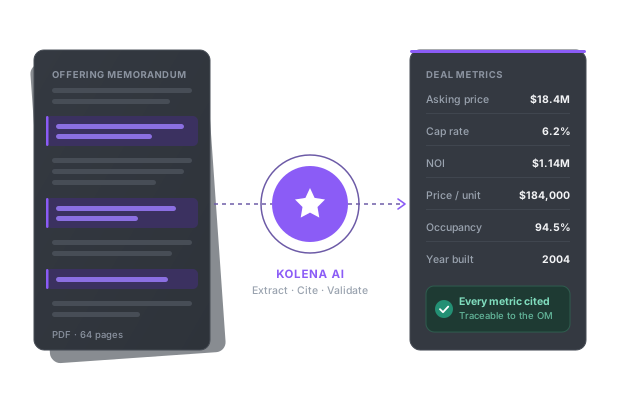
This reduces manual data entry and makes document-based information available to valuation systems faster. Extraction results can also retain references to source pages, tables, or cells, allowing analysts to trace important inputs back to the original document.
Normalize Inconsistent Property and Financial Data
Property documents often use different labels, formats, units, and accounting categories for the same information. AI can map these variations to a standard data schema before the information enters an AVM or underwriting model.
For example, "repairs and maintenance," "R&M," and "maintenance expense" may need to map to the same expense category. AI can also standardize dates, property types, monetary values, square-footage measurements, and rent fields.
Normalization makes data easier to compare across properties and reduces errors caused by inconsistent source formats. It is especially important when an organization combines documents from different owners, brokers, property managers, and third-party data providers.
Reconcile Data Across Multiple Source Documents
The same property metric may appear in several documents with different values. AI can compare appraisals, rent rolls, T12s, offering memorandums, borrower submissions, and other sources to identify inconsistencies.
For example, an appraisal might report 95% occupancy while the latest rent roll indicates 91%. Similarly, unit counts, square footage, NOI, or property addresses may differ between documents because they were prepared at different times or use different definitions.
Instead of silently choosing one value, the system can flag the discrepancy, record the competing values, and apply predefined source-priority rules. Analysts can then resolve material conflicts before inaccurate information affects the valuation.
Automate Valuation and Underwriting Model Population
Once data is extracted, normalized, and validated, AI can map the resulting values into valuation and underwriting models. This can automate population of fields such as rental revenue, expenses, NOI, occupancy, lease assumptions, comparable sales, and property characteristics.
The same workflow can perform calculations or prepare inputs for approaches such as direct capitalization, discounted cash flow analysis, or comparable-sales analysis. It can also populate internal spreadsheets and valuation platforms without requiring analysts to rekey information manually.
Automation reduces repetitive work and shortens the time between receiving source documents and running an analysis. Validation rules can check required fields, data types, calculation relationships, and expected ranges before the model produces an output.
Flag Low-Confidence Valuations for Human Review
AI systems can use model confidence, data completeness, comparable-property quality, document conflicts, and unusual inputs to identify valuations that require additional review. This helps organizations apply human attention where automated results carry greater uncertainty.
For example, a review might be triggered when comparable sales are scarce, financial statements contain unexplained changes, documents report conflicting NOI figures, or a property differs substantially from others in the model's training data. Large differences between several valuation methods can also indicate that further analysis is necessary.
The system can route these exceptions to an analyst while allowing higher-confidence cases to continue through the automated workflow. This human-in-the-loop approach combines the efficiency of automation with manual verification for complex, unusual, or poorly documented properties.
Feeding Reliable Valuation Data Into Your AVM with Kolena
An AVM is only as good as the property and financial data behind it, and most of that data arrives as leases, rent rolls, appraisals, and due diligence files rather than clean database fields. Kolena automates document-heavy real estate workflows end to end, from document intake through to structured, validated outputs. It collects leases, rent rolls, due diligence files, and compliance packages, extracts and cross-checks every clause, number, and date, and generates structured reports, financial models, and compliance-ready summaries your valuation and underwriting processes can rely on.
Key capabilities of Kolena for Real Estate:
- Document-to-decision automation: Kolena handles every step of the workflow, collecting documents, processing them with AI, and generating structured reports, financial models, and compliance-ready summaries.
- Extraction with validation and cross-checking: The platform extracts, validates, and cross-references data across documents so nothing gets missed, catching manual errors and missed clauses that slow review cycles.
- Citations and confidence scoring: Every extraction includes source citations and confidence scores, with 99%+ accuracy, so analysts can trace inputs back to the original document and prioritize what needs human review.
- Acquisition due diligence: Review leases, amendments, and rent rolls in hours instead of weeks, turning multi-day document processing into same-day analysis.
- Ongoing portfolio operations: Automate continuous lease analysis, invoice generation, utility bill processing, rent increase notices, and similar recurring workflows.
- Single-tenant net lease and compliance workflows: Verify rent obligations and lease amendments at scale, validate applicant qualifications, and audit HUD and affordable housing files automatically.
- Scale without added headcount: The same team achieves 10× throughput, expanding portfolio capacity and analysis coverage across assets.
- Standardized, audit-ready data: Consistent lease data keeps teams audit-ready and provides a defensible record behind every figure.
- Works with existing systems: Kolena connects directly with Yardi, Box, SharePoint, OneDrive, Excel, CoStar, and more, with no workflow disruption.
- Fast implementation: Prebuilt real estate workflows let teams go live in hours, backed by SOC 2 compliance and enterprise-ready infrastructure.
Want faster diligence and cleaner valuation inputs? Learn more about Kolena for real estate and request a demo.