What Is Underwriting in Real Estate?
Real estate underwriting is the in-depth risk evaluation process lenders and investors use to decide whether to approve a loan or fund a property purchase. This involves evaluating a property, borrower, or investment to determine its financial risk and expected return. Lenders use underwriting to decide whether to approve a loan and on what terms. Investors use a similar process to determine whether a property is worth buying.
How real estate underwriting works:
- Property and borrower data collection: Gathers property details, financial records, leases, and borrower information needed for the analysis.
- Income and expense analysis: Reviews rental income, occupancy, and operating costs to calculate net operating income.
- Property valuation: Estimates market value using income, comparable sales, appraisals, or other appropriate valuation methods.
- Cash flow analysis: Projects property cash flows and evaluates expected returns under different operating assumptions.
- Debt and financing assessment: Reviews loan terms, debt service, LTV, DSCR, and borrower liquidity.
- Risk analysis: Identifies property, market, tenant, financial, and operational risks that could affect performance.
- Underwriting decision and loan approval: Compares the results with lending standards to approve, modify, condition, or decline the loan.
This is part of a series of articles about real estate investing
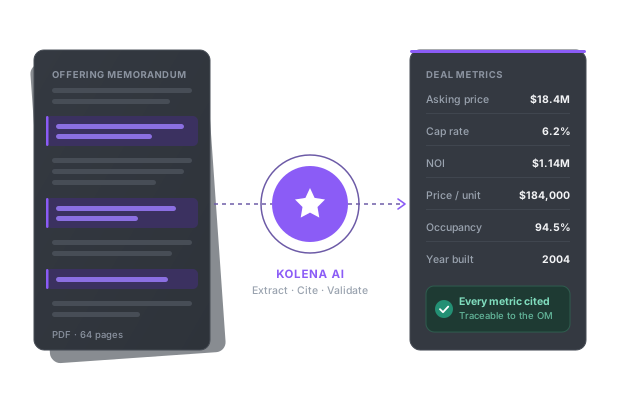
Analyze your first offering memo in minutes with AI
How Does Real Estate Underwriting Work?
Step 1: Property and Borrower Data Collection
The underwriter gathers information about the property, including its location, size, condition, occupancy, leases, rent roll, and operating history. Documents may include financial statements, tax records, insurance information, and property inspection reports.
For a loan, the underwriter also reviews the borrower. This includes credit history, income, assets, existing debt, liquidity, and experience with similar properties. The goal is to determine whether both the property and borrower can support the proposed financing.
Step 2: Income and Expense Analysis
For an income-producing property, the underwriter reviews rental and other property income. Current rents are compared with leases, historical collections, occupancy levels, and market rents to determine whether projected revenue is reasonable.
Operating expenses such as property taxes, insurance, maintenance, utilities, and management fees are also analyzed. Subtracting operating expenses from effective income produces net operating income (NOI), a key input for valuation and debt analysis.
Step 3: Property Valuation
The underwriter estimates the property’s market value using methods appropriate for the property type. For commercial real estate, the income approach is common. It estimates value by dividing NOI by an appropriate capitalization rate.
Recent sales of comparable properties can provide another valuation benchmark. Lenders may also require an independent appraisal. The resulting value helps determine metrics such as the loan-to-value (LTV) ratio.
Step 4: Cash Flow Analysis
Cash flow analysis measures how much money the property is expected to generate after expenses. The underwriter may build projections covering rents, vacancy, operating costs, capital expenditures, and other recurring cash requirements.
For investment underwriting, the analysis may extend over several years and include a projected sale. Metrics such as cash-on-cash return, internal rate of return (IRR), and equity multiple can then be used to evaluate potential returns.
Step 5: Debt and Financing Assessment
The underwriter reviews the proposed loan amount, interest rate, amortization period, maturity date, and repayment structure. These terms determine the property’s required debt payments and affect the amount of cash available to the owner.
A common metric is the debt service coverage ratio (DSCR), which compares NOI with required debt service. Lenders also examine LTV and borrower liquidity to determine whether there is enough income and equity to reduce repayment risk.
Related content: Read our article about loan underwriting software.
Step 6: Risk Analysis
Underwriters identify factors that could reduce property value or cash flow. Common risks include tenant concentration, lease expirations, high vacancy, deferred maintenance, environmental issues, rising expenses, and changes in local supply or demand.
They may also perform sensitivity analysis by changing assumptions such as rents, vacancy rates, interest rates, or exit capitalization rates. This shows how the deal performs under less favorable conditions rather than relying only on the base-case forecast.
Step 7: Underwriting Decision and Loan Approval
After completing the analysis, the underwriter compares the results with the lender’s underwriting standards. The loan may be approved as proposed, approved with conditions, modified to reduce risk, or declined.
Conditions can include a lower loan amount, additional borrower equity, reserves, guarantees, or completion of property repairs. Once all requirements are satisfied, the lender can issue final approval and move the loan toward closing.
What Do Real Estate Underwriters Evaluate?
Real estate underwriters evaluate whether a property can generate enough income to support its financing and whether the borrower can meet the loan obligations. They review both current performance and assumptions about future performance:
- For the property, underwriters examine location, condition, occupancy, tenant quality, lease terms, market rents, and comparable properties. They also review historical and projected income and operating expenses to calculate net operating income (NOI) and estimate the property’s value.
- For the borrower, underwriters assess credit history, income, net worth, liquidity, existing debt, and real estate experience. Commercial lenders may also review guarantors and the financial strength of the entity that owns the property.
Key Real Estate Underwriting Metrics
Real estate underwriters use financial metrics to compare a property’s income, value, debt, and expected returns. The actual metrics depend on the property and deal type, but common measures include:
- Net operating income (NOI): Property income minus operating expenses, excluding debt service, income taxes, depreciation, and capital expenditures. NOI is commonly used to assess operating performance and property value.
- Capitalization rate (cap rate): NOI divided by property value or purchase price. It shows the property’s unlevered income yield and helps compare similar investments.
- Loan-to-value (LTV) ratio: Loan amount divided by the property’s appraised value. A higher LTV means the borrower contributes less equity and the lender assumes more risk.
- Debt service coverage ratio (DSCR): NOI divided by annual debt service. A DSCR above 1.0 indicates that property income exceeds required principal and interest payments.
- Cash-on-cash return: Annual pre-tax cash flow divided by the investor’s cash equity. It measures the return generated on the actual cash invested.
- Internal rate of return (IRR): The discount rate at which the net present value of projected investment cash flows equals zero. It accounts for the timing of cash flows, including a potential sale.
- Equity multiple: Total cash distributions divided by total equity invested. For example, a 2.0x equity multiple means the investor receives twice the amount of invested equity over the holding period.
- Debt yield: NOI divided by the loan amount. Unlike DSCR and LTV, debt yield does not depend on the interest rate, amortization schedule, or appraised property value.
What Documents Are Used in Real Estate Underwriting?
Real estate underwriters use documents that verify the property’s financial performance, physical condition, value, and the borrower’s ability to repay the loan. Requirements vary by property and loan type, but commonly requested documents include:
- Loan application: Provides details about the requested financing, property, borrower, and intended use of funds.
- Rent roll: Lists tenants, rental rates, lease dates, unit information, and occupancy status for income-producing properties.
- Leases: Verify rental income, lease terms, renewal options, tenant obligations, and upcoming expirations.
- Operating statements: Show historical property income and expenses, often covering the previous two or three years.
- Pro forma: Projects future rents, occupancy, expenses, net operating income (NOI), and other financial results.
- Borrower financial statements: Detail the borrower’s assets, liabilities, income, net worth, and liquidity.
- Tax returns: Help verify the borrower’s reported income and financial history.
- Credit reports: Provide information about payment history, outstanding debt, and other credit obligations.
- Bank and investment statements: Verify available cash, reserves, and funds required for the down payment or closing.
- Property appraisal: Provides an independent estimate of market value and supports loan-to-value (LTV) calculations.
- Property condition or inspection report: Identifies physical defects, deferred maintenance, and potential repair or capital expenditure requirements.
- Title report: Identifies property ownership, liens, easements, and other title-related issues.
- Insurance documents: Confirm existing or proposed property coverage and help determine whether it meets lender requirements.
- Environmental reports: Identify potential contamination or environmental liabilities, particularly for commercial properties.
Related content: Read our complete guide to the offering memorandum in real estate.
Challenges in Real Estate Underwriting
Manual Data Entry
Real estate underwriting often requires transferring data from rent rolls, leases, operating statements, appraisals, and borrower documents into underwriting models. Manual entry takes time and can introduce errors in rents, expenses, lease dates, loan terms, or formulas. These errors can affect NOI, DSCR, LTV, valuation, and return calculations.
How to address: Standardized templates, data validation rules, and automated document extraction can reduce repetitive entry, but underwriters still need to verify source data and unusual items.
Incomplete or Missing Property Information
Underwriters may receive files with missing leases, outdated rent rolls, incomplete operating statements, or limited information about repairs and capital expenditures. Missing data makes it harder to establish reliable assumptions about income, expenses, occupancy, and property condition. Material gaps may delay approval, reduce the supported loan amount, or prevent the lender from completing the underwriting process.
How to address: Underwriters typically request additional documentation or use conservative assumptions until the information is verified.
Identifying Discrepancies Across Documents
Property information often appears in several documents, and the figures may not agree. For example, rental income on an operating statement may differ from the rent roll, while lease terms may conflict with tenant information entered in the underwriting model.
How to address: Underwriters must reconcile these differences and determine which source is current and reliable. Comparing documents systematically can reveal expired leases, incorrect expense classifications, inconsistent occupancy figures, or unsupported projections that could materially change the underwriting results.
How AI Is Changing Real Estate Underwriting
Automated Document Processing
AI can classify and process underwriting documents such as:
- Rent rolls
- Leases
- Operating statements
- Appraisals
- Tax records
- Borrower financial statements
It can identify document types, locate relevant fields, and convert information from PDFs and spreadsheets into structured data. This reduces the time spent sorting files and manually transferring information into underwriting systems. Human review remains important for documents with unusual formats, poor-quality scans, handwritten information, or ambiguous terms.
Financial Data Extraction
AI systems can extract financial fields from source documents, such as:
- Rental income
- Operating expenses
- Taxes
- Insurance costs
- Loan balances
- Borrower assets
The extracted values can then populate underwriting models or databases. Automated extraction can reduce repetitive data entry, but the results require validation. Differences in accounting terminology, reporting periods, and expense classifications can otherwise produce incorrect calculations or comparisons.
Rent Roll and T12 Analysis
AI can analyze rent rolls alongside trailing 12-month (T12) operating statements to compare contractual rents with actual property revenue. It can also summarize:
- Occupancy
- Lease expirations
- Unit rents
- Concessions
- Tenant concentration
Comparing the two sources can identify gaps between expected and collected income. Underwriters can use these findings to investigate vacancy, unpaid rent, concessions, or other factors before determining stabilized revenue and NOI.
Cross-Document Data Validation
AI can compare the same information across leases, rent rolls, operating statements, appraisals, and loan documents. For example, it can check whether these details are consistent across files:
- Tenant names
- Lease dates
- Rental rates
- Property addresses
- Financial figures
When values conflict, the system can flag them for review rather than silently selecting one source. This helps underwriters focus on discrepancies that could affect property income, valuation, or loan sizing.
Automated Property Financial Analysis
AI can use extracted and validated data to support calculations such as:
- NOI
- Cap rate
- DSCR
- LTV
- Debt yield
- Cash-on-cash return
It can also help organize historical results and projected assumptions for comparison. Automation makes it easier to rerun calculations when rents, expenses, financing terms, or valuation assumptions change. However, underwriters still need to determine whether the assumptions and accounting treatment behind those calculations are appropriate for the property.
Anomaly and Discrepancy Detection
AI can identify unusual values and patterns that may require further investigation. Examples include:
- Sudden expense changes
- Rents that differ significantly from comparable units
- Inconsistent occupancy figures
- Duplicate entries
- Financial totals that do not reconcile
These flags do not necessarily indicate an error or problem. They provide a review queue that helps underwriters investigate exceptions and determine whether the underlying data is accurate, incorrectly entered, or requires an adjustment.
Real Estate Underwriting Best Practices
Organizations should consider the following best practices when working with underwriting for real estate investments.
1. Standardize Underwriting Criteria and Assumptions
Use consistent definitions, calculation methods, and approval thresholds across deals. Standards can cover vacancy, management fees, expense growth, replacement reserves, DSCR, LTV, debt yield, and other factors used to size or approve a loan. Standardization makes deals easier to compare and reduces differences caused by individual modeling practices. Exceptions should be identified and supported by property-specific or market-specific evidence.
Key actions:
- Define standard formulas for core underwriting metrics.
- Set consistent thresholds for DSCR, LTV, debt yield, and reserves.
- Use common assumptions for vacancy, expenses, and growth.
- Document property-specific exceptions.
- Review standards when market conditions or lending policies change.
2. Verify Data Against Source Documents
Underwriting models should be checked against original documents such as leases, rent rolls, operating statements, tax bills, insurance records, and loan statements. This helps prevent transcription errors or unsupported figures from affecting the analysis. Material inputs should also be checked for reporting period and effective date. An accurate number from an outdated document may not represent the property's current financial position.
Key actions:
- Trace material inputs back to original documents.
- Confirm reporting periods and effective dates.
- Validate rents, expenses, taxes, insurance, and debt balances.
- Flag outdated or incomplete documents.
- Route material discrepancies for review.
3. Cross-Reference Information Across Financial and Property Documents
Important data should be compared across multiple sources when possible. Rent roll revenue can be checked against leases and operating statements, while occupancy figures can be compared with appraisal, inspection, and property management information. Differences should be investigated rather than automatically resolved in favor of one document. Reconciliation can uncover outdated records, classification differences, missing income, or lease terms that materially affect NOI and valuation.
Key actions:
- Compare rent rolls with leases and operating statements.
- Reconcile occupancy across management, appraisal, and inspection records.
- Check property details across multiple source documents.
- Investigate material inconsistencies before finalizing assumptions.
- Record how discrepancies were resolved.
4. Separate Historical Performance from Underwriting Assumptions
Keep actual historical results distinct from projections and adjustments. Historical income and expenses show how the property has performed, while underwriting assumptions reflect expectations about future rents, occupancy, costs, and other conditions. Clearly separating the two makes it easier to identify where projected performance differs from operating history. Underwriters can then evaluate whether each adjustment is supported by leases, market data, planned improvements, or other evidence.
Key actions:
- Keep actual results and projections in separate model sections.
- Label normalized or adjusted figures clearly.
- Support assumptions with leases, market data, or documented plans.
- Compare projected performance with historical trends.
- Highlight assumptions that materially affect value or loan sizing.
5. Document Adjustments and Underwriting Decisions
Maintain a record of material changes made during underwriting and the reasons behind them. Examples include adjustments to rents, vacancy, expenses, capitalization rates, reserves, property value, or loan sizing. Documentation creates an audit trail and allows reviewers to understand how the final analysis was reached. It also makes later updates easier because underwriters can distinguish intentional adjustments from errors or unexplained model changes.
Key actions:
- Record material changes to rents, expenses, reserves, and valuation.
- Document the rationale and supporting evidence for each adjustment.
- Track changes to loan sizing and approval conditions.
- Maintain version history for underwriting models.
- Preserve an audit trail for review and future updates.
Automating Real Estate Underwriting Documents with Kolena
Real estate underwriting depends on data buried in leases, rent rolls, operating statements, and due diligence files, and most of that data still gets moved by hand. Kolena is an AI platform that automates document-heavy real estate workflows end to end: it collects the source documents, extracts and cross-checks every clause, number, and date, and returns structured reports, financial models, and compliance-ready summaries. Underwriting reviews that took days move to hours, with the audit trail underwriters and credit committees need to stand behind the numbers.
Key capabilities of Kolena:
- Document intake across underwriting files: Collects leases, rent rolls, due diligence files, and compliance packages, and connects directly to Yardi, Box, SharePoint, OneDrive, CoStar, and Excel so there is no workflow disruption.
- Extraction with validation and cross-checking: Processes each document with AI that extracts, validates, and cross-references data across files, so conflicting clauses, numbers, and dates are surfaced rather than missed.
- Cited, confidence-scored output: Delivers 99%+ accuracy with source citations and confidence scores on every extraction, so reviewers can trace any figure back to its origin in the underlying document.
- Acquisition due diligence at deal speed: Reviews leases, amendments, and rent rolls in hours instead of weeks, removing the bottleneck that limits how many deals a team can underwrite.
- Structured deliverables, not raw text: Generates structured reports, financial models, and compliance-ready summaries directly from the source documents.
- Portfolio-level scale: Gives the same team roughly 10× throughput, expanding portfolio capacity without adding headcount.
- Coverage across the property lifecycle: Supports acquisition due diligence, ongoing operations such as lease analysis and rent increase notices, HUD and affordable housing compliance, and single-tenant net lease investments.
- Fast, enterprise-ready deployment: Goes live in hours with prebuilt real-estate workflows, backed by SOC 2 compliance and shared results across teams and partners.
Learn more about Kolena's AI for real estate workflows and see how faster diligence and cleaner underwriting data change what your team can close.