What is Commercial Real Estate Underwriting?
Commercial real estate underwriting is the process of evaluating a property's financial performance, risks, and market viability to decide whether a loan or investment is worth pursuing.
Investors typically use underwriting to estimate metrics such as net operating income, capitalization rate, cash-on-cash return, and internal rate of return. Lenders focus on measures such as the debt service coverage ratio and loan-to-value ratio. These calculations help both parties test assumptions, compare properties, and identify risks that could affect the deal’s performance.
Key components of commercial real estate underwriting:
- Property income: Estimates rent and other revenue sources, separating contractual income from projected leasing assumptions.
- Vacancy and credit loss: Accounts for income lost from vacant space, concessions, or tenant nonpayment.
- Operating expenses: Projects recurring property costs such as taxes, insurance, utilities, repairs, and management.
- Net operating income: Measures property income after vacancy, credit loss, and operating expenses, before debt service.
- Capital expenditures: Estimates major repair, replacement, and improvement costs that affect investor cash flow.
- Debt financing: Models loan proceeds, interest costs, debt service, leverage, and repayment terms.
- Property valuation: Estimates value using NOI, cap rates, discounted cash flow analysis, or comparable sales.
- Exit assumptions: Projects sale timing, exit cap rate, transaction costs, and future sale proceeds.
How to underwrite a commercial real estate property:
- Collect property and financial documents: Gather rent rolls, T12s, leases, operating statements, tax records, and insurance documents.
- Analyze the rent roll and historical financials: Review occupancy, lease expirations, tenant concentration, rent accuracy, and financial trends.
- Normalize income and operating expenses: Adjust reported figures to reflect sustainable revenue, vacancy, reimbursements, and recurring costs.
- Calculate net operating income: Determine current and stabilized NOI by subtracting normalized operating expenses from effective income.
- Build the pro forma and estimate property value: Project future cash flows, capex, leasing activity, and value based on market assumptions.
- Model debt financing and cash flows: Apply loan terms to calculate debt service, loan balance, and cash flow available to equity.
- Calculate key return and risk metrics: Measure cap rate, DSCR, LTV, debt yield, cash-on-cash return, IRR, and equity multiple.
- Run sensitivity analysis and make the underwriting decision: Stress-test key assumptions and decide whether risk-adjusted returns are acceptable.
This is part of a series of articles about real estate investing
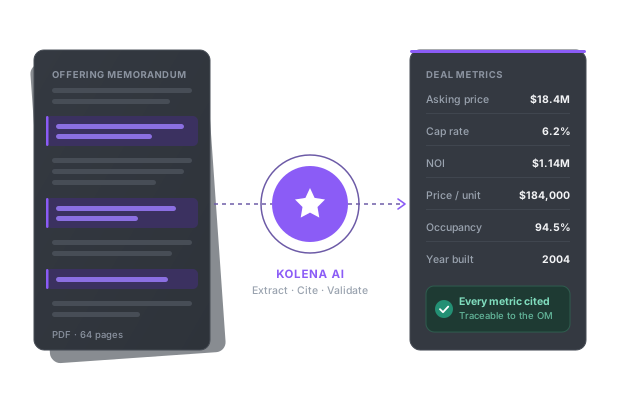
Analyze your first offering memo in minutes with AI
Key Components of Commercial Real Estate Underwriting
The following table summarizes the key elements of a commercial real estate underwriting program. We explore each element in more detail below.
Property Income
Property income includes the revenue a commercial property is expected to generate. Base rent is usually the largest source, but income can also include tenant reimbursements, parking fees, storage fees, percentage rent, and other property-specific revenue.
Underwriters typically begin with contractual rent from the rent roll and leases, then make assumptions about renewals, market rents, and rent growth. Separating contractual income from projected income makes it easier to identify which cash flows are already secured and which depend on future leasing performance.
Vacancy and Credit Loss
Vacancy and credit loss accounts for income that the property does not collect because space is vacant or tenants fail to pay. Underwriters usually deduct an assumed amount from potential rental income rather than assuming the property will remain fully occupied.
The assumption may be based on current occupancy, historical performance, lease expirations, tenant quality, and market vacancy rates. Underwriters may also model specific periods of vacancy when existing leases expire, particularly for office, retail, and industrial properties.
Operating Expenses
Operating expenses are the recurring costs required to operate and maintain the property. Common expenses include property taxes, insurance, utilities, repairs, maintenance, property management, payroll, landscaping, and administrative costs.
Underwriters review historical statements and current contracts to establish an appropriate expense level. They may adjust historical figures for inflation, unusual costs, or expected changes after acquisition. Expense reimbursements from tenants are generally modeled separately because lease structures determine how much of these costs can be recovered.
Net Operating Income (NOI)
Net operating income, or NOI, measures property-level income after operating expenses. It is generally calculated by subtracting vacancy, credit loss, and operating expenses from property revenue. Debt service, depreciation, income taxes, and most capital expenditures are excluded from NOI.
NOI is central to both valuation and financing analysis. Underwriters use it to calculate capitalization rates, debt service coverage, and other performance measures. Because small changes in revenue or expenses can materially affect NOI, the assumptions behind the calculation require careful review.
Capital Expenditures
Capital expenditures are costs for major improvements or replacements that extend the useful life of the property. Examples include roof replacement, HVAC systems, elevators, parking lot resurfacing, major renovations, and some tenant improvements.
These costs are usually modeled separately from operating expenses because they are not part of NOI. Underwriters estimate when capital expenditures will occur and how much they will cost. Large future requirements can reduce cash available to investors even when the property reports strong NOI.
Debt Financing
Debt financing determines how much of the acquisition is funded with borrowed money and how the loan affects cash flow. Key inputs include the loan amount, interest rate, amortization period, loan term, interest-only period, fees, and repayment structure.
Underwriters calculate scheduled debt service and compare it with property income using measures such as the debt service coverage ratio. They also evaluate loan-to-value and loan-to-cost ratios. Financing assumptions affect investor equity requirements, annual cash flow, refinancing risk, and overall returns.
Related content: Read our article about loan sizing and the five metrics lenders rely on.
Property Valuation
Property valuation estimates what the commercial property is worth based on its income and market conditions. A common underwriting method is direct capitalization, which divides stabilized NOI by an appropriate capitalization rate. Underwriters may also use discounted cash flow analysis and comparable property sales.
The selected capitalization rate should reflect factors such as property type, location, tenant quality, lease duration, condition, and current market pricing. Underwriters often test several valuation assumptions to see how changes in NOI or capitalization rates affect the estimated value.
Exit Assumptions
Exit assumptions estimate the conditions under which the property will be sold at the end of the investment period. Important inputs include the expected holding period, future NOI, exit capitalization rate, and transaction costs associated with the sale.
The projected sale price is commonly calculated by dividing forward NOI by the assumed exit capitalization rate. Because sale proceeds can represent a large portion of total investment returns, underwriters typically use sensitivity analysis to test different exit rates, income growth assumptions, and holding periods.
What Documents Are Used in Commercial Real Estate Underwriting?
Rent Roll
A rent roll provides a current snapshot of the property’s tenants, occupied space, and rental income. It typically lists tenant names, unit or suite numbers, leased area, monthly or annual rent, lease start dates, expiration dates, and vacant space. Some rent rolls also include security deposits, renewal options, and scheduled rent increases.
Underwriters use the rent roll to calculate occupancy, in-place rental income, average rent, and lease rollover exposure. They also compare it with leases and financial statements to identify discrepancies. For example, a large share of leases expiring in the same year may indicate higher vacancy and renewal risk.
Related content: Get our free rent roll template and reporting guide.
Trailing 12-Month Statement (T12)
A trailing 12-month statement, or T12, shows the property’s actual income and operating expenses for the previous 12 months. The statement usually breaks results down by month and includes rental income, reimbursements, utilities, repairs, management fees, payroll, insurance, and other operating costs.
Underwriters use the T12 to calculate historical net operating income and understand recent property performance. Monthly data can reveal changes in occupancy, unusual expenses, or seasonal revenue patterns. Comparing the T12 with the rent roll also helps determine whether reported rental income is supported by current leases.
Operating Statements
Operating statements show a property’s revenue, expenses, and net operating income over a specific accounting period. Underwriters often review statements from several previous years rather than relying only on the latest 12 months. This provides a longer view of changes in income and operating costs.
Historical statements help distinguish recurring expenses from one-time costs and identify trends that may affect future cash flow. Underwriters can compare prior results with the current T12 and proposed budget. Large differences may require adjustments or additional investigation before projected net operating income is established.
Offering Memorandum
An offering memorandum is a document prepared by a seller or broker to present a commercial property to potential buyers. It typically includes property specifications, financial information, tenant details, market data, photographs, comparable transactions, and projected investment performance.
Underwriters use the offering memorandum as a starting point rather than as the sole source of financial data. Broker projections may include assumptions about future rents, occupancy, expenses, or property improvements. These assumptions should be checked against rent rolls, leases, operating statements, and independent market data.
Tenant Leases and Lease Abstracts
Tenant leases contain the contractual terms governing occupancy and payments at a commercial property. Important provisions include base rent, scheduled increases, lease expiration dates, renewal or termination options, expense reimbursements, tenant improvement obligations, and responsibility for repairs and maintenance.
Lease abstracts summarize these provisions in a format that is easier to use in an underwriting model. Underwriters review the underlying leases or verified abstracts to model contractual rent, reimbursements, lease expirations, and renewal assumptions. This analysis is especially important for properties where a small number of tenants generate a large share of revenue.
Property Tax and Insurance Records
Property tax records provide information about assessed value, tax rates, exemptions, and current tax payments. Insurance records show existing premiums, coverage limits, deductibles, and relevant policy terms. Together, these documents help establish two significant operating expenses in the underwriting model.
Underwriters also determine whether current costs are likely to continue after the transaction. A sale may trigger a property tax reassessment in some jurisdictions, while insurance premiums may change because of replacement costs, claims history, location, or coverage requirements. Adjusting these expenses can materially change projected net operating income and property value.
How AI Document Automation Is Transforming Commercial Real Estate Underwriting
Extract Data From Rent Rolls, T12s, and Offering Memorandums
AI systems can extract structured fields from spreadsheets, PDFs, scanned documents, and tables. For rent rolls, this may include tenant names, suite numbers, lease dates, square footage, rent, and occupancy status. For T12s, the system can capture monthly revenue and expense line items.
Offering memorandums often combine tables, narrative text, charts, and property details in a single file. Document automation can identify relevant financial and operating data without requiring an analyst to manually copy each value into a spreadsheet.
Standardize Inconsistent Property and Financial Data
Source documents rarely use identical labels or formats. One property may use "repairs and maintenance," while another separates repairs, maintenance, and contracts into different accounts. Dates, currency formats, area measurements, and tenant names can also vary.
AI automation can map these differences into a standard underwriting schema. This makes it easier to compare properties, combine data from multiple files, and apply the same calculations across a portfolio.
Reconcile Information Across Multiple Source Documents
Underwriting often requires comparing the same information across several files. Rental income in the T12 should align with the rent roll, while lease dates and rent amounts should match executed tenant leases.
AI systems can compare these sources and flag mismatches for review. For example, they can identify when a tenant appears on the rent roll but not in the lease files, or when contractual rent differs from the amount shown in another document.
Automatically Populate Underwriting Models
Once extracted and standardized, property data can be written directly into an underwriting model. This may include current rent, occupancy, operating expenses, lease expirations, reimbursements, and historical financial results.
Automation reduces repetitive spreadsheet entry and helps keep the model consistent with source documents. Analysts can spend more time reviewing assumptions, adjusting projections, and evaluating risk instead of transferring data manually.
Related content: Read our article about real estate underwriting software and AI.
Validate NOI, Revenue, and Expense Calculations
AI-assisted workflows can recalculate revenue, operating expenses, and NOI using extracted source data. The resulting figures can then be compared with totals shown in the T12, operating statements, or underwriting model.
These checks can identify formula errors, omitted accounts, duplicate line items, or incorrect classifications. Validation is especially useful when several documents contain different versions of the same financial figures.
Identify Missing, Conflicting, or Low-Confidence Data
Document automation can flag fields that are missing, contradictory, or difficult to extract reliably. Examples include an unreadable lease date, a missing expense category, or two documents reporting different occupancy figures.
Instead of treating every extracted value as correct, well-designed systems assign confidence levels or create exception queues. Analysts can then focus their review on fields that require judgment or additional verification.
Maintain Citations Back to Source Documents
Automated underwriting systems can retain links between extracted values and their original locations in source documents. A rent figure, expense amount, or lease date can be traced back to the page, table, or cell where it was found.
These citations improve auditability and make review faster. Analysts can verify important inputs without searching through entire document packages, while lenders, investors, and internal reviewers can see how each model assumption was supported.
Key Commercial Real Estate Underwriting Metrics
Commercial real estate underwriting uses financial metrics to measure property performance, valuation, leverage, and investment returns. The most important metrics include:
- Net Operating Income (NOI): Property revenue minus vacancy, credit loss, and operating expenses. It measures the property’s operating profitability before debt service and capital expenditures.
- Capitalization Rate (Cap Rate): NOI divided by property value or purchase price. It helps compare a property’s income yield with similar investments.
- Debt Service Coverage Ratio (DSCR): NOI divided by annual debt service. Lenders use DSCR to assess whether property income is sufficient to cover loan payments.
- Loan-to-Value Ratio (LTV): Loan amount divided by the property’s appraised or underwritten value. It measures the amount of debt relative to the property value.
- Loan-to-Cost Ratio (LTC): Loan amount divided by total project or acquisition cost. It is commonly used for development, renovation, and value-add transactions.
- Cash-on-Cash Return: Annual pre-tax cash flow divided by the investor’s cash equity. It measures the annual cash return generated on invested capital.
- Internal Rate of Return (IRR): The discount rate that makes the net present value of projected cash flows equal to zero. It accounts for the timing of operating cash flows and sale proceeds.
- Equity Multiple: Total cash distributions divided by total equity invested. It shows how much cash an investor receives relative to the original investment.
- Debt Yield: NOI divided by the loan amount. Lenders use it to evaluate loan risk without relying on interest rates or amortization terms.
- Break-Even Occupancy: The occupancy level required for property income to cover operating expenses and debt service. It indicates how much occupancy can decline before the property cannot meet these obligations.
How to Underwrite a Commercial Real Estate Property: Step by Step
Step 1: Collect Property and Financial Documents
The underwriting process starts with gathering all documents needed to understand the property’s current operations, lease obligations, income, and expenses. These documents form the foundation for every assumption used later in the analysis. If the source data is incomplete, outdated, or inconsistent, the valuation and return projections may be unreliable. Identifying missing information early helps prevent unsupported assumptions from distorting NOI, financing analysis, and investment returns.
Action items:
- Request the rent roll: Collect the most recent rent roll showing tenants, units, square footage, rents, lease dates, and occupancy status.
- Collect operating statements: Obtain the trailing 12-month statement and at least two to three years of historical income and expense statements.
- Review tenant leases: Gather leases, amendments, renewal options, reimbursement clauses, rent escalations, and termination rights.
- Obtain property records: Request tax bills, insurance invoices, utility records, service contracts, and capital improvement history.
- Compare source documents: Identify inconsistencies between the rent roll, leases, financial statements, and offering memorandum.
Step 2: Analyze the Rent Roll and Historical Financials
After collecting the source documents, the next step is to analyze how the property is currently performing. The rent roll shows the contractual income profile, tenant exposure, lease rollover risk, and occupancy position. Historical financials show how much income was actually collected and how expenses have changed over time. Comparing these sources helps determine whether the property’s reported performance is sustainable or requires adjustment.
Action items:
- Review occupancy levels: Identify occupied, vacant, and non-revenue units or spaces, and compare current occupancy with historical trends.
- Check lease expirations: Build a lease expiration schedule to understand rollover risk and potential future vacancy.
- Analyze tenant concentration: Determine whether income depends heavily on a small number of tenants or one major occupant.
- Compare rents to leases: Confirm that base rent, escalations, reimbursements, and lease dates match the signed lease documents.
- Evaluate historical trends: Review revenue, expenses, collections, and occupancy changes across the T12 and prior-year statements.
- Flag unusual items: Identify one-time income, nonrecurring expenses, abnormal repairs, concessions, or temporary vacancies.
Step 3: Normalize Income and Operating Expenses
Normalization adjusts the property’s reported performance to reflect sustainable income and expenses. Historical statements may include unusual revenue, missing costs, temporary savings, or nonrecurring events that should not drive valuation. Income should be adjusted for realistic occupancy, collections, concessions, and lease terms. Expenses should reflect what a typical owner is likely to pay to operate the property over time.
Action items:
- Adjust rental income: Use current contractual rent and realistic market assumptions rather than relying only on historical collections.
- Apply vacancy and credit loss: Include assumptions for physical vacancy, economic vacancy, concessions, and bad debt.
- Normalize reimbursements: Confirm tenant reimbursement income matches lease terms and recoverable expense categories.
- Remove nonrecurring items: Exclude unusual income or expenses that are not expected to continue after acquisition.
- Add missing expenses: Include recurring costs that may be absent, such as management fees, reserves, repairs, or owner-paid utilities.
- Review major expense categories: Normalize taxes, insurance, payroll, utilities, repairs, maintenance, and administrative costs.
Step 4: Calculate Net Operating Income (NOI)
Net operating income measures the property’s income before debt service, income taxes, depreciation, and most capital expenditures. It is one of the most important figures in commercial real estate underwriting because it directly affects valuation, loan sizing, and investment returns. Underwriters often calculate both current NOI and stabilized NOI. Current NOI reflects existing performance, while stabilized NOI estimates operations after rents, occupancy, and expenses reach sustainable levels.
Action items:
- Calculate effective gross income: Start with potential rental income, then subtract vacancy, concessions, and credit loss.
- Add other income: Include recurring income such as parking, laundry, storage, utility reimbursements, or tenant recoveries.
- Subtract operating expenses: Deduct normalized expenses required to operate and maintain the property.
- Exclude financing costs: Do not include debt service, lender fees, depreciation, income taxes, or investor-level expenses in NOI.
- Calculate current NOI: Use in-place income and normalized current expenses to measure existing performance.
- Calculate stabilized NOI: Adjust income and expenses to reflect a sustainable operating level after lease-up or repositioning.
Step 5: Build the Pro Forma and Estimate Property Value
The pro forma translates underwriting assumptions into a multi-year financial projection. It should show how income, vacancy, reimbursements, expenses, capital expenditures, and cash flow are expected to change over the hold period. Assumptions should be supported by lease terms, market data, comparable properties, and the business plan. The projected NOI is then used to estimate value through direct capitalization, discounted cash flow analysis, or comparable sales.
Action items:
- Project rental income: Forecast rent based on lease terms, market rent growth, renewals, expirations, and downtime assumptions.
- Model vacancy and concessions: Include expected lease-up periods, renewal probabilities, tenant turnover, and market concessions.
- Forecast operating expenses: Apply inflation assumptions and known changes to taxes, insurance, utilities, payroll, and repairs.
- Include capital expenditures: Model planned improvements, leasing costs, tenant improvements, and replacement reserves.
- Estimate value using cap rates: Apply a market-supported cap rate to current or stabilized NOI.
- Test exit assumptions: Evaluate sale value using exit cap rates, market comparables, and discounted cash flow analysis.
Step 6: Model Debt Financing and Cash Flows
Debt financing has a major effect on both risk and investor returns. The underwriting model should include proposed loan terms such as loan amount, interest rate, amortization, maturity, fees, covenants, and any interest-only period. These assumptions determine annual debt service and the loan balance over time. After debt service and capital costs are included, the model can estimate cash flow available to equity investors.
Action items:
- Enter loan terms: Include loan proceeds, interest rate, amortization period, maturity date, origination fees, and interest-only period.
- Calculate debt service: Model required principal and interest payments for each year of the hold period.
- Track loan balance: Estimate the remaining loan balance at refinance, sale, or maturity.
- Calculate cash flow after debt: Subtract debt service and capital expenditures from NOI to estimate equity cash flow.
- Review refinancing risk: Assess whether future NOI and value can support refinance proceeds at loan maturity.
- Measure leverage impact: Compare leveraged and unleveraged returns to understand how debt changes risk and upside.
Step 7: Calculate Key Return and Risk Metrics
Key metrics help investors and lenders evaluate whether the property meets required return and risk thresholds. Some metrics focus on valuation, while others measure leverage, income stability, and investor returns. No single metric should be used in isolation because each one highlights a different part of the risk profile. For example, a strong IRR may depend on aggressive exit assumptions, while a weak DSCR may indicate limited cash flow protection.
Action items:
- Calculate cap rate: Divide NOI by purchase price or estimated value to measure the property’s income yield.
- Calculate DSCR: Divide NOI by annual debt service to assess the property’s ability to cover loan payments.
- Calculate LTV: Divide the loan amount by property value to measure leverage relative to collateral value.
- Calculate debt yield: Divide NOI by loan amount to evaluate lender risk without relying on cap rates or amortization.
- Calculate cash-on-cash return: Divide annual pre-tax cash flow by invested equity to measure annual equity yield.
- Calculate IRR and equity multiple: Measure total investor return over the hold period, including cash flow and sale proceeds.
Step 8: Run Sensitivity Analysis and Make the Underwriting Decision
Sensitivity analysis tests how the investment performs when assumptions change. Because underwriting relies on projections, the base case should be compared against downside and upside scenarios. Common variables include rent growth, vacancy, expense inflation, interest rates, exit cap rates, sale price, and capital expenditures. The final decision should consider both expected returns and the property’s ability to withstand weaker operating or market conditions.
Action items:
- Test rent assumptions: Model lower rent growth, slower lease-up, weaker renewals, or greater concessions.
- Stress vacancy and credit loss: Evaluate the impact of lower occupancy, tenant defaults, or longer downtime.
- Increase expense assumptions: Test higher insurance, taxes, utilities, repairs, payroll, and management costs.
- Adjust financing assumptions: Analyze higher interest rates, lower loan proceeds, reduced interest-only periods, or refinance risk.
- Stress exit valuation: Use higher exit cap rates or lower sale prices to evaluate downside sale proceeds.
- Compare results to requirements: Decide whether the deal meets return targets, lender standards, and downside protection thresholds.
Related content: Read our guide to the investment memo in commercial real estate.
Accelerate Commercial Real Estate Underwriting with Kolena
Underwriting slows down when analysts spend days pulling numbers out of leases, rent rolls, and financial statements before any real analysis begins. Kolena automates document-heavy real estate workflows end to end, from document intake to structured, validated outputs, so teams can review leases, amendments, and rent rolls in hours instead of weeks and move faster on more deals. Kolena extracts, validates, and cross-checks every clause, number, and date, then returns structured reports, financial models, and compliance-ready summaries.
Key capabilities of Kolena for Real Estate:
- Automated document intake: Processes leases, rent rolls, due diligence files, and compliance packages without manual rekeying.
- Extraction with validation: Extracts, validates, and cross-references data across documents so clauses, figures, and dates aren't missed.
- Citations and confidence scoring: Every extraction includes source citations and confidence scores, with 99%+ accuracy for auditable review.
- Acquisition due diligence: Reviews leases, amendments, and rent rolls in hours rather than weeks to compress diligence timelines.
- Structured outputs: Generates structured reports, financial models, and compliance-ready summaries directly from source documents.
- Portfolio-level scale: Delivers 10× throughput with the same team, so analysis scales across assets without added headcount.
- Ongoing lease and operations support: Handles lease analysis, invoice generation, utility bill processing, and rent increase notices after close.
- Prebuilt workflows and integrations: Goes live in hours with prebuilt real-estate workflows and connects to Yardi, Box, SharePoint, OneDrive, CoStar, and Excel.
- Enterprise-grade compliance: SOC 2 compliant and enterprise ready, with standardized lease data that keeps teams audit-ready.
Learn more about Kolena for Real Estate and see how faster diligence and cleaner data can support your underwriting process.