What Is Compliance Testing in Banks?
Compliance testing in banks is an independent process used to verify that internal controls effectively manage regulatory, financial, and operational risks. Testing typically examines a sample of transactions, customer records, reports, or operational processes to determine whether required controls are working as designed.
For example, a bank may test whether customer due diligence was completed before accounts were opened, whether suspicious activity was identified and escalated correctly, or whether lending disclosures contained required information. Other common areas include anti-money laundering controls, sanctions screening, consumer protection, data privacy, and regulatory reporting.
Compliance testing differs from simply confirming that a policy exists. Testers collect evidence and compare actual practices with defined requirements. They document exceptions, assess their severity and cause, and track corrective actions. The results help compliance teams identify control weaknesses before they lead to repeated violations, customer harm, regulatory findings, or financial penalties.
This is part of a series of articles about bank compliance
Check a document for CFPB compliance in minutes with AI
Why Is Compliance Testing Important for Banks?
Identify Regulatory Compliance Gaps
Compliance testing compares actual banking practices with applicable regulations, internal policies, and procedures. Testers may review transaction samples, customer files, disclosures, system records, and employee actions to find missing or incorrectly performed compliance steps.
These tests can reveal gaps such as incomplete customer due diligence, missed regulatory deadlines, or procedures that no longer reflect current requirements. Banks can then correct the underlying process and determine whether similar issues exist elsewhere.
Reduce Legal and Financial Risk
Compliance failures can result in regulatory enforcement, fines, litigation, remediation costs, and restrictions on business activities. Testing helps reduce these risks by identifying violations and control weaknesses before they become widespread or persistent.
Test results also give management information about the severity and frequency of compliance issues. This helps the bank direct resources toward higher-risk problems and document how identified deficiencies are being corrected.
Verify That Compliance Controls Work as Intended
A control may look effective on paper but fail during actual operations. Compliance testing checks whether controls are consistently performed and whether they produce the expected result.
For example, testers can verify that sanctions screening identifies relevant matches, required approvals occur before transactions are processed, or automated monitoring rules generate appropriate alerts. Failed tests can indicate problems with system configuration, procedures, training, or control design.
Identify Errors Before They Affect Customers
Compliance errors can lead to incorrect fees, inaccurate disclosures, improper account restrictions, or other outcomes that directly affect customers. Regular testing can detect these problems while they are limited to a small number of transactions or accounts.
Early detection also helps banks determine the scope of an error and take corrective action. Depending on the issue, this may include fixing a system rule, updating a procedure, retraining employees, reviewing additional accounts, or providing customer remediation.
What Areas Do Banks Test for Compliance?
1. Account Statements and Disclosures
Banks test statements and disclosures to verify that required information is complete, accurate, and provided at the required time. This can includeL
- Interest rates
- Transaction details
- Fees
- Payment information
- Changes to account terms
Testing may compare generated documents with account data and regulatory requirements. It can also check whether disclosures were delivered through an approved channel and within required deadlines.
2. Credit and Lending Documents
Credit and lending tests examine:
- Applications
- Underwriting records
- Agreements
- Related disclosures
Testers verify that required information is documented and that lending processes follow applicable consumer protection and fair lending requirements. Tests may also check interest rates, repayment terms, adverse action notices, approval records, and other data used in credit decisions. Sampling can reveal inconsistent procedures or missing documentation.
3. Marketing and Promotional Materials
Banks review advertisements, website content, emails, product pages, and other promotional materials for misleading or incomplete claims. Testing checks whether the following elements are presented accurately:
- Advertised rates
- Fees
- Eligibility requirements
- Product conditions
Reviewers may also verify that required disclosures accompany specific claims. This helps ensure customers receive enough information to understand important conditions before applying for a product.
4. Billing and Fee Calculations
Testing verifies that the following are calculated according to account agreements and applicable requirements:
- Interest
- Service charges
- Penalties
- Other fees
Testers can recalculate selected transactions and compare expected amounts with amounts charged. This testing can identify incorrect formulas, system configuration problems, or fees applied under the wrong conditions. Banks may then assess whether the issue affects additional accounts.
5. Communications
Banks test notices, letters, emails, and other customer communications for accuracy, required content, and timely delivery. Examples include:
- Adverse action notices
- Account change notifications
- Payment notices
- Complaint responses
Testing can also verify that communication templates use current regulatory language and accurate customer data. This is important when automated systems generate large volumes of notices.
6. Loan and Closing Documentation
Loan and closing tests focus on documents provided before, during, and after a lending transaction closes. Testers may examine:
- Loan estimates
- Closing disclosures
- Agreements
- Signatures
- Dates
- Evidence of required approvals
They also compare information across documents and source systems to identify inconsistencies. Testing can detect missing disclosures, incorrect loan terms, timing violations, or incomplete records.
Related content: Read our article about loan origination
7. KYC and Customer Due Diligence Records
KYC and customer due diligence testing checks whether banks collect, verify, and maintain required customer information. Testers may review:
- Identity verification records
- Beneficial ownership information
- Customer risk ratings
- Enhanced due diligence for higher-risk relationships
Testing can also determine whether customer information is updated when required and whether identified risks receive appropriate review. These checks support anti-money laundering and financial crime compliance programs.
8. Policies, Procedures, and Internal Controls
Banks test whether compliance policies and procedures reflect current requirements and are followed in practice. This includes reviewing:
- Approval processes
- Employee responsibilities
- Escalation procedures
- Recordkeeping
- Monitoring controls
Testing also examines whether controls produce reliable evidence of their operation. When policies and actual practices differ, the bank can determine whether procedures, systems, training, or control ownership need to change.
What Regulations Are Commonly Included in Bank Compliance Testing?
Truth in Lending Act (TILA) and Regulation Z
The Truth in Lending Act (TILA), implemented primarily through Regulation Z, establishes disclosure and other requirements for consumer credit products. It covers areas such as annual percentage rates, credit card disclosures, periodic statements, mortgage disclosures, servicing requirements, and certain appraisal requirements.
Banks may test loan and credit account samples to verify that required disclosures are accurate, complete, and delivered at the correct time. Testing can also recalculate APRs and finance charges, compare disclosed terms with system data, and check whether servicing and statement processes comply with applicable Regulation Z requirements.
Real Estate Settlement Procedures Act (RESPA)
RESPA and its implementing Regulation X establish requirements for federally related mortgage loans. Regulation X covers areas including mortgage origination and servicing disclosures, escrow accounts, servicing transfers, error resolution, force-placed insurance, and restrictions on kickbacks and unearned fees.
Compliance testing may review mortgage applications, disclosures, escrow records, servicing activities, and closing documentation. Banks can test whether required information was provided within applicable timeframes, fees were handled correctly, and servicing procedures followed regulatory requirements.
Electronic Fund Transfer Act and Regulation E
The Electronic Fund Transfer Act (EFTA) and Regulation E establish consumer protections for electronic fund transfers, including ATM transactions, direct deposits, point-of-sale transactions, prepaid accounts, and certain remittance transfers. Requirements address disclosures, unauthorized transactions, error resolution, receipts, preauthorized transfers, and consumer liability.
Banks may test electronic transaction records and customer disputes to determine whether required disclosures were provided and errors were investigated within applicable timelines. Testing can also verify the handling of unauthorized transfers, recurring payments, and related customer notifications.
Unfair, Deceptive, or Abusive Acts or Practices (UDAAP)
Federal consumer financial law prohibits covered financial service providers from engaging in unfair, deceptive, or abusive acts or practices. Compliance reviews therefore often evaluate whether product terms, fees, marketing, sales practices, servicing activities, and customer communications create potential consumer harm or misrepresent material information.
Testing may examine advertisements, agreements, customer complaints, call recordings, transaction samples, and operational procedures. Banks can use these reviews to identify practices that are technically consistent with individual procedures but could still create broader UDAAP risk.
Fair Lending Requirements
Banks are subject to fair lending requirements including the Equal Credit Opportunity Act (ECOA), implemented by Regulation B, and the Fair Housing Act. These laws prohibit discrimination in credit transactions and, in the case of the Fair Housing Act, certain housing-related lending activities.
Compliance testing may compare loan applications, pricing, underwriting decisions, approval rates, servicing practices, and adverse action records. Banks can use file reviews and comparative testing to identify inconsistent treatment and determine whether differences are supported by legitimate, nondiscriminatory factors.
Bank Secrecy Act and Anti-Money Laundering Requirements
The Bank Secrecy Act (BSA) and related anti-money laundering requirements require banks to maintain controls designed to detect and report potentially suspicious financial activity. Compliance responsibilities commonly include customer identification, customer due diligence, transaction monitoring, recordkeeping, and regulatory reporting.
Testing typically evaluates whether required customer information was obtained, monitoring systems identify relevant activity, alerts are investigated appropriately, and required reports are filed accurately and on time. Banks may also test whether higher-risk customers receive enhanced review and whether identified AML deficiencies are properly remediated.
Gramm-Leach-Bliley Act (GLBA)
The Gramm-Leach-Bliley Act establishes requirements relating to the privacy and safeguarding of consumers' nonpublic personal information. Financial institutions must address how customer information is collected, shared, disclosed, and protected, subject to the specific rules and regulators applicable to the institution.
Compliance testing can review privacy notices, information-sharing practices, access controls, security safeguards, and oversight of service providers that handle customer data. Testing helps determine whether privacy and security controls are implemented consistently and whether customer information is protected throughout its lifecycle.
Common Challenges with Manual Compliance Testing in Banks
Large Volumes of Documents and Accounts
Banks can generate large volumes of statements, disclosures, loan files, customer records, and transaction data. Reviewing these records manually requires significant compliance resources, particularly when information is distributed across multiple systems. High volumes can also make it difficult to test every relevant record. Compliance teams must decide which accounts or documents to prioritize, increasing the importance of accurate risk-based sampling.
Time-Consuming Manual Reviews
Manual testing often requires reviewers to retrieve records, compare fields, recalculate values, check dates, and document findings. Repeating these steps across hundreds or thousands of records can make each testing cycle lengthy. Long review cycles can delay the identification of compliance problems. By the time an issue is reported, the same error may have affected additional transactions or customers.
Limited Testing Samples
Because manual reviews require substantial time, banks often test only a sample of the total population. Sampling can provide useful evidence about control performance, but it may not identify problems that occur infrequently or affect specific customer groups. Small samples can also make it harder to determine the full scope of an identified issue. Additional testing may be required to establish how many accounts, transactions, or documents are affected.
Inconsistent Testing Between Reviewers
Manual testing can involve judgment about how requirements should be interpreted and whether evidence satisfies a test step. Different reviewers may therefore reach different conclusions when evaluating similar records. Clear testing procedures, standardized checklists, reviewer training, and quality assurance can reduce this variation. However, manual processes still create opportunities for inconsistent classification, documentation, and escalation of findings.
How AI Can Automate Compliance Testing in Banks
Here are some of the ways that banks can use AI to improve compliance testing.
1. Extract Data from Statements and Financial Documents
AI can extract relevant fields from bank statements, loan documents, disclosures, contracts, and other financial records without requiring testers to enter the information manually. Extracted data might include interest rates, fees, payment amounts, dates, account terms, balances, and disclosure text.
The resulting structured data can then be used as input for automated compliance tests. This reduces the time required to locate information manually and makes it easier to process large volumes of documents consistently.
Key actions:
- Extract required fields from financial and compliance documents.
- Convert unstructured document content into standardized data.
- Validate extracted values before using them in compliance tests.
2. Apply Compliance Rules Across Large Data Sets
Banks can translate defined compliance requirements into automated tests that run across large volumes of accounts, transactions, and documents. Rules might check whether a required disclosure appears, whether a fee falls within an allowed range, or whether a specific condition triggers an additional compliance requirement.
This approach can increase testing coverage compared with reviewing only a limited sample. It can also help banks identify recurring issues that might be difficult to detect when records are reviewed individually.
Key actions:
- Convert defined compliance requirements into automated test rules.
- Run tests across large populations of accounts and transactions.
- Identify recurring exceptions and patterns across the tested population.
3. Validate Disclosures and Required Language
AI can review customer-facing documents to determine whether required disclosures and regulatory language are present, complete, and consistent with underlying account or product data. These checks can be applied to statements, notices, agreements, marketing materials, and other communications.
Automated testing can identify missing disclosures, incorrect rates or fees, outdated wording, or deviations from approved templates. Compliance teams can then focus their attention on the documents that contain potential issues.
Key actions:
- Check documents for required disclosures and regulatory language.
- Compare rates, fees, and terms with underlying source data.
- Flag missing, outdated, or inconsistent disclosure content.
4. Verify Calculations and Billing Information
AI-assisted testing can combine extracted financial data with deterministic calculation rules to verify interest, fees, payment amounts, promotional rates, and other billing information.
The system can calculate the expected amount and compare it with what was actually charged or disclosed. Differences can be flagged for investigation, helping banks identify incorrect formulas, configuration errors, or billing logic that may affect multiple customers.
Key actions:
- Recalculate interest, fees, payments, and other financial amounts.
- Compare expected calculations with charged or disclosed amounts.
- Flag discrepancies for investigation and impact analysis.
5. Cross-Check Information Across Multiple Documents
Many compliance tests require information from several documents or systems. AI can extract and compare data across applications, statements, agreements, disclosures, account records, and other sources to identify inconsistencies.
For example, automated testing can compare an interest rate in a loan agreement with the rate shown on a customer statement or verify that product terms advertised to a customer match the terms ultimately provided. This reduces the need for testers to manually move between documents and systems.
Key actions:
- Extract comparable fields from documents and source systems.
- Check rates, terms, dates, and other data for consistency.
- Flag conflicting or missing information for further review.
6. Flag Exceptions for Human Review
AI can perform high-volume checks and separate records that appear compliant from those containing unusual values, missing information, inconsistencies, or potential violations.
Compliance professionals can then review the flagged exceptions rather than inspecting every record manually. This exception-based approach preserves human judgment for ambiguous or higher-risk cases while reducing the effort spent on routine testing.
Key actions:
- Identify missing information, anomalies, and potential violations.
- Prioritize exceptions according to risk and severity.
- Route ambiguous and higher-risk cases to compliance professionals.
7. Generate Compliance Workpapers Automatically
AI can automatically document test inputs, rules applied, results, exceptions, and supporting evidence as compliance tests are performed. This information can be organized into standardized workpapers and reports for compliance teams, management, internal audit, or regulatory examinations.
Automated documentation can also improve traceability by linking each finding to the underlying account, document, calculation, or compliance rule. This reduces manual reporting work and creates a more consistent record of how testing was performed and how exceptions were identified.
Key actions:
- Record test inputs, rules, results, and supporting evidence.
- Link findings to relevant documents, accounts, and calculations.
- Generate standardized workpapers and compliance reports.
Related content: Read our article about banking compliance automation
Automating Compliance Testing in Banks with Kolena
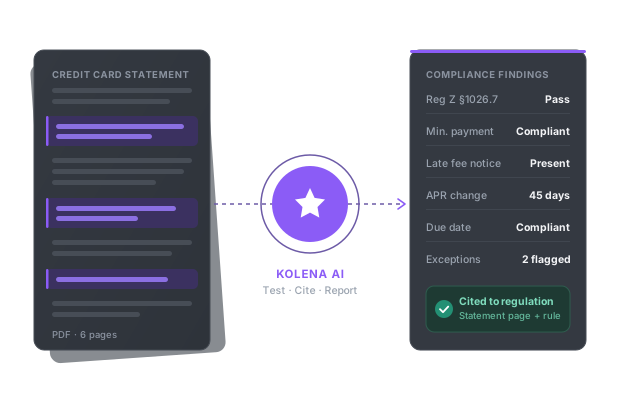
Kolena is an AI platform for banking document workflows that runs your compliance test scripts across products, disclosures, statements, and marketing materials, covering areas such as TILA, RESPA, UDAAP, Regulation E, Regulation Z, and fair lending. Kolena agents read and classify every page, apply your policy checklist, cross-reference data, and flag exceptions, then produce the workpaper with the supporting evidence attached. Every value carries a page citation and a reasoning log, so compliance, credit, and operations teams can defend each result to an examiner, an auditor, or a customer.
Key capabilities of Kolena:
- Full-population compliance testing: Tests every record instead of a sample, so exceptions are found rather than estimated, with up to 90% less time per testing cycle and wider coverage.
- Cited, exam-ready workpapers: Cites the exact clause or figure behind every pass, fail, and observation, producing a reasoning log and evidence file that examiners can follow.
- Procedure and logic alignment: Keeps written procedure documents and agent logic in sync as rules change, so updates to testing take minutes instead of rebuilds.
- KYC and beneficial ownership review: Resolves ownership chains across operating agreements, cap tables, and org charts, and flags expired IDs, unsigned certifications, and gaps against CIP requirements to produce a BSA/AML-ready file.
- Complaint and restitution review: Categorizes complaints consistently for CFPB reporting and trend analysis, and recomputes fees, interest, and refunds across affected accounts and populations.
- Loan package and closing file validation: Reconciles names, amounts, dates, and signatures across every document in a closing package, surfacing missing, stale, or inconsistent documents before funding.
- High-volume parallel processing: Processes hundreds of files at a time, routes exceptions to reviewers, and delivers outputs to your LOS, core banking system, or compliance evidence file.
- Enterprise security and governance: PCI, SOC 2, and HIPAA compliant, with no training on customer data, encryption in transit and at rest, role-based access control, and a complete audit trail.