What Are Banking Compliance Regulations?
Banking compliance regulations are the legal rules and standards that financial institutions must follow to prevent financial crime, protect consumer data, and ensure economic stability. Banks implement these requirements through policies, internal controls, compliance monitoring, and audits. Common examples include know your customer (KYC), anti-money laundering (AML), sanctions screening, and regulatory reporting requirements. The exact rules depend on the jurisdictions where a bank operates and the products and customers it serves.
Key regulatory frameworks:
- Bank Secrecy Act (BSA) and anti-money laundering (AML): Requires banks to monitor accounts, verify customer identities, and file reports for cash transactions over $10,000 or suspicious activities.
- USA PATRIOT Act: Strengthens customer identification, correspondent banking controls, information sharing, and enhanced due diligence for higher-risk relationships.
- OFAC sanctions requirements: Requires screening of customers and transactions against sanctions restrictions and appropriate blocking, rejection, reporting, and recordkeeping.
- Gramm-Leach-Bliley Act (GLBA): Requires banks to protect nonpublic personal information, provide privacy notices, control data sharing, and oversee service-provider security.
- Equal Credit Opportunity Act (ECOA) and Regulation B: Prohibits discriminatory credit practices and establishes requirements for fair lending, adverse action notices, and recordkeeping.
- Fair Credit Reporting Act (FCRA): Regulates permissible use, accuracy, dispute handling, consumer notices, and identity theft controls involving consumer credit information.
- Truth in Lending Act (TILA) and Regulation Z: Requires standardized disclosures for consumer credit, including APRs, finance charges, payment terms, and applicable mortgage and credit card requirements.
- Electronic Fund Transfer Act (EFTA) and Regulation E: Establishes consumer protections for electronic transfers, including disclosures, unauthorized transaction liability, error resolution, and transaction records.
- Community Reinvestment Act (CRA): Requires covered institutions to demonstrate how they help meet community credit needs, with performance evaluated by federal regulators.
- Basel III / Basel Framework: Establishes international standards for bank capital, liquidity, leverage, and risk management that are implemented through national regulation.
Check a document for CFPB compliance in minutes with AI
Why Is Regulatory Compliance Important in Banking?
Regulatory compliance helps banks operate within legal requirements while controlling financial, operational, and reputational risks. Effective compliance processes also help institutions detect suspicious activity and protect customers and financial systems:
- Reduces legal and financial risk: Compliance helps banks avoid fines, sanctions, lawsuits, and restrictions imposed by regulators.
- Prevents financial crime: Controls such as KYC, AML monitoring, and sanctions screening help identify fraud, money laundering, and prohibited transactions.
- Protects customers: Compliance requirements support fair treatment, transparent products, responsible lending, and protection of customer data.
- Maintains operational stability: Clear controls and reporting processes reduce compliance failures that can disrupt banking operations.
- Builds trust: Consistent compliance demonstrates that a bank manages customer funds and sensitive information according to established standards.
- Supports market access: Meeting regulatory requirements allows banks to maintain licenses, correspondent banking relationships, and access to regulated financial markets.
Key Regulatory Frameworks in Banking
1. Bank Secrecy Act (BSA) and Anti-Money Laundering (AML) Requirements
The Bank Secrecy Act (BSA) is a U.S. law designed to prevent financial institutions from being used for money laundering and other financial crimes. Together with related anti-money laundering (AML) requirements, it requires banks to establish controls for identifying customers, monitoring activity, keeping records, and reporting suspicious or qualifying transactions.
- Customer due diligence: Banks must identify customers, verify relevant information, and understand the nature of customer relationships.
- Transaction monitoring: Banks monitor transactions for patterns that may indicate money laundering or other suspicious activity.
- Regulatory reporting: Banks must file required reports, including suspicious activity reports (SARs) and currency transaction reports (CTRs).
- AML programs: Banks maintain risk-based AML programs that include internal controls, training, independent testing, and designated compliance personnel.
2. USA PATRIOT Act
The USA PATRIOT Act expanded U.S. anti-money laundering requirements after the September 11 attacks. Among its banking provisions, it strengthened customer identification requirements and controls involving correspondent accounts, information sharing, and relationships with certain foreign financial institutions.
- Customer identification: Banks must maintain customer identification programs (CIPs) for verifying the identity of customers opening accounts.
- Correspondent banking controls: Banks apply additional controls to certain accounts maintained for foreign financial institutions.
- Information sharing: The law provides mechanisms for sharing information related to suspected money laundering and terrorist financing.
- Enhanced due diligence: Certain higher-risk relationships require additional review and monitoring.
3. Office of Foreign Assets Control (OFAC) Sanctions Requirements
The U.S. Department of the Treasury's Office of Foreign Assets Control (OFAC) administers economic and trade sanctions based on U.S. foreign policy and national security objectives. Banks must avoid prohibited transactions involving sanctioned countries, entities, vessels, and individuals and comply with applicable blocking or rejection requirements.
- Sanctions screening: Banks screen customers, counterparties, and transactions against applicable sanctions lists and restrictions.
- Transaction controls: Payments involving sanctioned parties or prohibited activity may need to be blocked or rejected.
- Reporting: Banks must submit required reports concerning blocked or rejected transactions to OFAC.
- Risk management: Banks use sanctions risk assessments, screening systems, escalation procedures, and recordkeeping controls.
4. Gramm-Leach-Bliley Act (GLBA)
The Gramm-Leach-Bliley Act (GLBA) establishes requirements for how U.S. financial institutions handle consumers' nonpublic personal information. Its privacy and safeguards provisions require covered institutions to explain certain information-sharing practices and maintain measures that protect customer information.
- Privacy notices: Banks provide required notices describing their privacy policies and information-sharing practices.
- Information security: Banks implement safeguards designed to protect customer information from unauthorized access or use.
- Data sharing controls: Banks must comply with restrictions and applicable opt-out requirements when sharing certain customer information.
- Service provider oversight: Banks must address information security risks associated with service providers that handle protected information.
5. Equal Credit Opportunity Act (ECOA) and Regulation B
The Equal Credit Opportunity Act (ECOA), implemented by Regulation B, prohibits creditors from discriminating against applicants in credit transactions on specified protected grounds. It applies across the credit lifecycle, including applications, underwriting, pricing, servicing, and certain notification requirements.
- Fair lending: Banks must apply lending policies without prohibited discrimination.
- Credit decisions: Underwriting criteria and automated models must be managed to avoid unlawful discriminatory treatment.
- Adverse action notices: Applicants generally must receive required explanations or disclosures when credit is denied or other adverse action occurs.
- Recordkeeping: Banks retain specified application and credit records to support compliance and regulatory review.
6. Fair Credit Reporting Act (FCRA)
The Fair Credit Reporting Act (FCRA) regulates the collection, use, and reporting of consumer credit information. Banks that obtain consumer reports, furnish information to consumer reporting agencies, or use credit data for covered decisions must follow requirements concerning permissible purposes, accuracy, disputes, and notices.
- Permissible use: Banks may obtain consumer reports only for purposes allowed by the FCRA.
- Data accuracy: Banks that furnish information must maintain processes for providing accurate information and handling disputes.
- Consumer notices: Certain uses of credit information require adverse action or risk-based pricing notices.
- Identity theft controls: Banks must comply with applicable requirements for detecting and responding to identity theft risks.
7. Truth in Lending Act (TILA) and Regulation Z
The Truth in Lending Act (TILA), implemented by Regulation Z, requires standardized disclosures for many forms of consumer credit. Its purpose is to help consumers understand and compare credit costs and terms, including interest rates, fees, payment obligations, and other material conditions.
- Credit disclosures: Banks disclose required information such as the annual percentage rate (APR), finance charges, and payment terms.
- Mortgage requirements: Covered mortgage lending is subject to additional disclosure, underwriting, servicing, and timing rules.
- Credit card controls: Banks must follow requirements governing disclosures, billing practices, rate changes, and certain fees.
- Advertising: Credit advertisements that include specified terms can trigger additional disclosure requirements.
8. Electronic Fund Transfer Act (EFTA) and Regulation E
The Electronic Fund Transfer Act (EFTA), implemented by Regulation E, establishes consumer protections for electronic fund transfers. It covers services such as debit card transactions, ATM transfers, and certain electronic account transfers, while setting requirements for disclosures, unauthorized transactions, and error resolution.
- Required disclosures: Banks provide information about transfer terms, fees, consumer liability, and error-resolution procedures.
- Unauthorized transfers: Rules limit consumer liability for qualifying unauthorized electronic fund transfers when applicable requirements are met.
- Error resolution: Banks must investigate covered consumer notices of errors within specified procedures and timeframes.
- Transaction documentation: Consumers receive required records or statements showing covered electronic fund transfer activity.
9. Community Reinvestment Act (CRA)
The Community Reinvestment Act (CRA) encourages certain federally insured depository institutions to help meet the credit needs of the communities they serve, including low- and moderate-income neighborhoods, consistent with safe and sound banking operations. Federal regulators evaluate covered institutions' performance under the applicable CRA framework.
- Community lending: Banks' lending activity can form part of regulatory assessments of how they serve their communities.
- Performance evaluation: Regulators periodically examine covered banks and assign CRA ratings.
- Data and records: Depending on the institution and applicable requirements, banks may need to collect, maintain, and report relevant data.
- Regulatory impact: CRA performance may be considered when regulators evaluate certain applications, such as mergers or branch-related actions.
10 Basel III / Basel Framework
The Basel Framework is a set of international banking standards developed by the Basel Committee on Banking Supervision. Basel III strengthened standards following the global financial crisis, particularly for regulatory capital, leverage, liquidity, and risk management. The framework is implemented through national laws and regulations rather than operating as a single directly binding global law.
- Capital requirements: Banks subject to implementing rules must maintain specified levels and quality of capital relative to their risk exposures.
- Liquidity requirements: Applicable rules can require banks to maintain sufficient liquid assets and stable funding.
- Leverage controls: Leverage requirements provide a backstop to risk-based capital measures.
- Risk management: The framework influences how banks measure and manage credit, market, operational, and other material risks.
Common Banking Compliance Challenges
Processing Large Volumes of Customer Documents
Banks process large volumes of documents during customer onboarding, lending, KYC reviews, and ongoing account monitoring. These can include identity documents, bank statements, tax records, corporate registration documents, and proof of address. Compliance teams must extract and verify relevant data while maintaining accurate records.
Manual document processing can become slow and error-prone as volumes increase. Different formats, poor-quality scans, missing pages, and unstructured data make review more difficult. These issues can delay onboarding and investigations while increasing the risk that important compliance information is overlooked.
Related content: Read our article about loan processing.
Incomplete or Inconsistent Customer Information
Compliance processes depend on accurate customer data, but information can be missing, outdated, or inconsistent across banking systems. For example, a customer's address, ownership information, or business activity may differ between onboarding records, transaction systems, and later KYC reviews.
These inconsistencies make customer risk assessments and regulatory checks less reliable. Compliance teams may need to request additional documents, compare multiple data sources, and resolve discrepancies manually. Unresolved data quality issues can also reduce the effectiveness of sanctions screening, transaction monitoring, and customer due diligence.
High Volumes of Compliance Alerts and False Positives
Transaction monitoring, sanctions screening, and fraud detection systems can generate large numbers of alerts for compliance teams to investigate. Many alerts are false positives, where legitimate customers or transactions match predefined rules or resemble suspicious activity without presenting an actual compliance concern.
High false-positive rates consume analyst time and can create investigation backlogs. They may also make it harder to prioritize genuinely high-risk activity. Banks therefore need to tune detection rules, improve data quality, and apply risk-based prioritization while ensuring that changes do not cause relevant suspicious activity to be missed.
Related content: Read our article about bank compliance software.
How AI and Automation Are Changing Banking Compliance
Intelligent Document Processing
Intelligent document processing uses technologies such as optical character recognition, machine learning, and natural language processing to convert customer documents into structured data. Banks can use it to process compliance materials such as:
- Identity documents
- Financial statements
- Tax forms
- Corporate records
Automation can identify document types, extract required fields, and route exceptions to compliance analysts. This reduces repetitive data entry and speeds up document reviews. Human review remains important for low-confidence results, unusual documents, and decisions that require compliance judgment.
Automated KYC Data Extraction
KYC reviews require banks to collect information such as:
- Names
- Addresses
- Dates of birth
- Company details
- Beneficial ownership data
AI-based extraction tools can capture these fields directly from submitted documents and transfer them into KYC systems. Automated extraction reduces manual copying and helps standardize customer records. Confidence scores and validation rules can flag uncertain or missing fields for review. Banks can therefore focus analyst time on exceptions rather than manually entering every data point.
Identity Document Classification
Customers may submit identity documents such as:
- Passports
- Driver's licenses
- National identity cards
- Residence permits
Classification models can automatically determine the document type and, where supported, its issuing country or jurisdiction. Correct classification allows the system to apply the appropriate extraction and validation rules. It can also identify unsupported or unexpected documents and send them for manual review. This makes identity verification workflows more consistent across large customer populations.
Cross-Document Data Validation
Customer information often appears across multiple documents, and discrepancies can indicate data quality problems or require further investigation. Automated validation systems can compare fields across submitted records, including:
- Names
- Addresses
- Dates of birth
- Company names
- Registration numbers
The system can flag mismatches instead of requiring analysts to compare each document manually. Rules can distinguish acceptable variations from material discrepancies and route exceptions for review. This helps banks detect inconsistent information earlier in onboarding and periodic KYC reviews.
Automated Customer Due Diligence
Customer due diligence requires banks to identify customers, understand relevant aspects of their activities, assess risk, and perform checks required by their compliance programs. Automation can combine extracted customer data with approved data sources, such as:
- Sanctions screening
- Politically exposed person checks
- Risk indicators
Rules and models can then support risk scoring, identify missing information, and route higher-risk cases for enhanced review. Automation can make routine due diligence faster and more consistent, but banks still need governance, testing, audit trails, and human oversight for decisions with significant compliance consequences.
Banking Compliance Best Practices
Here are some of the ways that organizations can better ensure compliance with the relevant banking regulations.
1. Maintain an Up-to-Date Regulatory Inventory
Banks should maintain a centralized inventory of the laws, regulations, regulatory guidance, and internal obligations that apply to their operations. The inventory should map each requirement to relevant products, jurisdictions, business units, processes, and responsible owners. Compliance teams should update the inventory when regulations or business activities change. A structured change-management process helps identify affected controls, policies, systems, training, and reporting requirements before new obligations take effect.
Key actions:
- Assign an owner to each regulatory requirement and map it to the affected products, processes, systems, and controls.
- Monitor regulatory changes and assess their impact before new or revised requirements take effect.
- Record policy, control, system, training, and reporting updates made in response to regulatory changes.
2. Apply Risk-Based Compliance Controls
Compliance controls should reflect the level and type of risk associated with customers, products, transactions, delivery channels, and jurisdictions. Higher-risk activities generally require stronger controls, more frequent monitoring, or additional due diligence. Banks should document how risks are assessed and how control levels are determined. Risk assessments should also be reviewed periodically so controls remain appropriate as customer behavior, products, regulations, and financial crime patterns change.
Key actions:
- Classify customers, products, transactions, channels, and jurisdictions according to documented compliance risk criteria.
- Apply enhanced due diligence, monitoring, or approval requirements to higher-risk activities.
- Reassess risk ratings periodically and when customer behavior, products, regulations, or threat patterns materially change.
3. Use Automated Controls Without Eliminating Human Oversight
Automation can improve compliance by screening large data sets, extracting document information, monitoring transactions, and prioritizing alerts. However, automated systems can produce false positives, miss unusual cases, or make incorrect classifications when data quality is poor. Banks should define when automated results require human review and which decisions cannot be made solely by a system. They should also test models and rules, monitor performance, document changes, and provide analysts with adequate information.
Key actions:
- Define confidence thresholds and exception criteria that determine when automated findings require analyst review.
- Test and monitor automated rules and models for accuracy, false positives, false negatives, and changes in performance.
- Preserve the data, system outputs, reviewer decisions, and model or rule versions needed to audit automated compliance processes.
4. Establish Clear Escalation Procedures
Compliance teams need documented procedures for cases that cannot be resolved through standard workflows. Escalation criteria can cover suspicious activity, sanctions matches, customer information discrepancies, policy exceptions, and other issues requiring specialized review or management approval. Procedures should specify escalation triggers, responsible teams, required documentation, and decision authority. Clear workflows help prevent high-risk cases from remaining unresolved and create a consistent process for recording decisions and follow-up actions.
Key actions:
- Define escalation triggers for suspicious activity, sanctions matches, unresolved discrepancies, policy exceptions, and other high-risk cases.
- Assign clear ownership, decision authority, response timelines, and required documentation for each escalation path.
- Track escalated cases through resolution and record the final decision, supporting evidence, and follow-up actions.
5. Maintain Complete Records and Audit Trails
Banks should retain the records needed to demonstrate how compliance activities and decisions were performed. Depending on the process, these records may include customer documents, screening results, alerts, investigation notes, approvals, risk assessments, and regulatory reports. Audit trails should show relevant actions, timestamps, data sources, system outputs, and decision makers. Complete records help internal auditors and regulators reconstruct compliance decisions and verify that required controls operated correctly.
Key actions:
- Retain customer records, screening results, alerts, investigations, approvals, risk assessments, and regulatory filings for required periods.
- Capture timestamps, data sources, system actions, reviewers, and decision rationale so compliance activity can be reconstructed.
- Protect compliance records from unauthorized modification or deletion and regularly verify that retention and retrieval controls work as intended.
Meeting Banking Compliance Requirements with Kolena
Most banking compliance obligations come down to documents: loan packages, borrower files, identity records, disclosures, statements, and the evidence needed to prove a control operated correctly. Kolena is an AI document automation platform for banking document workflows. It picks up loan packages, UCC filings, borrower documents, and compliance test scripts where they already land, applies your credit and compliance logic, and delivers the finished output to your LOS, core banking system, or compliance evidence file, hundreds of files at a time, with every value carrying a page citation and a reasoning log that credit, operations, and compliance can defend to an examiner or auditor.
Key capabilities of Kolena for banking:
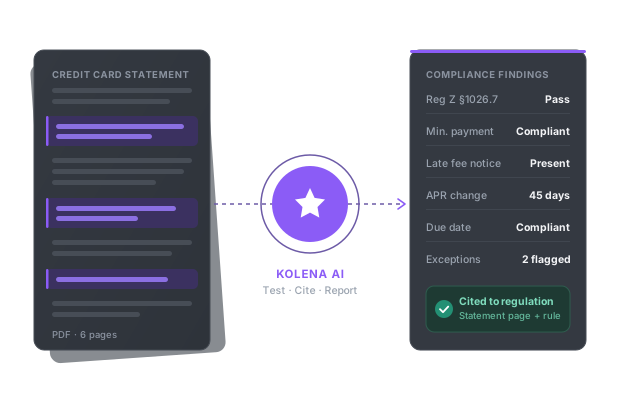
- Consumer-protection compliance testing: Runs your compliance test scripts across products, disclosures, statements, and marketing materials, including TILA, RESPA, UDAAP, Reg E, Reg Z, and fair lending, and produces the workpaper with the evidence attached. Kolena tests full populations rather than a sample, so exceptions are found instead of estimated, and keeps procedure documents aligned with agent logic as rules change.
- KYC and beneficial ownership document review: Identity documents, beneficial-ownership certifications, entity-structure documents, and screening materials go in, and a structured KYC review record comes out with every field cited to its source. It resolves ownership chains across operating agreements, cap tables, and org charts, flags expired IDs, unsigned certifications, and gaps against your CIP requirements, and produces a BSA/AML-ready file an examiner can follow field by field.
- UCC filing and lien position review: Reads UCC-1 and UCC-3 filings, search certificates, and equipment schedules, extracts debtor name, secured party, filing date, and collateral description, and determines lien position, matching debtor names across filings to catch mismatches and flagging prior blanket liens, stale filings, and collateral overlaps before funding.
- Loan package and closing file validation: Checks the full closing package against your funding checklist, reconciling names, amounts, dates, and signatures across every document and surfacing missing, stale, or inconsistent records before the file reaches the funder.
- Bank statement analysis and financial spreading: Normalizes twelve months of statements across any bank's format, spreads them into your credit template, calculates the ratios your policy requires, and surfaces NSFs, unexplained deposits, and undisclosed debt service for the credit memo.
- Complaint resolution and restitution review: Reads complaint intake, call notes, correspondence, and account history together, classifies issue and root cause, categorizes complaints consistently for CFPB reporting, and recomputes fees, interest, and refunds across affected accounts.
- Examiner-ready governance and security: Complete audit trails and traceability, reasoning logs behind every result, PCI, SOC 2, and HIPAA compliance, encryption in transit and at rest, RBAC and access control, and no training on customer data.
Start with one workflow and bring your own files, send a set of UCC filings, a week of closing packages, or a compliance test script, and see the citations and ROI against your own volumes. Explore Kolena's banking solutions.