AI for KYC document review reads identity documents, beneficial-ownership certifications, entity-structure documents, and OFAC screening materials, extracts structured data, and produces a documented review record with every field cited to its source — meeting the audit-trail and decision-logic obligations that BSA/AML compliance requires and that manual or offshore review struggles to provide.
This is for commercial banks, community banks, credit unions, and fintech lenders subject to BSA/AML requirements.
This is part of a series of articles about Bank Compliance.
The Pain: A Compliance Requirement With Hard Obligations
KYC document review isn't optional, and it isn't only about speed. Covered financial institutions must identify and verify their customers — and, for legal-entity customers, the beneficial owners behind them — under the FinCEN Customer Due Diligence (CDD) rule, and they must be able to show a documented basis for each decision under BSA/AML supervision. Manual review is slow and, across a rotating team, produces inconsistent documentation; offshore processing tends to deliver an output without traceable reasoning, which is precisely what an examiner asks to see. (Note that the separate Corporate Transparency Act beneficial-ownership reporting regime changed in 2025: under FinCEN's March 2025 interim final rule, US-formed companies and US persons are exempt from filing BOI reports, with the requirement now applying only to foreign reporting companies. A bank's own CDD obligation to identify beneficial owners of legal-entity customers is distinct from that reporting regime and remains in force.)
Check a document for CFPB compliance in minutes with AI
How AI Handles It
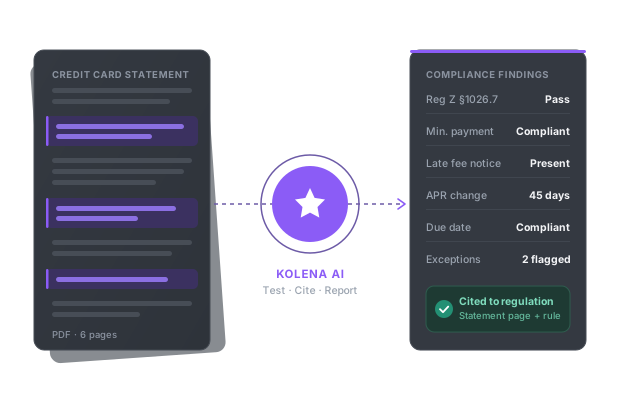
AI reads the KYC document package, extracts the structured data — identity details, ownership percentages, entity structure, screening results — and produces a documented review record in which every field is cited to the source document it came from. That gives the bank the documented decision logic BSA/AML compliance requires, natively rather than as an afterthought, and applies the same review rubric to every customer so documentation is consistent across the book.
| Factor | Manual / offshore KYC review | AI KYC document review |
|---|---|---|
| Audit trail | Inconsistent; reasoning often not traceable | Documented record, every field cited |
| Consistency | Varies by reviewer | Same rubric every customer |
| Turnaround | Slow; queue lag offshore | Fast |
| Data residency / PII | Offshore-jurisdiction exposure | Onshore, SOC 2 Type II |
| Decision logic for BSA/AML | Reconstructed after the fact | Produced natively, per review |
The audit trail is the decisive factor: because a bank can't outsource its compliance responsibility, a documented, traceable basis for each clear-or-escalate decision — which AI produces and manual or offshore review often doesn't — is what stands up to examination.
What Changes in the Workflow
With AI, onboarding and periodic-review KYC stops being a trade-off between speed and documentation. Customers are cleared faster, the documentation behind each decision is consistent and examiner-ready, and the PII in identity and ownership documents stays onshore. Analysts shift from assembling records to reviewing flagged exceptions — the cases where judgment actually matters.
Who Should Adopt This — and Who Shouldn't
Adopt it when KYC volume is meaningful, when audit-trail consistency is a supervisory concern, or when onboarding speed affects the business. A very small institution with low onboarding volume may manage manually. Critically, AI produces the documented review record and extraction; the compliance decision — clear, escalate, or file — and the accountability for it stay with your BSA/AML officers.
Learn more about Bank Compliance Software.
How Kolena Works
Kolena is an AI document automation platform built for banks, credit unions, and fintech lenders under BSA/AML. Identity documents, beneficial-ownership certifications, entity-structure documents, and OFAC screening materials go in; a documented, structured KYC review record — every field cited to its source — comes out.
It reads any format and pushes structured output into your core and compliance systems, keeping PII onshore, with each field cited to its source for a BSA/AML-ready audit trail. Every run produces a full audit trail: not just what was extracted, but the specific line, field, or clause that justified each data point. SOC 2 Type II certified, onshore processing, no training on customer data.