Perplexity is one of the strongest AI products of the last few years. Its answer engine pairs a large language model with live web search to return cited, traceable answers to almost any question. Paid tiers add Spaces for research collections, the Comet agentic browser, Pages for deliverables, the Sonar developer API, Deep Research for longer synthesis, and a Computer agent for multi-step tasks. For analysts and knowledge workers who live in finding and synthesizing information, it's genuinely excellent.
However, research synthesis and document-workflow execution are two completely different jobs. Operational work has to be automated: abstract every new lease, normalize every new loss run, review every new loan file, run every new CFPB check, every day, against the documents the business actually receives. That isn't the problem Perplexity solves.
Kolena is built for exactly that. Kolena’s purpose-built AI agents run lease abstraction, loss run analysis, loan diligence, appraisal extraction, CFPB compliance reviews, UCC lien analysis, rent roll processing, and dozens of other document workflows end-to-end, automatically, with no per-task instructions, with field-level validation, with source-page citations, inside an enterprise security perimeter built for financial services from day one.
This article walks through why, for the operational work an enterprise actually runs, Kolena is the better fit.
Kolena Runs Your Entire Workflow — Not Just Give Answers
Perplexity’s defining capability is sense-making. You ask a question, the engine searches across the web and any documents you have uploaded, and it returns a coherent, cited answer you can trust and trace. For research, market analysis, due diligence reading, and ad-hoc investigation, that capability is excellent. It is the right shape of tool for the work it was built for.
Enterprise document operations are not that shape of work. The question is not "what do these documents say?" instead it is "extract these specific fields from every document that arrives, validate them against the source page, populate the firm’s template, and route the result into the system of record, every day, without a human in the loop." That is execution, not synthesis. It is a workflow, not research.
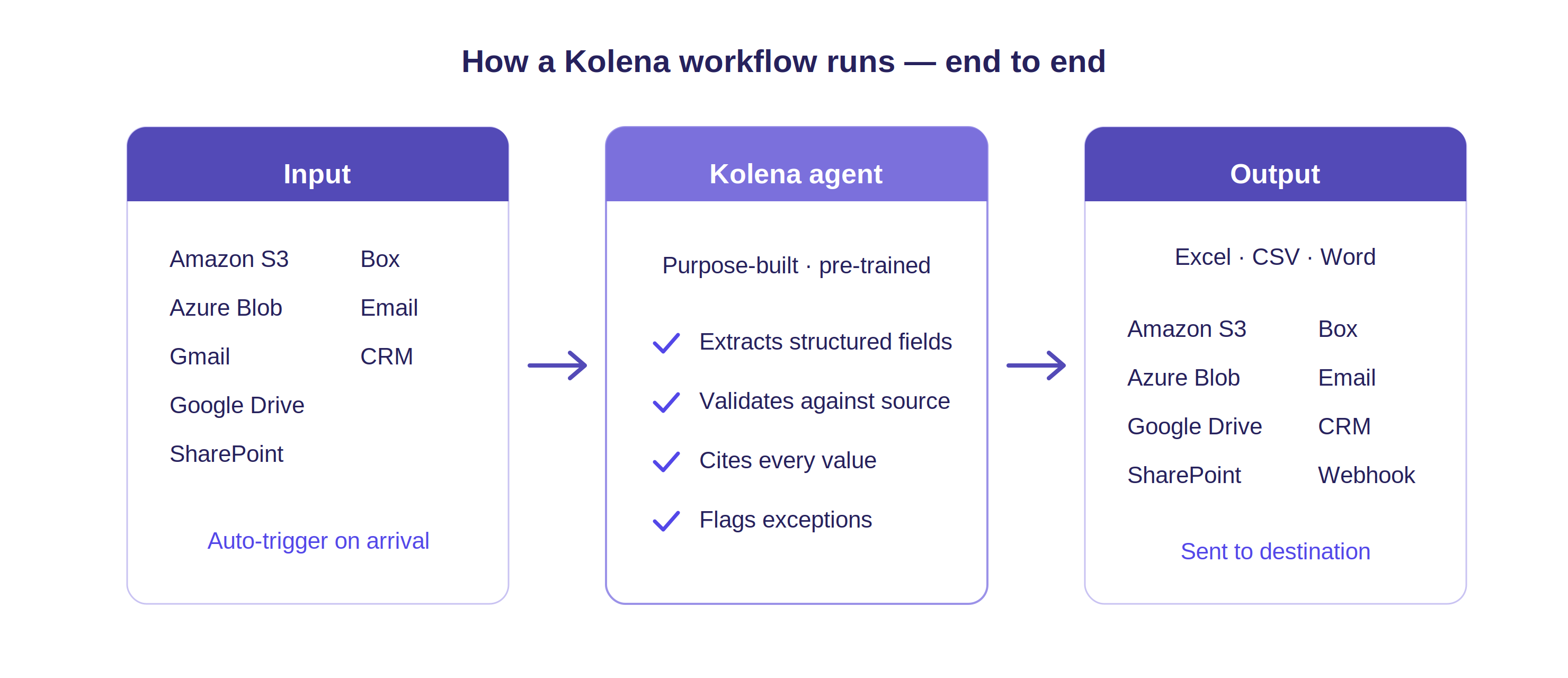
Kolena’s agents are designed for that shape of problem. They are persistent, purpose-built, and pre-trained for specific document workflows. Each agent triggers automatically when a document lands in the watched folder, inbox, or upload endpoint. Each one already knows the fields it must extract, the validation rules it must meet, and the template it must populate because the agent was built for that workflow on thousands of real-world documents. The operations team does not describe the work each time. The work runs.
That is the difference between an AI that helps you read documents and an AI that turns documents into structured business outcomes.
Nine free AI document tools — pick your workflow
What About Comet, Spaces, and Perplexity’s Agent Modes?
This is the right question, and it deserves a direct answer. Perplexity has shipped meaningful agentic capabilities such as Comet, the AI-native browser; Spaces, persistent research collections with shared context and uploaded files; the Sonar API for developers; and Computer Mode, an autonomous multi-step agent that can navigate web interfaces. These extend Perplexity well beyond a chatbot, and they overlap with parts of what Kolena does.
But they overlap on the wrong axis. Comet is a browser that helps an individual user move faster through web-based tasks; it is not a centrally governed workflow platform that runs documents through pre-built agents on a schedule or trigger. Spaces hold collections of files and produce research outputs, but they are research collections, not production extraction pipelines and their file capacity is structurally small for enterprise document operations. Computer Mode and Sonar API are powerful, but they are toolkits that a customer builds on, not finished workflows that the customer simply runs.
Kolena is the inverse of a toolkit. The agents for lease abstraction, loss run analysis, loan file diligence, appraisal extraction, CFPB compliance review, UCC lien analysis, REIT investment memo generation, rent roll processing and much more are already built, already tuned, and already validated against thousands of real-world documents in production. Your team does not assemble them from primitives. They run from day one. When customization is needed, Kolena's no-code agent builder lets the operations team itself extend or adapt an agent by adding a field, changing a template, and adjusting a validation rule. And to add a new step, you write one rough, plain-language prompt and Kolena's built-in prompt engineering turns it into several polished options to choose from—engineered once, applied consistently on every run. All without calling an API or touching code.
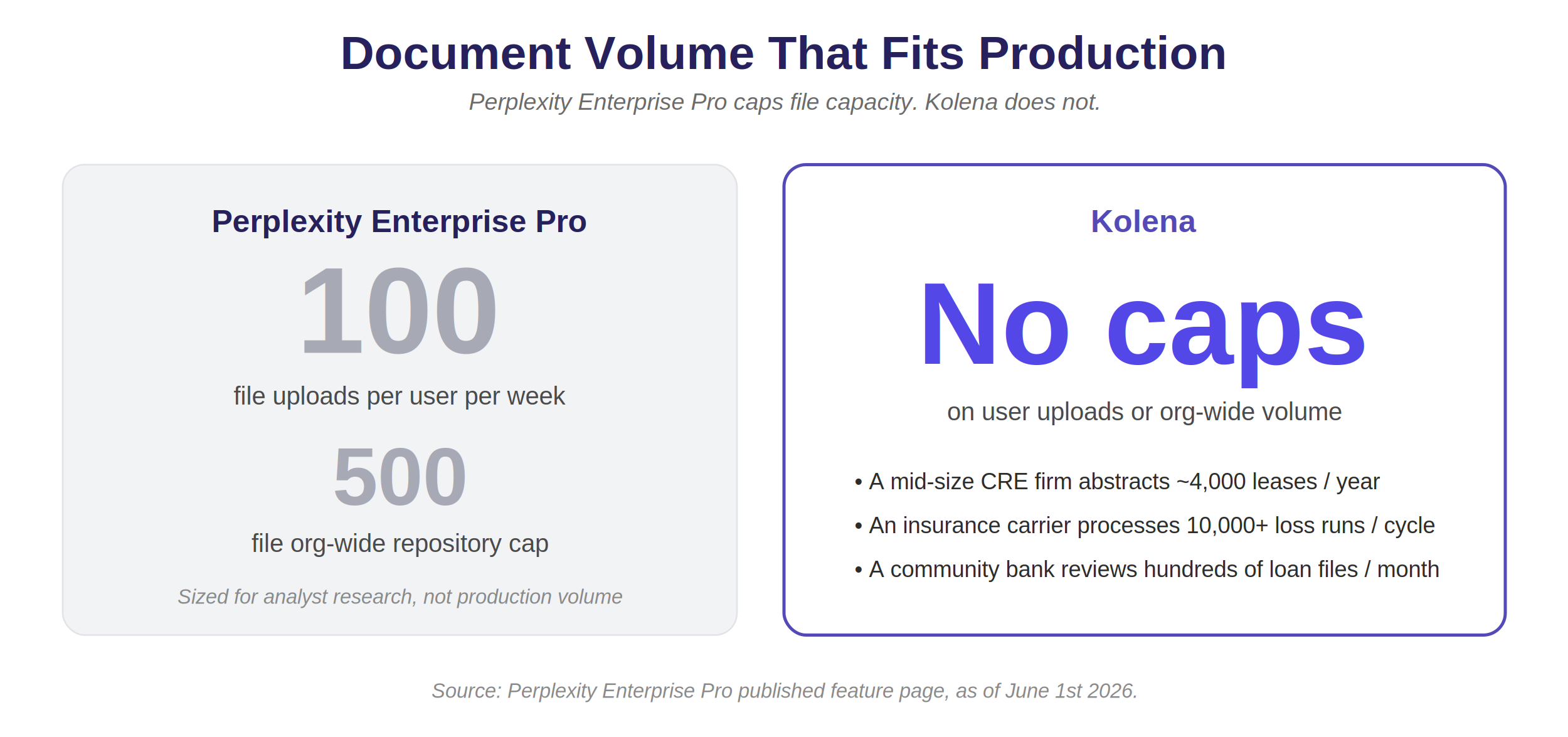
Production Document Volume Doesn’t Fit a Research Tool
A single mid-sized commercial real estate firm typically abstracts ~4,000 leases a year. An insurance carrier processes tens of thousands of loss runs in a renewal cycle. A community bank reviews hundreds of loan files a month. A REIT abstracts thousands of estoppels across a single acquisition. The defining feature of enterprise document operations is volume.
Perplexity's file limits are sized for what it is: a research tool, where an analyst builds a Space around a single project from a manageable set of documents. That's not the design for an asset management team processing 4,000 leases a year, or a claims team normalizing 12,000 loss runs a quarter.
Kolena was built for that scale from day one—no per-user limits, no document caps. It routinely processes thousands of files in seconds, on intake or on a schedule, with no human triggering each run. As volume grows, the workflow keeps pace, because operational scale isn't an add-on to Kolena; it's the entire point.
The Time Difference Is Transformational
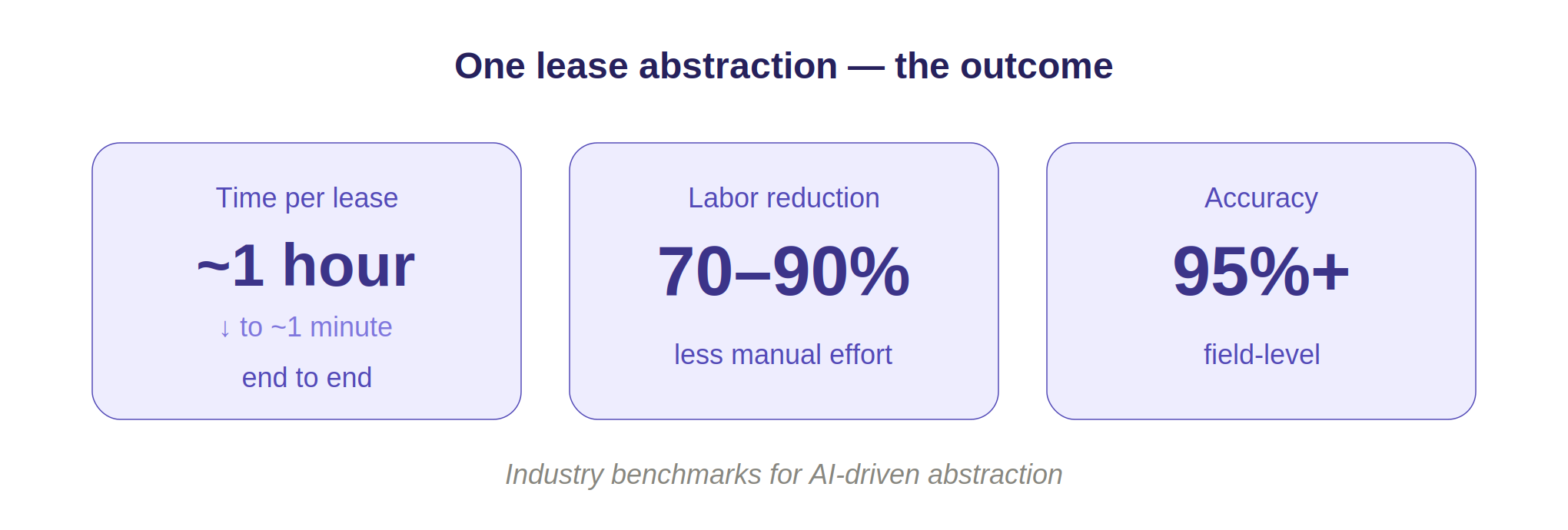
In a Perplexity workflow, even one built carefully on a Space with uploaded files and a custom Sonar API integration, a single lease abstraction typically takes an hour or more once you factor in prompt design, the per-file context refresh, manual validation against the source, exporting the answer into a structured format, and copying it into the firm’s template.
With Kolena, the same lease takes roughly one minute. Industry benchmarks suggest AI-driven abstraction reduces labor by 70–90%, with accuracy rates above 95%, and Kolena routinely processes thousands of files in seconds.
The difference is that Kolena runs the workflow end to end. No prompt design. No per-file context setup. No manual validation pass. No copy-paste. Documents come in, structured outputs go out, source-page citations attach automatically, exceptions flag automatically, and the result lands in the firm’s exact template.
Built to Fit the Document Systems Your Business Already Uses
Perplexity’s document workflow assumes a user-driven pattern: an individual uploads files into a Space, asks questions, and gets cited answers. That model works for an analyst doing focused research. It does not match how documents flow through an enterprise.
Kolena integrates directly with the systems organizations use for both intake and delivery — Google Drive, Microsoft SharePoint, Box, email, and enterprise cloud storage. Documents flow in automatically the moment they arrive. Structured outputs flow out to whatever destination the workflow needs — an Excel rent roll, a CSV import for a lease management platform, a Word investor memo, a row in a claims system. No manual uploads. No copy-paste. No per-document user action.
Accuracy You Can Actually Defend
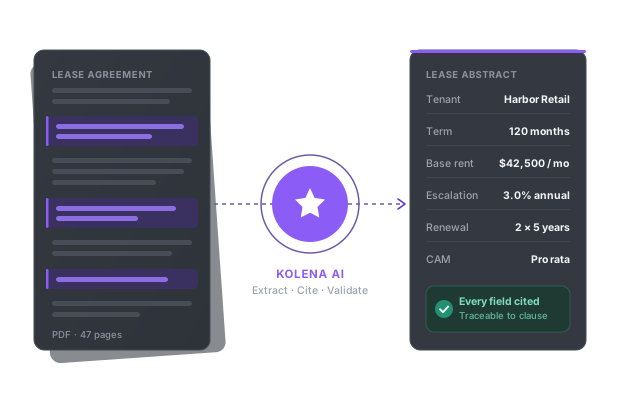
Kolena is built for decision-grade AI. Accuracy and traceability are foundational, not optional. Every Kolena workflow is backed by proprietary quality-checking models trained specifically on the document types and field schemas of each vertical, automated validation layers that prevent hallucinated fields, field-level confidence scores on every extracted value, source-page citations linking every value back to the exact page in the original document, and clear reasoning explaining how the agent interpreted complex clauses.
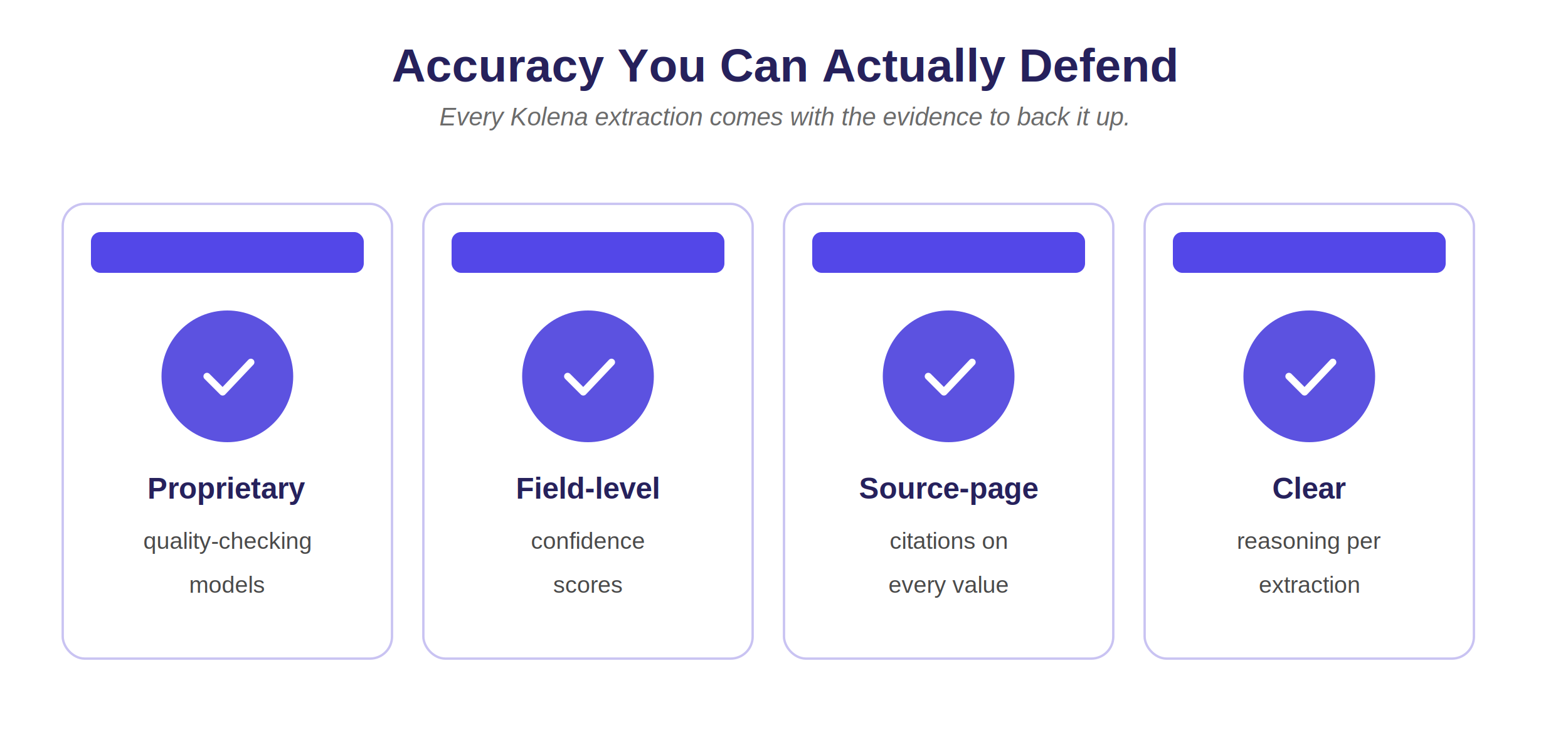
Perplexity is well known for source citations on its answers, and those citations are a real strength of the product. But citations on a research answer are not the same as field-level validation on a structured extraction. A Perplexity answer says "according to this source, the lease term is 10 years"; a Kolena workflow returns a value of 10 in the Lease Term column, with a confidence score, a citation to the exact page, and a flag if the value disagrees with another clause in the document. The first helps an analyst read faster. The second can populate the firm’s rent roll without an analyst reading at all.
This is why teams trust Kolena with high-impact workflows. We are AI you can trust.
Workflow Building Is a Hidden Cost Kolena Eliminates
Industry observers have begun describing what some call "AI clutter" — the accumulation of half-built, abandoned AI workflows that employees stand up quickly but never refine or integrate into daily operations. Because modern platforms like Perplexity make agent and Space creation easy, organizations end up with dozens of one-off automations that generate research outputs nobody routes anywhere. The work of turning a research answer into operational value still falls on the user.
Kolena removes that burden entirely. Customers describe what they want in natural language. The platform handles agent construction, prompt optimization, model routing, validation, and template delivery behind the scenes. Kolena’s team owns the maintenance as document patterns evolve. No internal team is responsible for prompt design, Space curation, Sonar API integration, validation logic, or output routing. The workflow runs because the platform runs.
Your Workflow Partner, not a Search Vendor
Perplexity is, fundamentally, a search and research vendor. That is the right product for the audience it serves. But Perplexity is not in the business of abstracting your lease portfolio, normalizing your loss runs, reconciling your loan files, or running your CFPB compliance reviews. Comet, Spaces, the Sonar API, and Computer Mode give your team tools to attempt that work — the work itself remains yours.
Kolena is a workflow partner. Every customer receives:
Dedicated AI architects who design and tune agents to the firm’s specific workflows
Hands-on implementation support from intake to production
Training on how operations teams can build and customize agents themselves — no engineering required
A dedicated account manager and ongoing operational support
Maintenance of the agent stack as documents and regulations evolve
Perplexity provides answers. Kolena provides outcomes. We deploy with you, tune with you, and scale with you.
Enterprise Security and Data Privacy: Built for Regulated Industries from the Ground Up
On compliance certifications, both Perplexity and Kolena have invested seriously, and the comparison is closer than most competitors. Perplexity holds SOC 2 Type II, complies with GDPR and PCI DSS, and offers HIPAA Business Associate Agreements for customers on Enterprise Pro and Enterprise Max plans, with enterprise data excluded from training.
Kolena’s posture is at least as strong, with one practical advantage that matters to regulated buyers. Perplexity’s HIPAA coverage is gated to the higher-priced Enterprise tiers and requires an executed BAA. Kolena’s compliance posture — SOC 2 Type II, HIPAA, and PCI — applies to the entire platform out of the box. There is no version of the product that sits outside the compliance perimeter, and no tier that has to be upgraded to unlock regulated-industry use.
The second advantage is governance scope. Perplexity is designed for users to query across uploaded files and the live web. For a regulated firm processing leases that may reference tenant PII, claims data that may include PHI, or loan files that may include payment data, that breadth is a friction point in a security review even when the underlying controls are sound. Kolena’s workflows are scoped tightly — each agent operates against a defined set of documents, with full audit logs, role-based access, single sign-on, and centralized data governance. The blast radius of any single workflow is limited to what that workflow needs.
Customer data is never used to train Kolena’s models. Zero data retention policies are enforced. Every action is logged, every output is auditable, every workflow is administered centrally. Your data remains yours, always.
Kolena vs. Perplexity at a Glance
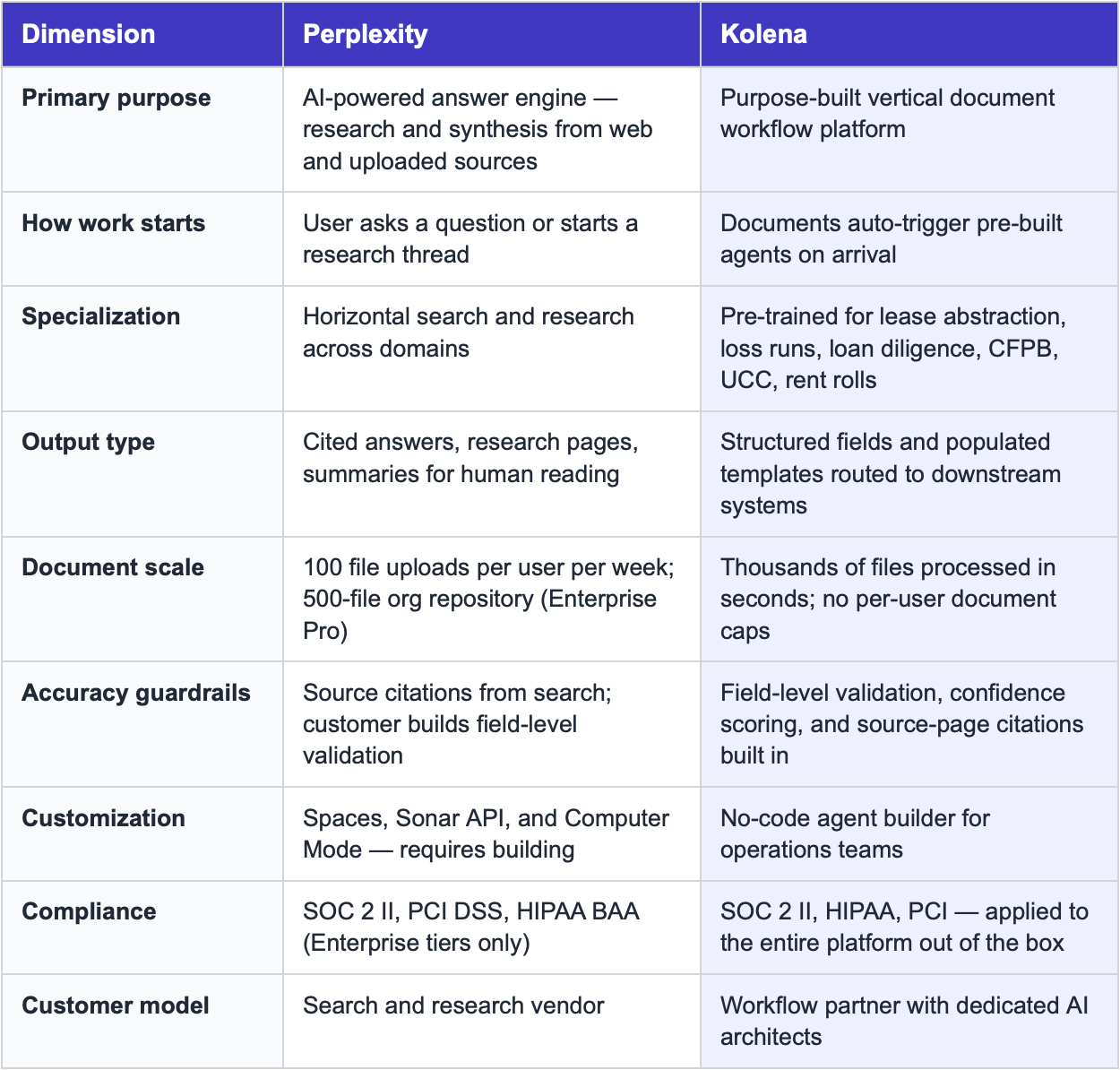
Why Kolena Wins on Production Document Work
Perplexity is one of the strongest research and synthesis tools on the market, and for analysts, consultants, and knowledge workers doing investigation-led work, it is an excellent choice. The cited answers, the Spaces for project context, the Comet browser, the Computer Mode — for the audience Perplexity was built for, the product is genuinely best-in-class.
But the work that defines a regulated enterprise — abstracting every new lease, normalizing every new loss run, reviewing every new loan file, scoring every new offering memorandum, processing every new compliance disclosure, doing it every day, automatically, at production volume — is not the work Perplexity was built for.
It is the work Kolena was built for.
Purpose-built vertical agents. Zero per-task instructions. End-to-end automation from intake to delivery. Field-level validation. Source-page citations. No prompt engineering, no Space curation, no Sonar integrations, no user-driven uploads. PCI, HIPAA, and SOC 2 Type II certified across the entire platform. Zero data retention. Full audit logs. Centralized admin control. A workflow partner that owns the agent stack with you.
If your operation is document-heavy, accuracy-critical, regulated, and built for repeatable production work, Kolena is the better fit, and it is not close.