What Is Insurance Underwriting?
Insurance underwriting is the process an insurance company uses to evaluate an applicant's risk level, decide whether to offer coverage, and set the appropriate price and terms. The assessment determines whether the insurer will offer coverage and under what conditions. It can affect the premium, coverage limits, deductibles, exclusions, and other policy terms. If the risk falls outside the insurer’s guidelines, the application may be declined.
How the process works:
- Application and submission intake: Collects the initial insurance application and checks whether it is complete and suitable for underwriting.
- Document and data collection: Gathers supporting information such as claims histories, financial records, inspections, medical records, or property details.
- Risk assessment: Evaluates factors that affect the probability and potential severity of future claims.
- Verification and validation: Confirms important application information and identifies missing, inaccurate, or inconsistent data.
- Risk classification and scoring: Assigns the applicant to a risk category using underwriting rules, models, or standardized scores.
- Pricing and premium determination: Calculates the premium based on the assessed risk, expected claims, expenses, and other pricing factors.
- Coverage and policy terms: Establishes coverage limits, deductibles, exclusions, endorsements, and other policy conditions.
- Approval, referral, or rejection: Approves qualifying applications, refers complex cases for further review, or declines risks outside acceptable guidelines.
This is part of a series of articles about insurance claims processing
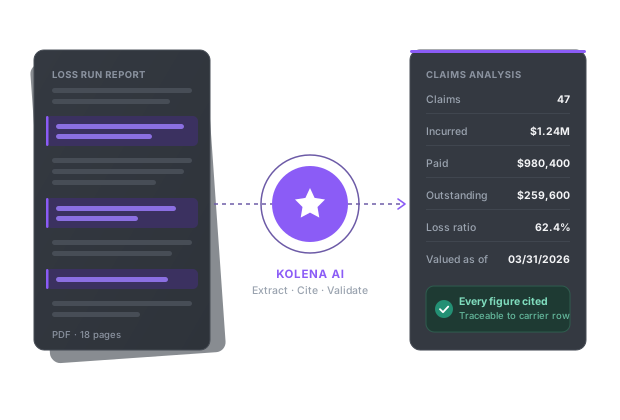
Turn loss runs into a clean spreadsheet in minutes with AI
How Does the Insurance Underwriting Process Work?
1. Application and Submission Intake
The underwriting process starts when an applicant submits a request for insurance. The application provides basic information about the person, property, vehicle, or business that needs coverage.
The insurer checks whether the submission is complete and falls within its underwriting guidelines. Straightforward applications may move directly to automated processing, while incomplete or complex cases may require manual review.
2. Document and Data Collection
The insurer gathers the information needed to evaluate the application. Sources can include application forms, financial statements, claims histories, inspection reports, medical records, property details, and third-party databases.
The required data depends on the insurance product. Commercial insurers, for example, may request payroll figures, revenue, contracts, and loss runs, while property insurers may need construction details and information about fire protection systems.
3. Risk Assessment
Underwriters analyze the collected information to identify factors that could increase the likelihood or cost of a claim. They compare these factors with the insurer's underwriting rules, historical loss data, and risk appetite.
The assessment may consider both the probability and potential severity of losses. Underwriters can also evaluate controls that reduce risk, such as security systems, workplace safety programs, or property maintenance practices.
4. Verification and Validation
Before making a decision, the insurer verifies important information provided by the applicant. This can involve checking records against external databases, reviewing supporting documents, or ordering inspections and reports.
Validation helps detect inaccurate, inconsistent, or missing information that could affect the risk assessment. Cases with significant discrepancies may be returned for clarification or sent to an underwriter for further review.
5. Risk Classification and Scoring
The insurer assigns the applicant to a risk category based on the assessment. Many insurers also use rating models or underwriting scores that combine multiple risk variables into a standardized result.
Classification makes it easier to apply consistent underwriting rules across similar risks. Higher-risk applicants may face stricter requirements or higher prices, while lower-risk applicants may qualify for more favorable terms.
6. Pricing and Premium Determination
Once the risk is classified, the insurer calculates the premium required to cover it. Pricing models typically account for expected claims, operating expenses, reinsurance costs, regulatory requirements, and the insurer's target return.
Underwriters may adjust the calculated price when permitted by underwriting guidelines and applicable regulations. Factors such as deductibles, coverage limits, prior losses, and risk controls can affect the final premium.
7. Coverage and Policy Terms
The insurer determines what coverage it is willing to provide and under which conditions. This includes setting coverage limits, deductibles, exclusions, endorsements, and other policy provisions.
For higher or unusual risks, the insurer may limit certain coverage or require the applicant to take specific risk-control measures. These terms help align the policy with the level and type of risk identified during underwriting.
8. Approval, Referral, or Rejection
The underwriting process ends with a decision. Applications that meet established criteria can be approved and prepared for policy issuance, sometimes without manual intervention.
Applications outside standard guidelines may be referred to a senior underwriter or specialist for review. If the risk exceeds the insurer's acceptable limits or cannot be priced appropriately, the insurer may reject the application.
Types of Insurance Underwriting
Life Insurance Underwriting
Life insurance underwriting evaluates the likelihood that an applicant will die during the policy period. Underwriters may consider:
- Age
- Medical history
- Current health
- Occupation
- Lifestyle
- Family medical history
- The amount of coverage requested
Depending on the product and coverage amount, insurers may use medical exams, prescription records, laboratory results, or automated data sources. The assessment helps determine eligibility, risk class, premium, and any applicable policy conditions.
Health Insurance Underwriting
Health insurance underwriting assesses expected healthcare costs based on factors such as:
- Medical history
- Existing conditions
- Age
- Prior healthcare use
The information insurers are permitted to use depends heavily on local laws and the type of health insurance. In markets where medical underwriting is allowed, insurers may use it to determine eligibility, premiums, exclusions, or other terms. In regulated markets that restrict medical underwriting, insurers must use approved rating factors instead.
Property Insurance Underwriting
Property insurance underwriting evaluates the likelihood and potential cost of damage to buildings, equipment, inventory, and other physical assets. Relevant factors include:
- Location
- Construction type
- Building age
- Occupancy
- Replacement cost
- Exposure to hazards such as fire, storms, or flooding
Underwriters may also review inspections and protective measures such as sprinklers, alarms, and security systems. These findings help determine coverage limits, deductibles, exclusions, and premiums.
Casualty and Liability Underwriting
Casualty and liability underwriting focuses on the risk that an insured party could cause injury, property damage, or other losses for which it may be legally responsible. Underwriters examine the applicant's:
- Activities
- Claims history
- Operating practices
- Contracts
- Exposure to third parties
Because liability claims can develop over long periods and vary significantly in severity, underwriters also consider potential maximum losses. They may manage exposure through coverage limits, deductibles, exclusions, or unique policy conditions.
Commercial Insurance Underwriting
Commercial insurance underwriting assesses risks associated with a business and can cover several insurance lines, including property, liability, workers' compensation, cyber, and commercial auto. The assessment varies according to the company's:
- Industry
- Size
- Locations
- Operations
- Revenue
- Loss history
For complex businesses, underwriters may combine financial information, inspections, industry data, and specialized risk models. They can also evaluate how different exposures interact before setting premiums, coverage limits, exclusions, and risk-control requirements.
What Information Do Insurance Underwriters Review?
Application and Applicant Information
Underwriters start with information supplied in the insurance application. This can include:
- Identity details
- Occupation
- Business activities
- Requested coverage
- Locations
- Insured values
- Other information relevant to the policy
They also check whether the application is complete and consistent. Missing or conflicting answers may require clarification before the risk can be assessed. For business insurance, underwriters may also review ownership structure, years in operation, employee counts, products or services, and geographic reach.
Application information provides the baseline for the rest of the underwriting process. It helps the insurer determine which additional records, inspections, or specialist reviews are needed before making a decision.
Financial Records
Financial information helps underwriters evaluate an applicant's financial condition and the size of the exposure. Depending on the insurance type, they may review:
- Revenue
- Payroll
- Balance sheets
- Income statements
- Debt
- Cash flow
- Asset values
These records are particularly important in commercial, credit, surety, and some liability insurance. They can help determine appropriate coverage limits and whether financial conditions create additional risk.
Underwriters may also compare current financial results with previous periods to identify significant changes. Rapid growth, declining revenue, high debt, or changes in payroll can alter the insurer's estimate of exposure and affect pricing or policy terms.
Claims and Loss History
Past claims provide information about the frequency, type, and severity of previous losses. Underwriters review:
- When losses occurred
- What caused them
- How much they cost
- Whether similar problems could happen again
A high number of claims does not automatically result in rejection. Underwriters may examine whether the underlying causes were corrected and whether new risk controls have been introduced.
Patterns are especially important. Several similar losses can indicate an ongoing operational or safety problem, while a single large claim may result from an unusual event. Underwriters use this context to decide how much weight to give historical losses when assessing future risk.
Property and Asset Information
For property-related coverage, underwriters review details about the assets being insured. These can include:
- Location
- Age
- Construction materials
- Occupancy
- Replacement value
- Equipment
- Maintenance history
- Exposure to natural hazards
This information helps estimate both the probability of damage and the potential size of a loss. It can also influence coverage limits, deductibles, and required protective measures.
Underwriters may also consider how assets are distributed across locations. A large concentration of property in one building or geographic area can increase the potential loss from a single fire, storm, earthquake, or other event.
Inspection Reports and Images
Inspections provide evidence about conditions that may not be clear from an application. Reports and images can reveal:
- Building conditions
- Fire hazards
- Unsafe equipment
- Inadequate maintenance
- Other physical risks
Underwriters use these findings to confirm application data and identify risk improvements. In some cases, coverage may depend on repairs or safety measures being completed.
Inspections can be conducted on-site or, for some risks, through photographs, video, satellite imagery, or remote assessment tools. The findings may lead to updated property values, new policy conditions, or recommendations designed to reduce the probability or severity of a loss.
Third-Party Risk Data
Insurers may supplement application data with information from authorized external sources. Depending on the insurance product and applicable laws, this can include:
- Driving records
- Property data
- Catastrophe models
- Credit-based insurance information
- Business records
- Industry databases
Third-party data can improve risk classification and help verify information provided by applicants. Insurers must follow applicable privacy, consumer protection, and insurance regulations when collecting and using it.
External data can also help insurers assess risks that are difficult to measure from an application alone. For example, geographic datasets may show wildfire, flood, or storm exposure, while industry data can help compare a company's loss experience with similar businesses.
Supporting Documents and Policy Records
Underwriters may review documents such as:
- Contracts
- Certificates
- Schedules of assets
- Prior policies
- Safety procedures
- Leases
- Technical reports
Commercial applications can require extensive supporting material when operations or exposures are complex. Existing policy records are also useful during renewals. They allow underwriters to compare previous terms with current exposures, claims, coverage requirements, and changes in the insured risk.
Supporting documents can also reveal contractual obligations that affect liability or coverage needs. By reviewing these records together, underwriters can identify gaps, confirm important details, and determine whether existing limits and policy terms remain appropriate.
Common Insurance Underwriting Challenges
Manual Document Review
Underwriters often need to review applications, financial statements, loss runs, inspection reports, contracts, and other supporting documents manually. Important information may be spread across multiple files and presented in different formats.
Manual review takes time and increases the chance that relevant details are overlooked or entered incorrectly. It can also leave skilled underwriters spending significant time on data extraction and verification instead of risk analysis and decision-making.
Large Volumes of Unstructured Data
Much of the information used in underwriting is unstructured. It can appear in PDFs, emails, images, reports, free-text application fields, and scanned documents rather than standardized database fields.
Extracting and organizing this information can be difficult, particularly for complex commercial risks. Insurers may need to convert unstructured content into usable data before underwriting rules, scoring models, or analytics systems can process it.
Missing or Inconsistent Information
Applications frequently contain missing fields, outdated records, conflicting values, or information that does not match supporting documents. For example, reported revenue may differ between an application and a financial statement.
These inconsistencies can prevent an underwriter from accurately assessing risk. Resolving them often requires additional checks and communication with applicants, agents, or brokers, adding more steps to the underwriting workflow.
Slow Underwriting Turnaround Times
Manual reviews, data collection, verification, and repeated requests for information can extend the time required to reach an underwriting decision. Complex submissions may also need referrals to senior underwriters or specialists.
Long turnaround times can delay quotes and policy issuance while increasing processing costs. Insurers can reduce these delays by automating routine data extraction, validation, and low-complexity decisions while directing exceptions to underwriters for further review.
Related content: Read our article about automated claims processing
How AI Is Used in Insurance Underwriting
Extracting Data from Insurance Documents
AI can extract underwriting data from applications, loss runs, financial statements, inspection reports, schedules, and other documents. It can identify fields such as insured values, addresses, revenue, payroll, coverage limits, and claim amounts.
This reduces manual data entry and converts information from PDFs, scans, tables, and free text into structured fields. Extracted data can then be sent to underwriting systems, rating engines, or downstream validation workflows.
Document processing systems can also classify files and identify relevant sections before extracting individual fields. For example, an AI system can distinguish a loss run from a property schedule and apply the appropriate extraction rules to each document.
Reviewing Entire Submission Packages
Commercial insurance submissions can contain dozens or hundreds of pages across multiple document types. AI can process the package as a whole and identify information relevant to a particular underwriting workflow.
For example, it can summarize operations, exposures, prior coverage, losses, and financial information. This gives underwriters a consolidated view of the submission while preserving links to the source material for verification.
AI can also organize documents by type and highlight information that requires attention. Instead of opening every file individually, an underwriter can start with a structured summary and inspect the underlying documents where additional judgment is required.
Cross-Checking Information Across Multiple Documents
The same underwriting information often appears in several documents. AI can compare values across applications, financial statements, loss runs, schedules, and prior policies to determine whether they agree.
For example, it can detect when revenue reported on an application differs from a financial statement or when a property address differs between documents. These comparisons help underwriters focus on discrepancies instead of checking every field manually.
Cross-document checks can also cover dates, insured values, employee counts, coverage limits, and named entities. The system can record where each value came from, making it easier for an underwriter to investigate differences and determine which source is current.
Identifying Missing or Contradictory Information
AI systems can check submissions against required fields and underwriting rules to identify missing information. They can also detect statements or values that conflict with information elsewhere in the submission.
The system can generate a list of issues that need clarification before underwriting continues. This can reduce repeated manual checks and help brokers or applicants provide missing information earlier in the process.
These checks can be tailored to the insurance product or risk type. For example, a system might require specific property details for a building submission or particular financial records for a commercial account, then flag the submission when those items are absent.
Analyzing Loss Runs and Claims History
AI can extract individual claims from loss runs and organize them by date, type, status, cause, paid amount, and reserve amount. It can then calculate measures such as claim frequency, total incurred losses, and average claim severity.
More advanced systems can identify recurring causes of loss or unusual changes in claims activity. Underwriters can use these findings as inputs to their risk assessment rather than manually reviewing each claim record.
AI can also group similar claims and compare losses across policy periods, locations, or business units. This can make patterns easier to identify, such as repeated workplace injuries at one facility or increasing property losses over several years.
Analyzing Images and Inspection Reports
Computer vision and language models can help analyze property photographs, inspection reports, and other visual evidence. Depending on the use case, systems may identify visible property characteristics, damage, maintenance issues, or potential hazards.
AI can also connect observations in images with written inspection findings. Because image-based assessments can be uncertain, material findings generally require appropriate validation before they influence underwriting decisions.
For property insurance, analysis might cover roof condition, building characteristics, surrounding vegetation, or visible safety equipment. Combining these observations with inspection text can help underwriters find areas that require closer review without manually examining every image.
Pre-Filling Underwriting Systems and Forms
After extracting and validating submission data, AI can populate fields in underwriting workbenches, policy administration systems, and internal forms. This reduces duplicate entry when the same information must be transferred between systems.
Automation can also map information from different document formats to standardized data fields. Underwriters can review the populated values and correct exceptions rather than entering the entire submission manually.
Systems can retain the source associated with each populated field so users can verify important values before approval. Confidence thresholds can also be used so uncertain extractions are sent for manual review instead of being entered automatically.
Flagging Applications for Further Review
AI can apply underwriting rules or risk models to identify submissions that require additional attention. Flags might be triggered by unusual loss patterns, missing documents, inconsistent values, high-risk characteristics, or cases outside predefined thresholds.
These applications can be routed to an underwriter or specialist for manual assessment. Lower-complexity cases that meet established criteria may continue through automated workflows, allowing underwriters to spend more time on risks that require judgment.
The flags can also include the reason a case was selected for review and the underlying data that triggered it. This helps underwriters investigate specific issues rather than treating an AI-generated risk indicator as a decision on its own.
Automating Insurance Underwriting with Kolena
Kolena automates loss run analysis, risk profiling, and compliance reviews so insurers can underwrite faster, reduce errors, and serve clients with confidence. Insurance underwriting is document-heavy, with loss runs, ACORD forms, compliance checks, and operational data piling up for every submission. Kolena AI automates extraction, validation, and anomaly detection so underwriters can focus on decisions rather than data entry. Highview Insurance's underwriting team, for example, cut time spent on underwriting by 60–70% and now reviews new-business submissions in minutes instead of hours.
Key capabilities of Kolena for Insurance:
- Risk profile analysis: Ingests underwriting factors, claim history, and safety protocols to create detailed risk assessments for each submission.
- Loss run analysis: Standardizes loss run reports from multiple carriers to identify claim trends and exposures instantly.
- Fraud and compliance monitoring: Analyzes policy and applicant data to flag anomalies and reduce missed compliance issues.
- Operational insights: Searches company operations, sanctioned-party lists, or hazard grades in seconds.
- Faster turnaround: Cuts underwriting review time from weeks to minutes.
- Consistency across carriers: Standardizes loss run formats and risk scoring across carriers.
- High extraction accuracy: Extracts values automatically with 99%+ accuracy.
- Audit-ready outputs: Produces outputs that are audit-ready and regulator compliant.
- Quick deployment and scalability: Deploys in hours without complex IT projects and scales underwriting capacity without adding headcount.