What Are FNMA Forms?
FNMA forms are standardized documents created and maintained by the Federal National Mortgage Association, commonly known as Fannie Mae. These forms ensure consistency, transparency, and regulatory compliance in the mortgage lending process. They cover a range of transactions, including loan applications, appraisals, income verification, and property analysis.
By using these forms, mortgage professionals and related parties can communicate clearly and follow industry standards, minimizing errors and discrepancies that could affect loan approval or property valuation.
FNMA forms are integrated throughout the mortgage lifecycle. From the initial loan request to the final review and transfer of funds, these documents serve as official records and compliance checkpoints. Their standardized structure allows for easier data collection, audit trails, and faster processing compared to ad hoc or custom forms.
Abstract your first appraisal report in minutes with AI
Who Uses FNMA Forms?
1. Mortgage Lenders
Mortgage lenders are among the primary users of FNMA forms, as these documents are required for originating and servicing loans that comply with Fannie Mae guidelines. Lenders rely on these forms to collect, verify, and document borrower information, property details, and other data required for loan approval. The standardized nature of FNMA forms allows lenders to simplify their processes, reduce risk, and ensure regulatory compliance, which is necessary for selling loans to the secondary market.
Additional use cases:
In addition to origination, mortgage lenders use FNMA forms throughout the servicing lifecycle. These documents help track loan performance, manage modifications, and handle transfers of servicing rights. By adhering to FNMA form requirements, lenders maintain eligibility to participate in Fannie Mae programs and support transactions with investors, auditors, and other stakeholders. This standardization supports operational efficiency in the mortgage industry.
2. Loan Officers
Loan officers use FNMA forms as the foundation for gathering and submitting borrower information during the mortgage application process. They are responsible for ensuring that applicants complete documents such as the Uniform Residential Loan Application (Form 1003) accurately and thoroughly. FNMA forms help loan officers organize financial data, employment history, and disclosures in a way that meets industry standards and regulatory expectations, reducing the risk of errors that can delay approvals.
Additional use cases:
Beyond application intake, loan officers also use FNMA forms to communicate with underwriters, appraisers, and other parties involved in the loan process. The consistency of these forms makes it easier to track application status, provide updates to borrowers, and confirm that documentation is complete. This improves workflow efficiency and reduces unnecessary delays.
3. Mortgage Brokers
Mortgage brokers act as intermediaries between borrowers and lenders, and FNMA forms are central to their workflow. Brokers use these standardized documents to collect borrower information, prepare loan packages, and present applications to multiple lenders. By relying on FNMA forms, brokers can ensure that the information submitted is complete, accurate, and in a format recognized by participating lenders.
Additional use cases:
FNMA forms also help mortgage brokers maintain compliance with industry regulations and lender requirements. The forms provide a clear structure for documenting disclosures, loan terms, and borrower authorizations. This reduces the risk of missing details and helps brokers avoid legal and financial penalties.
4. Appraisers
Appraisers use FNMA forms to document property valuations in accordance with Fannie Mae standards. The most commonly used form is the Uniform Residential Appraisal Report (Form 1004), which requires appraisers to provide detailed information about the property, its condition, and comparable sales. By following FNMA formats, appraisers ensure that their reports are accepted by lenders and underwriters.
Additional use cases:
These standardized forms guide appraisers through analyzing property data, identifying market trends, and supporting conclusions with evidence. FNMA forms reduce subjectivity and promote consistency across appraisals, which supports risk management in mortgage lending.
5. Underwriters
Underwriters assess risk and ensure loans meet Fannie Mae guidelines. FNMA forms provide a standardized format for reviewing borrower qualifications, property valuations, and supporting documentation. These forms help underwriters verify that information is present and consistent, reducing the likelihood of errors or omissions that could lead to loan defaults or buybacks.
Additional use cases:
The use of FNMA forms also simplifies underwriting by enabling automated checks and clear communication among parties. Underwriters can cross-reference data across documents, identify red flags, and request additional information when needed. This speeds up loan approvals and supports regulatory compliance and risk management.
Common FNMA Forms and What They’re Used For
FNMA Form 1003 – Uniform Residential Loan Application
FNMA Form 1003, known as the Uniform Residential Loan Application, is the foundational document for most residential mortgage loans. Borrowers use it to provide personal, financial, employment, and property information when applying for a mortgage. Lenders rely on Form 1003 to assess creditworthiness, determine loan eligibility, and collect disclosures required by federal regulations.
Read about FNMA 1003 Form.
Why it’s needed:
The standardized structure ensures that relevant data is captured consistently for underwriting and secondary market transactions. Form 1003 also serves as a legal record of the borrower’s intent and authorization for the lender to verify the details provided. It supports conventional, FHA, and VA loans. Its widespread adoption makes it a core document in the mortgage industry.
FNMA Form 1004 – Uniform Residential Appraisal Report
FNMA Form 1004, the Uniform Residential Appraisal Report, is the standard document used by appraisers to evaluate single-family homes. The form requires property descriptions, an assessment of the home’s condition, and a comparison with similar properties recently sold in the area. Using Form 1004 provides lenders and underwriters with a consistent evaluation that supports the property’s market value.
Why it’s needed:
The structure of Form 1004 ensures that relevant aspects of the property are considered, including location, amenities, and factors that could affect value. It also requires supporting documentation such as photographs and maps to support the appraisal.
FNMA Form 1007 – Single-Family Comparable Rent Schedule
FNMA Form 1007, the Single-Family Comparable Rent Schedule, is used to estimate market rent for a single-family investment property. Appraisers complete this form when the property being financed will be used as a rental. The form requires analysis of rental rates for comparable properties in the area.
Read about FNMA 1007 Form.
Why it’s needed:
This form supports underwriting of investment property loans by providing a standardized basis for evaluating rental income potential. Lenders use this information to assess risk and set loan terms in accordance with Fannie Mae requirements.
FNMA Form 1025 – Small Residential Income Property Appraisal Report
FNMA Form 1025, the Small Residential Income Property Appraisal Report, is used to evaluate multi-unit residential properties, typically with two to four units. The form requires information about the property’s condition, income potential, and comparable sales. This allows lenders to assess the property’s value and the borrower’s ability to repay the loan based on projected rental income.
Why it’s needed:
Form 1025 standardizes the appraisal process for small income properties and documents both physical characteristics and income streams.
FNMA Form 1084 – Cash Flow Analysis
FNMA Form 1084, Cash Flow Analysis, is used by lenders and underwriters to assess the cash flow of self-employed borrowers or those with complex income streams. The form provides a standardized method for calculating qualifying income by analyzing tax returns, business expenses, and other financial data.
Why it’s needed:
The form is important for loans involving small business owners or borrowers with nontraditional income sources. By following the calculations and documentation required by Form 1084, underwriters reduce the risk of income miscalculation and support compliance with Fannie Mae underwriting guidelines.
FNMA Forms 2000 / 2000A – Field Review Forms
FNMA Forms 2000 and 2000A are used to perform field reviews of completed appraisal reports. These forms allow a qualified reviewer to assess the accuracy, completeness, and credibility of an appraisal by comparing the original report against market data and property observations. Lenders may require a field review when there are concerns about valuation accuracy or inconsistencies.
Why it’s needed:
Form 2000 is used for a full appraisal field review, while Form 2000A provides a limited review format. Both forms document the reviewer’s findings in a standardized format.
FNMA Form 3179 – Balloon Loan Refinancing Instrument
FNMA Form 3179, the Balloon Loan Refinancing Instrument, is used with certain balloon mortgages that allow borrowers to refinance the remaining balance when the balloon payment becomes due. Instead of requiring payment of the full outstanding principal in a lump sum, the form establishes the terms for converting the balance into a new repayment schedule, subject to the loan agreement.
Why it’s needed:
The form defines key terms such as the revised interest rate, repayment period, and procedures for exercising the refinancing option.
FNMA Form 482 – Seller’s Designation of Wire Transfer Instructions
FNMA Form 482, Seller’s Designation of Wire Transfer Instructions, provides and authorizes wire transfer information for the movement of funds between parties in mortgage transactions. Sellers use the form to designate the financial institution, account details, and payment instructions that Fannie Mae or authorized parties should use when transferring funds.
Why it’s needed:
By standardizing the collection and verification of wire instructions, Form 482 helps ensure that funds are delivered to the correct account and that authorized payment details are documented.
How to Download FNMA Forms
Downloading FNMA forms starts with identifying the specific form needed. Fannie Mae makes many of its standard mortgage and appraisal forms available through its official website, where users can search by form number, title, or category. Mortgage professionals often access forms through the Fannie Mae Forms Library, which provides current versions and related instructions. Using official sources is important because form requirements and revisions can change.
To download a form:
Navigate to the form page.
Select the desired version.
Save the PDF or other available format to your device.
Before using a downloaded form, confirm that it is the latest version accepted by lenders and investors.
Review associated instructions to ensure the form is completed and submitted according to Fannie Mae guidelines.
Many loan origination systems, appraisal software platforms, and mortgage document providers include FNMA forms within their applications, allowing users to access and complete them electronically.
Some FNMA forms are intended for licensed professionals, approved lenders, servicers, or appraisers and may require access through industry platforms. Keeping an up-to-date library of forms can reduce processing delays and compliance issues.
Why FNMA Forms Are Hard to Process Manually
FNMA forms contain a large amount of structured information that must be completed accurately and consistently. Many forms require data from multiple sources, including borrower applications, tax returns, bank statements, appraisal reports, and employment records. Manually reviewing and transferring this information is challenging for several reasons:
Slow processing: It is time-consuming and increases the risk of data entry mistakes, omissions, and inconsistencies that may delay loan processing or trigger additional review requirements.
Complexity of the forms: Documents such as Form 1003, Form 1004, and Form 1084 contain numerous fields, calculations, and compliance requirements. Staff must verify that information is complete, matches supporting documentation, and complies with Fannie Mae guidelines. Even small errors, such as incorrect income calculations or missing signatures, can result in underwriting delays or document rework.
Difficult to maintain efficiency at scale: Mortgage lenders, brokers, and servicers often handle large volumes of documents each month. Reviewing forms individually requires significant staff time and can create bottlenecks during periods of high loan volume. Tracking document versions and ensuring the latest forms are used increases the administrative burden.
Security requirements: FNMA forms also contain financial and personal information that must be handled securely. Manual workflows can make it harder to maintain audit trails, enforce quality control standards, and ensure regulatory compliance. Many organizations use document automation, optical character recognition (OCR), and workflow management systems to extract data and validate information.
How AI Can Help Review FNMA Forms
Reviewing FNMA forms often involves extracting information from multiple documents, checking calculations, validating data consistency, and identifying missing information. AI can automate many of these tasks, helping mortgage teams process files faster while reducing manual effort and review errors:
Automatically extract data from FNMA forms: Capture borrower, property, income, appraisal, and loan details from forms such as 1003, 1004, 1007, and 1025. Convert unstructured documents into structured data for use in loan origination and underwriting systems. Eliminate repetitive manual data entry.
Validate information across documents: Compare data between FNMA forms, tax returns, bank statements, income documents, and appraisal reports. Identify discrepancies, missing fields, and conflicting information. Detect issues before underwriting or quality control review.
Review underwriting requirements: Apply predefined lending and investor guidelines automatically. Check whether required documents are present and complete. Flag exceptions, policy violations, and files that require additional review.
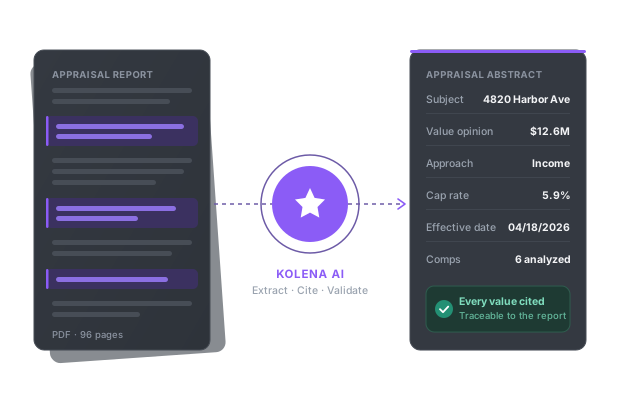
Analyze appraisal reports: Extract property information, valuation data, comparable sales, and characteristics from appraisal forms. Standardize appraisal data for review and reporting. Identify unusual values, inconsistencies, or missing details.
Create and validate loan data records: Populate loan tapes and reporting datasets from source documents. Verify that exported data matches information in FNMA forms and supporting records. Reduce errors caused by rekeying information across systems.
Support portfolio-level reviews: Review large volumes of loan files simultaneously. Identify documentation gaps, underwriting exceptions, and compliance concerns across portfolios. Accelerate due diligence processes.
Provide auditability and traceability: Maintain records of extracted data, validation checks, and identified exceptions. Generate reports showing where information originated within supporting documents. Improve transparency for quality control, compliance, and audit purposes.
Handle complex document packages: Process documents in different formats, including PDFs, scanned files, and image-based records. Incorporate new documents as they become available during the loan lifecycle. Reduce the operational burden of managing large document sets.
By automating extraction, validation, and review tasks, AI helps lenders, underwriters, and servicing teams improve accuracy, accelerate processing times, and scale FNMA form review workflows without proportionally increasing manual effort.
Related content: Learn how to choose the right loan underwriting software.
How to Process FNMA Forms Faster with Kolena
Kolena automates the document-heavy workflows that slow down mortgage and lending teams, turning the manual review of FNMA forms and supporting documents into a fast, accurate, and compliance-ready process. Built for lending and credit teams, Kolena automates the extraction, validation, and cross-referencing of borrower documents, collateral details, and payment data, helping lenders cut turnaround times, reduce errors, and fund deals faster.
Key capabilities of Kolena:
Document extraction and validation: Automatically extract and verify data across borrower documents, filings, and supporting paperwork, reducing manual effort while increasing accuracy and speed.
Compliance testing: Automate regulatory and consumer-protection checks across products, disclosures, and materials to keep loan files audit-ready.
Proof of payment validation: Validate invoices and supporting documents instantly during the funding process.
Funding process acceleration: Automate repetitive data reviews to cut multi-day funding cycles down to hours, reducing turnaround from five days to just a few.
Scalability: Review dozens or hundreds of loans simultaneously with the same team, with workflows that adapt to SBA, equipment finance, or conventional lending.
Compliance and auditability: Maintain full audit trails and confidence scoring for every transaction, backed by SOC 2-compliant, enterprise-ready infrastructure.
Ready to accelerate your lending workflows? Request a demo to see how Kolena automates document-heavy banking and lending workflows — for faster funding, fewer errors, and greater confidence.