What Is the FNMA 1003 Form
Fannie Mae Form 1003, officially known as the Uniform Residential Loan Application (URLA), is the standard standardized form used by U.S. borrowers to apply for a mortgage. It requires detailed information about your personal identity, income, employment, assets, liabilities, and the specific property you are looking to finance.
Sections included in form 1003:
Borrower Information: Your personal details, current and former addresses, employment history, and income breakdown.
Financial Information - Assets and Liabilities: All of your bank accounts, retirement funds, credit cards, auto loans, and other debts.
Financial Information - Real Estate: Information about any properties you currently own and their associated mortgages or taxes.
Loan and Property Information: The type of mortgage applied for (e.g., Conventional, FHA, VA), loan amount, and property details.
Declarations: Specific questions about your financial history (e.g., past bankruptcies, lawsuits, or property foreclosures).
Acknowledgements and Agreements: Legal disclosures confirming the information provided is true and accurate.
Military Service: Information about current or prior military service, including active duty status, service history.
Demographic Information: Ethnicity, sex, and race (this is voluntary, though federal law mandates that lenders ask for it to monitor fair housing laws).
Loan Originator Information: Details about the broker or bank handling your application.
Additional Borrower (if applicable): If a co-borrower applies, this section captures their specific demographic and financial data.
This is part of a series of articles about FNMA Forms
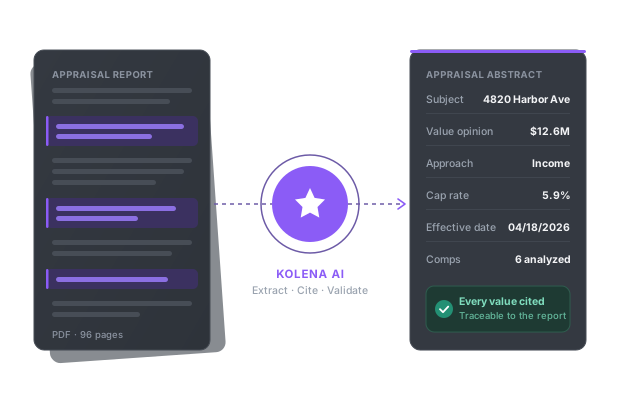
Abstract your first appraisal report in minutes with AI
Why Is the 1003 Mortgage Application Important?
The 1003 mortgage application serves as the foundation of the mortgage approval process and helps lenders make lending decisions based on borrower information:
Provides a complete financial profile: The form gathers details about income, assets, debts, employment, and housing history.
Supports loan eligibility decisions: Lenders use the data in the form to determine whether a borrower qualifies for a mortgage and which loan programs are appropriate.
Simplifies the underwriting process: Because the form follows a standardized format, underwriters can review applications consistently across lenders and loan types.
Helps verify borrower information: The details provided on the 1003 form are cross-checked against supporting documents such as pay stubs, tax returns, bank statements, and credit reports.
Promotes regulatory compliance: The form includes information required for federal lending regulations and reporting requirements.
Reduces processing delays: A complete and accurate application helps prevent missing information and delays during loan review and approval.
Creates a record of the loan application: The 1003 form serves as an official record of the borrower's representations and is maintained throughout the loan origination process.
Supports risk assessment: Lenders use the information collected to evaluate credit risk, calculate debt-to-income ratios, and assess the borrower's ability to repay the loan.
FNMA 1003 Form Overview
Purpose
The primary purpose of the FNMA 1003 form is to collect the data needed for a lender to evaluate a mortgage loan application. It serves as the official record of the borrower's intent to obtain a mortgage and provides the lender with details to assess credit risk. The form helps ensure that the borrower's financial situation, as well as specifics about the property, are captured at the outset of the application process.
Beyond its role as a data collection tool, the 1003 form also serves as a legal document that both parties, borrower and lender, can reference throughout the loan process. It establishes the borrower's consent for the lender to verify information, check credit, and process the loan application. The form is retained as part of the loan file and is subject to regulatory scrutiny, making accuracy and completeness required.
Joint Use
The FNMA 1003 accommodates joint applications, allowing multiple borrowers to apply for a mortgage together. This is common in situations involving co-borrowers, such as spouses, partners, or family members. The form includes separate sections for each applicant, ensuring that each individual's financial and personal information is documented and evaluated during underwriting.
Joint use of the form allows all borrower information to be captured in a single document. This helps lenders assess the combined financial strength of all applicants and structure the loan. It also simplifies compliance and recordkeeping, as all parties' information is consolidated for review and approval.
Structure
The FNMA 1003 form is structured into multiple sections, each dedicated to a specific category of information. These sections include borrower details, financial information, employment history, property details, declarations, and acknowledgments. The organization of the form enables borrowers and lenders to navigate the information and reduce the likelihood of missing data.
Each section uses standardized fields and checkboxes to ensure uniformity across applications. This structure aids in data collection and supports automation and electronic processing. By following a consistent layout, the form supports review, validation, and integration with loan origination systems and secondary market requirements.
Companion Document
The FNMA 1003 works with other documents, including the Uniform Loan Application Dataset (ULAD) and supporting documentation such as credit reports, pay stubs, and tax returns. The ULAD provides a digital, machine-readable format of the 1003, enabling electronic processing and compliance with industry data standards.
Lenders also require documents to verify the information provided on the 1003. These may include identification, proof of income, bank statements, and documentation related to the property being financed. Pairing the 1003 with these documents supports a compliant evaluation of each mortgage application and reduces the risk of fraud and error.
Sections Included in Form 1003
1. Borrower Information
The borrower information section gathers personal details about each applicant, such as name, Social Security number, date of birth, marital status, and contact information. This data is used for identifying the borrower, conducting credit checks, and supporting anti-fraud measures. Lenders use this section to establish the applicant’s identity and eligibility to apply for a loan.
This section also includes information about the borrower's current address, residency status, and the number of years at their current location. It helps lenders understand the borrower's background, which can factor into risk assessment. Accurate and complete borrower information is required for the rest of the application process and for meeting regulatory requirements.
2. Financial Information - Assets and Liabilities
This section requires borrowers to list financial assets, such as checking and savings accounts, retirement funds, investments, and other liquid assets. Lenders use this information to determine the borrower’s capacity to make a down payment, pay closing costs, and maintain reserves.
Borrowers must also disclose liabilities, including credit card debt, auto loans, student loans, and other outstanding obligations. This data enables lenders to calculate debt-to-income ratios, a key metric in loan underwriting. Full disclosure of assets and liabilities supports accurate risk assessment and helps avoid delays or denials during processing.
3. Financial Information - Real Estate
The financial information - real estate section captures details about any real estate the borrower currently owns, including primary residences, second homes, and investment properties. Borrowers must provide property addresses, estimated values, outstanding mortgage balances, and rental income, if applicable. This information helps lenders assess the borrower’s real estate exposure and obligations.
Lenders review this section to evaluate the impact of existing real estate holdings on the borrower’s financial situation. It can affect loan approval if the borrower has significant property-related expenses or liabilities. Accurate reporting of real estate assets supports a full assessment of the borrower’s financial position.
4. Loan and Property Information
In this section, borrowers specify the purpose of the loan, purchase, refinance, or construction, the type of property, single-family, multi-family, condo, and details about the property’s address and intended occupancy. Lenders use this information to match the loan product to the borrower’s needs and confirm the property meets underwriting criteria.
The section also includes proposed loan terms, such as the loan amount, interest rate, and repayment period. This information is used for determining eligibility, structuring the loan, and preparing disclosures. Clear and accurate property and loan details help prevent misunderstandings and support processing.
5. Declarations
The declarations section consists of yes/no questions addressing legal, financial, and property-related circumstances. Borrowers must disclose issues such as bankruptcy, foreclosure, lawsuits, delinquent debts, or citizenship status. This information helps lenders identify potential risks or disqualifying factors early in the process.
Failure to answer these questions truthfully can result in loan denial or legal consequences. Lenders review declarations to ensure compliance with lending standards and regulatory requirements. Complete responses are necessary for a transparent application process.
6. Acknowledgements and Agreements
This section outlines the borrower’s responsibilities, authorizations, and certifications. By signing, the borrower acknowledges the accuracy of the information provided and grants the lender permission to verify details, obtain credit reports, and process the application.
The acknowledgements and agreements clarify expectations and obligations. Borrowers confirm their understanding of the terms, and lenders document compliance with disclosure and authorization requirements. Accurate completion of this section is required for regulatory and legal purposes.
7. Military Information
The military information section collects details about a borrower's current or prior military service. This includes whether the borrower is actively serving, a veteran, a surviving spouse, or otherwise eligible for military-related housing benefits. Lenders use this information to determine eligibility for programs such as VA loans and to identify protections that may apply under federal laws.
Providing accurate military service information helps lenders evaluate available financing options and comply with applicable regulations. For eligible borrowers, this section may support access to specialized loan programs, reduced down payment requirements, or other benefits associated with military service.
8. Demographic Information
The demographic information section collects data related to race, ethnicity, and gender. This information is required under the Home Mortgage Disclosure Act (HMDA) and is used for fair lending analysis and reporting. Borrowers may choose to provide this information or opt out; refusal does not affect loan eligibility.
Lenders use the demographic data to ensure compliance with federal anti-discrimination laws and to monitor lending practices. Accurate reporting supports transparency and the identification of patterns of bias in lending decisions. The section is required for regulatory reporting and maintaining fair lending standards.
9. Loan Originator Information
This section records the details of the loan originator, including name, employer, license number, and contact information. Lenders are required to disclose this information to ensure transparency and accountability throughout the mortgage process.
Including loan originator details helps track the handling of the application and supports compliance with state and federal licensing requirements. This section also aids in resolving disputes or addressing questions about the loan process. Complete originator information is required for a compliant transaction.
10. Additional Borrower (If Applicable)
The additional borrower section is used when more than one person is applying for the mortgage. It captures the same categories of information required from the primary borrower, including personal details, employment history, income, assets, liabilities, and declarations. This ensures that each applicant's financial profile is documented for underwriting review.
Lenders evaluate the combined income, debts, and financial resources of all borrowers when determining loan eligibility. Including an additional borrower can strengthen an application by increasing qualifying income or improving financial capacity. All co-borrowers are generally subject to the same credit and documentation requirements as the primary applicant.
The section also establishes legal responsibility for the mortgage. Each borrower listed on the application may be responsible for repaying the loan, depending on the loan structure and closing documents. Accurate completion of this section is important because errors or omissions can affect underwriting decisions, loan approval timelines, and compliance requirements.
Related articles: FNMA 1007 Form and FNMA Form 1004.
How to Fill Out the FNMA 1003 Form
1. Gather Your Documents
Before starting the FNMA 1003 form, collect documents needed to verify the information you will provide. Common documents include recent pay stubs, W-2 forms, tax returns, bank statements, retirement account statements, identification, and information about current debts or properties owned. Having these materials available helps ensure accuracy and reduces the likelihood of missing information.
If you are self-employed or have nontraditional income sources, additional documentation may be required, such as profit and loss statements, business tax returns, or records of rental income. Gathering documents in advance can speed up the application and underwriting process.
2. Complete Borrower and Employment Details
Enter your personal information exactly as it appears on official records. This includes your full legal name, Social Security number, date of birth, contact information, and current address. If there are multiple borrowers, each applicant must provide their information in the appropriate sections.
Next, provide your employment history and income details. Include your current employer, job title, length of employment, and monthly or annual income. If you have additional income sources, such as bonuses, commissions, rental income, or retirement benefits, disclose them as instructed. Accurate employment information helps lenders verify your ability to repay the loan.
3. List Assets and Liabilities
Record all assets, including checking and savings accounts, investment accounts, retirement funds, and other financial resources. Provide current balances and identify the institution holding each asset. Lenders use this information to assess available funds for down payments, closing costs, and reserves.
You must also disclose outstanding debts and financial obligations. This includes credit cards, auto loans, student loans, personal loans, and other recurring liabilities. Complete reporting allows lenders to calculate your debt-to-income ratio and evaluate credit risk.
4. Review Declarations Carefully
Read each declaration question before answering. These questions cover topics such as bankruptcies, foreclosures, outstanding judgments, lawsuits, delinquent debts, and ownership interests in other properties. Responses must be truthful and complete, as lenders verify many of these details during underwriting.
Incorrect or misleading answers can result in delays, requests for additional documentation, loan denial, or legal consequences. If you are unsure how to answer a question, consult your lender or loan officer before submitting the application.
5. Sign the Acknowledgments
After reviewing all information for accuracy, complete the acknowledgments and agreements section. By signing, you certify that the information provided is true and correct to the best of your knowledge. You also authorize the lender to verify employment, assets, liabilities, and other information included in the application.
The signature serves as your consent for the lender to obtain credit reports and process the mortgage request. Before signing, review the entire application to ensure all sections are complete and errors have been corrected.
How FNMA 1003 Forms Fit into Mortgage Document Automation
Why Lenders Need Accurate 1003 Data Extraction
The FNMA 1003 form contains the information used throughout the mortgage origination process. Data from the form feeds loan origination systems, underwriting engines, compliance workflows, disclosure generation, and secondary market reporting. Accurate extraction ensures that borrower, income, asset, liability, and property information is transferred correctly into these systems.
Errors in extracted data can have consequences. A misplaced income figure, incorrect debt amount, or inaccurate borrower detail can affect:
Debt-to-income calculations
Underwriting decisions
Loan eligibility determinations
These mistakes often lead to additional verification requests, processing delays, higher operational costs, and compliance risks.
Automated data extraction helps lenders improve consistency and efficiency when handling large volumes of mortgage applications. By reducing manual data entry, organizations can accelerate loan processing, reduce human error, and create a reliable foundation for underwriting and quality control activities.
Common Manual Review Challenges with Form 1003
Manual review of FNMA 1003 forms can come with several challenges:
Time-consuming process: The document contains many sections with interconnected financial and personal information. Reviewers must verify data accuracy, compare information against supporting documents, and identify inconsistencies across records. This process becomes more difficult as loan volume grows.
Variability of application packages: Although the 1003 follows a standard format, supporting documents such as pay stubs, bank statements, tax returns, and asset statements may differ in structure and presentation. Reviewers often spend time locating and validating information across these documents.
Human error: Data entry mistakes, overlooked discrepancies, and inconsistent interpretations can affect underwriting outcomes and compliance reporting. Even small errors may trigger additional reviews, borrower follow-up requests, or loan file corrections, increasing processing times and costs.
Bottlenecks: Manual workflows can be too slow during periods of high application volume. As lenders receive more applications, review teams may struggle to maintain turnaround times while preserving accuracy. This has led many mortgage organizations to adopt document automation and intelligent data extraction technologies to improve scalability and efficiency.
How AI Document Automation Can Help
AI document automation can help mortgage teams in several ways:
Simpler and faster workflows: It allows teams to extract, validate, and route FNMA 1003 data with less manual effort. Instead of retyping information from applications and supporting files, automation can parse PDFs, spreadsheets, scanned documents, emails, and other file types to identify borrower, income, asset, liability, and property details.
Applying business rules and cross-checks: This helps to verify extracted fields. For example, income on the 1003 can be compared against pay stubs, debts can be checked against credit reports, and property details can be matched against appraisal documents. When values do not align, the system can flag the issue for review before it affects underwriting or compliance workflows.
Transparency: Document automation tools can provide confidence scores, citations, and reasoning for extracted data. This helps reviewers see where each value came from and why it was selected, which supports quality control and audit preparation.
Improved scale: Lenders can process large volumes of mortgage documents in parallel and send structured outputs into systems such as spreadsheets, CRMs, document repositories, or loan workflow platforms. This reduces bottlenecks, shortens review cycles, and helps teams maintain accuracy without expanding manual review capacity.
How Kolena Automates FNMA 1003 Form Processing
Kolena is an AI-powered document automation platform built for lending and credit teams that need to process loan files faster and more accurately. Instead of manually keying borrower, income, asset, and collateral details from the 1003 and its supporting documents, banking teams use Kolena to automatically extract, validate, and cross-reference data across loan packages—turning multi-day review cycles into a matter of hours while maintaining full audit trails and accuracy borrowers expect.
Key capabilities of Kolena:
Loan package validation: Automatically extracts and verifies borrower and collateral details across loan documents, validating supporting files instantly during the funding process.
Compliance testing: Runs regulatory and consumer-protection checks across products, disclosures, and materials so applications stay audit-ready.
Funding process acceleration: Automates repetitive data reviews to cut multi-day funding cycles down to hours, reducing turnaround time without adding headcount.
Accuracy and confidence scoring: Eliminates data errors and inconsistencies automatically, with confidence scoring and full audit trails for every transaction.
Scalability: Reviews dozens or hundreds of loans simultaneously with the same team, keeping pace during high-volume periods.
Lending flexibility: Adapts workflows for SBA, equipment finance, and conventional lending, and deploys in hours using prebuilt banking workflows.
Ready to speed up your loan file reviews and fund deals faster? Learn how Kolena automates banking and lending workflows.