What Is FNMA Form 1007 (Single-Family Comparable Rent Schedule)
Fannie Mae Form 1007, also known as the Single-Family Comparable Rent Schedule, is a standard document used by mortgage lenders to estimate the fair market rent of a one-unit residential investment property.
Why is it required?:
Lenders require Form 1007 when you are buying or refinancing a single-family investment property (or condo) and want to use the property's potential rental income to qualify for your mortgage loan. The estimated rent calculated in this form helps lenders assess your debt-to-income (DTI) ratio and your ability to cover the mortgage payments.
What information is included?:
Completed by a licensed appraiser, the form contains:
Subject property description: A breakdown of the property's size, condition, and location.
Comparable rent analysis: Market data and rent estimates for at least three similar, recently rented properties in the immediate area.
Adjustments: Upward or downward adjustments for differences in amenities, parking, or square footage.
Indicated monthly market rent: The final, supported monthly rent estimate.
How it is used in underwriting:
Purchases: Lenders may use Form 1007 as a stand-alone estimate if the property is not currently rented, or they may pair it with an executed lease agreement.
Refinances: For refinances, it is typically used alongside tax returns or existing lease agreements to determine eligible rental income.
This is part of a series of articles about FNMA Forms.
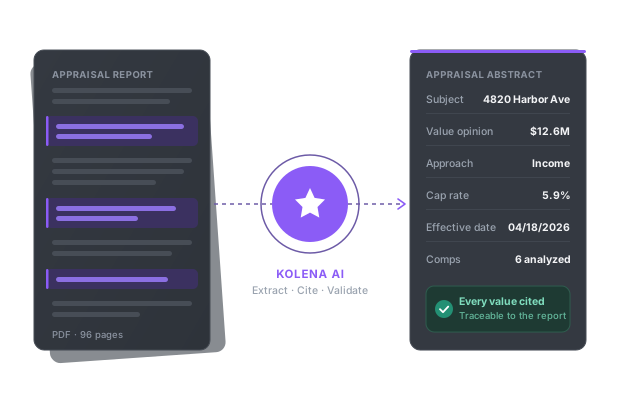
Abstract your first appraisal report in minutes with AI
When Is FNMA Form 1007 Required?
One-Unit Investment Properties
FNMA Form 1007 is required whenever a borrower seeks to finance a one-unit property that will be used as an investment, rather than as a primary residence or second home. Lenders and underwriters use the form to verify the potential rental income that could be generated from the property. This step determines the borrower's ability to meet mortgage obligations through rental earnings, which directly impacts the loan approval process.
The requirement applies to both purchase and refinance transactions involving single-family investment properties. By requiring completion of Form 1007, Fannie Mae ensures that lenders have an objective analysis of the property's market rent potential. This standardization reduces the risk of overestimating income and supports consistent mortgage lending practices for investment properties.
Purchase Transactions
In purchase transactions, FNMA Form 1007 is used when the borrower is acquiring a single-family property to rent it out. The form documents the appraiser’s opinion of the market rent, which is compared to the borrower's stated lease agreements or expected rental income. This comparison helps lenders assess whether the projected income aligns with current market conditions.
For buyers, an accurate rent schedule influences the lender's calculation of qualifying income. If the form indicates that market rents are lower than expected, it may affect the borrower’s debt-to-income ratio and loan approval. Lenders rely on this form to verify that the property will generate sufficient income to support the new mortgage, especially when the borrower’s personal income is supplemented by rental earnings.
Refinance Transactions
When refinancing a one-unit investment property, FNMA Form 1007 is required to determine the current market rent. The lender uses the form to ensure that the property meets income standards set by Fannie Mae for investment properties. This is particularly important if the borrower is seeking to cash out equity or restructure the loan terms based on the property’s rental performance.
The form also helps prevent inflated rent projections that could lead to unsound lending practices. By requiring an updated Comparable Rent Schedule during refinancing, lenders can confirm that the property remains viable under current market conditions. This assessment helps manage risk for both the lender and Fannie Mae.
What Information Is Included in FNMA Form 1007?
1. Subject Property Description
FNMA Form 1007 begins by capturing a description of the subject property. This section includes details such as:
The property address
The type of structure (for example, detached single-family or townhouse)
Square footage
The number of bedrooms and bathrooms
Amenities or upgrades
The appraiser also notes the property’s condition, age, and neighborhood characteristics to provide context for the rent analysis.
Accurate property descriptions serve as the foundation for selecting appropriate comparable rentals. The data entered here helps ensure that the properties chosen for comparison are similar to the subject property, which supports the market rent estimate. Features that might influence rent, such as a finished basement or a pool, are documented in this section.
2. Comparable Rent Analysis
The comparable rent analysis is the core component of FNMA Form 1007. The appraiser identifies at least three recently rented properties that closely match the subject property in location, size, age, and amenities. For each comparable, the form includes:
The address
The rental amount
Lease terms
A description of features and condition
The goal is to show what tenants are paying for similar homes in the same market.
The appraiser explains the similarities and differences between each comparable property and the subject property. This approach allows lenders to see how the subject property fits within the local rental market. The analysis provides enough detail for underwriters to evaluate the comparables and the resulting rent estimate.
3. Adjustments
Adjustments account for differences between the subject property and each comparable rental. These differences might include:
Variations in square footage
The number of bedrooms or bathrooms
The lot size
Age
Amenities such as garages or updated kitchens
The appraiser applies dollar adjustments to the rents of the comparables to align them with the subject property’s characteristics.
This process supports the indicated market rent. For example, if a comparable property has a renovated kitchen and the subject property does not, the appraiser will adjust the rent downward for the comparable to reflect this difference. Each adjustment is documented on the form, showing how the final rent estimate is derived.
4. Indicated Monthly Market Rent
After making adjustments to the comparable rents, the appraiser calculates the indicated monthly market rent for the subject property. This figure represents the probable rent that the property could command under current market conditions. The indicated rent is based on the analysis of comparables and adjustments.
The indicated market rent is a key data point for underwriters, as it affects the borrower’s qualifying income for the loan. If the indicated rent is lower than anticipated, it may affect the borrower’s eligibility or loan terms. By basing this figure on market data and documented adjustments, FNMA Form 1007 keeps rental income projections grounded in current conditions.
How Is FNMA Form 1007 Used in Underwriting
Lenders use FNMA Form 1007 in the underwriting process for investment property loans. The form’s indicated market rent is used to calculate the property’s gross rental income, which is then factored into the borrower’s total qualifying income. This helps lenders assess whether the property will generate enough cash flow to cover the mortgage and related expenses.
Underwriters review the comparables and adjustments documented on the form to confirm the rent estimate is supported by market data. If discrepancies or unsupported assumptions are found, the lender may request additional information or clarification from the appraiser. This review process supports lending standards and helps manage risk related to rental income projections.
Learn more about FNMA 1003 Form.
FNMA Form 1007 vs. Form 1025
FNMA Form 1007 and Form 1025 serve different purposes within the appraisal and underwriting process. Form 1007 is used for single-family investment properties and provides a comparable rent schedule based on similar rental homes. Form 1025 is used for two- to four-unit properties and provides a Small Residential Income Property Appraisal Report, which includes a more detailed income and expense analysis for multi-unit dwellings.
The main distinction is the scope and detail of the information collected. While Form 1007 focuses on estimating market rent for a single-unit property, Form 1025 includes both a rent schedule and an operating income statement, allowing lenders to evaluate the cash flow of multi-unit properties. Understanding the differences helps ensure that appraisers and lenders use the correct form for the property type.
Automating FNMA Form 1007 Documentation with AI
AI can help automate FNMA Form 1007 documentation by extracting property, lease, appraisal, and rent data from files such as PDFs, spreadsheets, emails, scans, and appraisal packages. Instead of manually reviewing each document, teams can use AI to identify document types, capture relevant fields, and organize the information needed for rent analysis.
AI can also apply business rules and cross-checks to validate extracted data. For example, it can compare rental figures, property details, lease terms, and supporting documents to flag missing values, inconsistencies, or unusual results. Confidence scores, citations, and reasoning help reviewers verify how each result was produced.
Structured outputs can then be exported into tools such as Excel, SharePoint, CRMs, or other internal systems. This reduces manual data entry and helps keep underwriting files consistent, traceable, and ready for review.
For lenders and appraisal teams handling high document volumes, automation can shorten review cycles while improving consistency. It supports faster rent schedule preparation, clearer validation, and reliable documentation across investment property loan files.
How to Automate FNMA Form 1007 and Appraisal Workflows with Kolena
Kolena is an AI-powered document automation platform built for financial services teams that handle complex, document-heavy processes—from investment due diligence to compliance testing. Kolena AI automates analysis, extraction, and reporting so lending and appraisal teams move faster with greater accuracy and transparency, turning manual reviews that once took weeks into audit-ready outputs delivered in hours.
Key capabilities of Kolena:
Automated data extraction: Extract key data across deal packages—including appraisals, legal documents, and reports—to support investment analysis and decision-making without manual data entry.
Source-cited, confidence-scored results: Every result comes with confidence scoring and source citations, so reviewers can verify accuracy and trust each data point.
Automated compliance testing: Review disclosures, statements, and forms against regulations automatically, validating complex documents and cross-referencing multiple sources so nothing slips through the cracks.
Report and memo generation: Summarize appraisals, filings, and reports into professional-grade memos and structured outputs using customizable templates that match your standards.
Parallel processing at scale: Process hundreds of documents simultaneously with the same team, accelerating turnaround across high-volume loan files.
Audit-ready outputs: Every output is traceable and regulator-compliant, supporting internal audit and compliance checks.
Ready to accelerate your loan file and appraisal reviews? Discover how Kolena's AI for Financial Services automates document analysis with accuracy your team can trust.