The difference between OCR, IDP, and Document AI is what each one understands: OCR converts an image to text but understands nothing, IDP adds machine learning to pull specific fields from document types it has been trained on, and Document AI (the agentic tier) reads documents with contextual understanding, applies your own rubric, reasons across multiple documents, and returns structured output with field-level citations. Choosing the right tier comes down to how variable your documents are and how much the output has to be trusted and traced.
This guide is for operations, technology, and process leaders in insurance, commercial real estate, banking, and financial services evaluating document automation. It explains what each tier does, what it costs, what it can't do, and how to tell which one your workflows actually need. The market context matters: intelligent document processing is now a multi-billion-dollar category growing at roughly 26% a year, and the center of gravity has shifted from OCR-plus-rules toward AI-driven and agentic approaches.
Tier 1: OCR — Converting Images to Text
Optical Character Recognition does one thing: it turns a scanned page, photo, or image-based PDF into machine-readable text. That's valuable — without it, downstream software can't process a scanned document at all — but OCR has no idea what the text means. It can tell you a page contains the characters "Base Rent: $12,500"; it cannot tell you that this is the base rent, that a later amendment superseded it, or where on the page it appeared in a way you can rely on.
What it costs and can't do. OCR is fast and cheap — often fractions of a cent per page — but accuracy on real-world inputs (skewed scans, mixed layouts, tables) has historically been far lower than marketing suggests, and it produces no structure and no judgment. Suits: digitizing archives, making documents searchable, feeding text into another system that adds the intelligence. On its own, OCR is a building block, not a solution for extracting decision-ready data.
Nine free AI document tools — pick your workflow
Tier 2: IDP — Extracting Fields from Known Document Types
Intelligent Document Processing is the umbrella category that sits on top of OCR: it adds machine-learning classification and extraction to capture specific fields from documents it recognizes. Feed an IDP system invoices, ACORD forms, or W-2s it has been trained on, and it will classify the document and pull the fields you've configured, often reaching 95%+ accuracy on those known types. Modern IDP platforms are capable, analyst-recognized products, and for high-volume, repetitive, well-defined document types they are a strong fit.
Read about best ai document automation platforms.
What it costs and can't do. IDP is a bigger investment than OCR — typically enterprise licensing — and it earns that cost when document types are stable and volume is high. Its limits are structural: it is brittle on unfamiliar formats it wasn't trained on, it generally extracts fields rather than reasoning about how they interact, and it doesn't natively reconcile information across a set of related documents. When a new format arrives or a value in one document depends on another, traditional IDP needs retraining or human intervention. Suits: standardized, high-volume document types — invoices, standard forms, claims attachments — where the formats don't change often.
Tier 3: Document AI — Reasoning Across Documents with Citations
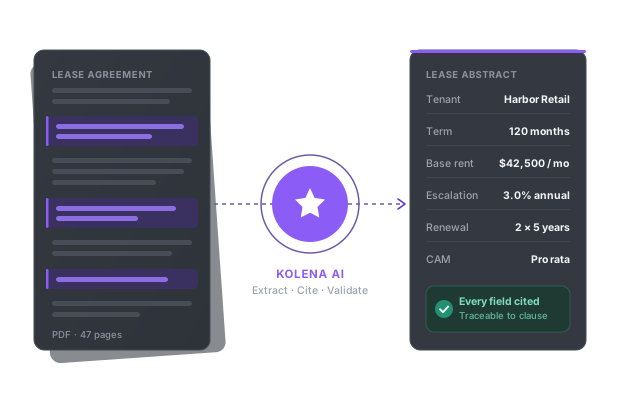
Document AI — the agentic tier, where Kolena sits — reads documents the way an analyst does: with contextual understanding, against a rubric you define, reasoning across multiple related documents, and returning structured output in which every value is cited to the exact location it came from. Instead of being trained on a fixed set of formats, it understands documents it hasn't seen before, and instead of treating each file in isolation, it reconciles them — consolidating a base lease and its amendments to the currently effective term, or cross-referencing a rent roll against a T12.
Read about ai document extraction source citations.
What it costs and can't do. Document AI is priced as a platform, typically per document or per volume tier rather than per seat. It is not the right tool for a single, unchanging form at massive scale where a cheaper IDP pipeline already works well, and it does not replace human judgment — it flags low-confidence items for review rather than guessing. Suits: variable, complex, multi-document workflows in regulated industries where output has to be trusted, traced, and defended — lease abstraction, loan-file review, claims intake, KYC, due diligence.
The Same Lease Through Each Tier
A concrete example makes the difference obvious. Take a commercial lease with three amendments, where a 2021 amendment changed the base rent. OCR returns the full text of all four documents as machine-readable characters — including every rent figure ever written, with no indication of which one is current and no structure. You now have searchable text and the same reading job you started with. IDP, if it has been trained on your lease format, classifies the documents and extracts a "base rent" field — but unless it was specifically built to consolidate amendments, it may return the original figure, the amended figure, or several values without resolving which governs, and a non-standard amendment format can throw it off entirely. Document AI reads all four documents as one related set, follows the amendment chain to the currently effective base rent, returns that single value in your template, and cites it to the exact clause in the 2021 amendment — flagging the item for review if anything is ambiguous. Same documents, three very different outputs, and only the third is decision-ready.
How the Three Tiers Compare
| Capability | OCR | IDP | Document AI |
|---|---|---|---|
| Understands meaning | No | Within trained types | Yes, contextual |
| Handles unfamiliar formats | N/A (text only) | Brittle; needs retraining | Reads new formats natively |
| Reasons across documents | No | Limited | Yes (reconciles related docs) |
| Custom rubric / template | No | Configured per type | Defined by you, applied per run |
| Field-level citations | No | Rarely | Yes, to the exact source |
| Typical cost | Fractions of a cent/page | Enterprise license | Platform, per document/volume |
| Best fit | Digitizing, search | Stable high-volume forms | Variable, regulated, multi-doc work |
The tiers aren't strictly competitors — Document AI uses OCR under the hood, and IDP remains excellent for the workflows it was built for. The question is which tier matches the shape of your documents and the stakes of your output.
Which Tier Do You Actually Need?
Match the tier to two variables: how much your documents vary, and how much the output has to be trusted. If you only need scanned pages turned into searchable text, OCR is enough. If you process a few stable, high-volume document types and mainly need fields pulled from them, IDP is the cost-effective fit. If your documents are variable, arrive in formats you can't fully anticipate, depend on each other, and produce outputs a regulator, auditor, lender, or investment committee will scrutinize, you need Document AI — because the reasoning across documents and the citation behind every value are exactly what those stakeholders require.
For insurance, CRE, banking, and financial services specifically, the third tier usually wins, because those industries combine high format variability (every carrier's loss run, every bank's statement, every landlord's lease is different) with hard audit-trail requirements. That is precisely the gap that OCR and traditional IDP leave open and that Document AI closes.
It's also worth noting the tiers can coexist in one organization. A firm might keep a cheap OCR pipeline for archiving, an IDP product for a single high-volume standardized form, and Document AI for the variable, high-stakes workflows where reasoning and citations are required. The mistake is forcing one tier to do another's job — stretching IDP across unpredictable formats it wasn't trained on, or paying for Document AI on a single static form that a rules-based pipeline already handles. Matching tier to task, workflow by workflow, is what keeps both cost and accuracy where they should be.
Why Citations and Onshore Processing Separate the Tiers in Practice
Two features decide whether a document automation tool is usable in a regulated workflow, and they map almost entirely to the top tier. The first is field-level citation: when an examiner or investor asks how you arrived at a number, "the system extracted it" is not an answer, but a link to the specific line on the tax return or the exact lease clause is. The second is data handling: where the documents are processed and whether the vendor trains on your data. Tools that keep processing onshore, hold SOC 2 Type II certification, and never train on customer data remove exposure that matters acutely when files contain SSNs, income, or confidential deal terms. These aren't universal across IDP or OCR products; they are defining features of enterprise Document AI.
How Kolena Works
Kolena is an AI document automation platform built for insurance, commercial real estate, banking, and financial services. Documents of any format go in — leases, loan files, claims, statements, KYC packages, data rooms — and structured data against your own rubric comes out, reasoned across related documents, with every value cited to its exact source.
It reads any format, reconciles related documents rather than treating them in isolation, and pushes structured output into the systems you already run — Yardi, MRI, loan-origination, core banking, and your data warehouse. Every run produces a full audit trail: not just what was extracted, but the specific line, field, or clause that justified each data point. SOC 2 Type II certified, onshore processing, no training on customer data.