AI document extraction needs source citations — not just the extracted data — because in any regulated or high-stakes workflow you have to prove where each value came from, and "the AI extracted it" is not a defensible answer to a regulator, auditor, lender, or investor. A citation that links each value to the exact page, section, or clause it was drawn from turns AI output from a claim into evidence. That is the difference between AI that does the work and AI that shows its work.
This is for operations and compliance leaders evaluating document AI vendors — anyone who has to stand behind extracted data in front of someone who can question it.
This is part of a series of articles about AI for Document Workflows.
Data Alone vs. Data With a Source
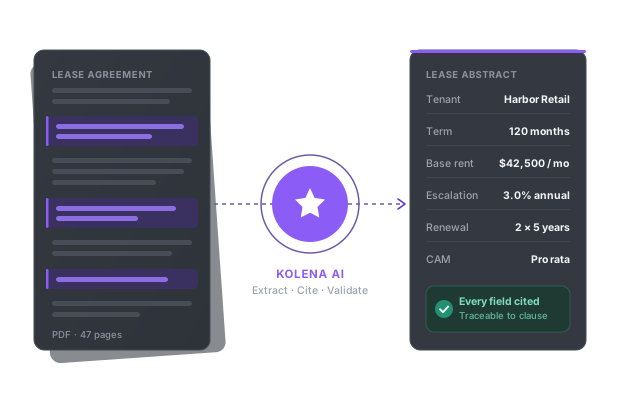
Most document AI platforms return a value: borrower income, $214,000. A platform with citations returns the same value plus a link to line 22 of the specific tax return it came from. In a demo the two look almost identical. In production they are completely different products, because everything downstream — verification, audit, error-handling — depends on whether you can get back to the source without re-reading the document.
Nine free AI document tools — pick your workflow
Regulatory and Audit Contexts
When a regulator or auditor asks how you determined a borrower's income, a coverage decision, or a customer's risk rating, they are asking for the basis, not the conclusion. An uncited extraction forces you to reconstruct that basis by hand, document by document, after the fact. A cited extraction answers the question directly: here is the value, here is the exact line it came from. For BSA/AML reviews, lending compliance, and insurance underwriting and claims, that documented decision logic is increasingly an expectation, not a nicety — and it has to exist at the moment of extraction, not be assembled later.
Lender and Investor Diligence
Credit memos and investment-committee memos live or die on sourced figures. A number in an IC memo that can't be traced to a source document gets re-verified by hand before anyone will rely on it — which erases the time the AI was supposed to save. Citations eliminate that re-verification step: the analyst clicks through to the source, confirms in seconds, and moves on. One PE customer uses Kolena for IC memo drafting and data-room due diligence precisely because cited figures let the team move fast without sacrificing rigor.
Error Detection
No extraction system is perfect, so the real question is what happens when a value is wrong. With a citation, a wrong value is a quick fix: you follow the link, see that the AI read the wrong line, and correct it. Without a citation, a wrong value is a much bigger problem — you have to re-process the entire document to find where the number should have come from, and you often don't even know a value is wrong because there's nothing to check it against. Citations make errors findable and fixable; their absence makes errors invisible until they cause damage.
Learn more about best ai document automation platforms.
| Scenario | Data only | Data with field-level citations |
|---|---|---|
| Auditor asks for basis | Reconstruct by hand | Click to the exact source line |
| Figure in a credit/IC memo | Re-verified before use | Verified in seconds, trusted |
| A value is wrong | Re-process whole document | Follow the link, fix the source |
| Compliance audit trail | Assembled after the fact | Produced at extraction time |
Compliance in Insurance
In regulated insurance markets, claims decisions, coverage determinations, and underwriting outputs increasingly require documented audit trails — a record of not just what was decided but what in the document supported it. Citations provide that natively: every extracted value carries its provenance, so the audit trail is a byproduct of the extraction rather than a separate, manual reconstruction project. That is what makes cited Document AI usable in environments where an examiner can ask, at any time, to see the basis for a decision.
The Standard for Enterprise Document Automation
The takeaway for buyers is simple: in regulated industries, citations are not a premium feature, they are the baseline for trustworthy automation. AI that returns data asks you to trust it; AI that returns data with sources lets you verify it — and verification is what regulators, auditors, lenders, and investors actually require. When evaluating document AI, treat field-level citation as a requirement, not a nice-to-have.
How Kolena Works
Kolena is an AI document automation platform built for regulated insurance, real estate, banking, and financial services workflows. Documents go in; structured data comes out with every value linked to the exact page, section, or clause it was drawn from — so each extraction arrives with its own proof.
It reads any format and pushes structured, cited output into your existing systems, so verification is a click to the source rather than a re-read of the document. Every run produces a full audit trail: not just what was extracted, but the specific line, field, or clause that justified each data point. SOC 2 Type II certified, onshore processing, no training on customer data.