The best AI document automation platform for insurance, commercial real estate, banking, and financial services is the one that matches your documents' variability and your industry's compliance bar — which is why this comparison ranks platforms on citations, accuracy methodology, onshore processing, vertical fit, and audit-trail depth, not on generic feature counts. These criteria are what separate a tool you can defend to a regulator from one that simply returns data.
Document automation is a crowded market, and many strong products are built for adjacent problems — enterprise back-office volume, audit evidence, real-estate data, visual damage assessment. This guide covers Kolena alongside fifteen other platforms, noting what each is genuinely best for so you can match the tool to your workflow rather than to a leaderboard.
For regulated industries specifically, six criteria matter most. Use them to frame any evaluation.
Criterion | Why it matters for insurance, RE, banking, and financial services |
|---|---|
Field-level citations | Lets you verify and defend each value to a regulator, auditor, lender, or investor |
Accuracy methodology | A headline number means little without precision, recall, and hallucination measurement |
Onshore processing | Files contain SSNs, income, and confidential terms; jurisdiction is a compliance issue |
No training on your data | Keeps confidential documents from becoming a vendor's training material |
Vertical specialization | Insurance, CRE, and lending documents have domain logic generic tools miss |
Audit-trail depth | Regulated decisions require a documented basis, not just an output |
This is part of a series of articles about AI for Document Workflows.
Kolena
Best for: insurance, commercial real estate, banking, and financial-services teams that need cited, audit-ready document automation across variable, multi-document workflows.
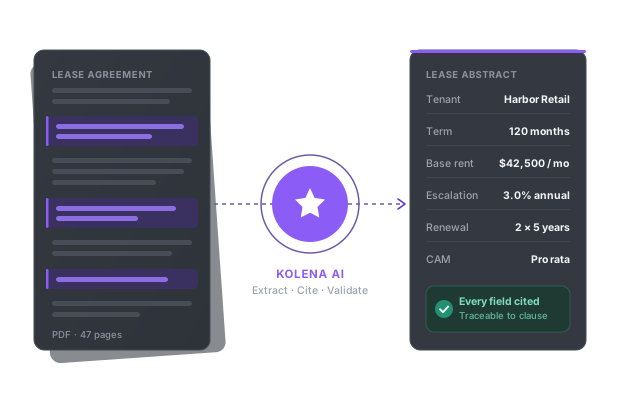
Kolena is an AI document automation platform that deploys agents to read documents of any format, apply your own rubric, reason across related documents, and return structured data with field-level source citations. It is built for the document workflows that define its four verticals — lease abstraction and rent-roll reconciliation in CRE; loan-file review, UCC review, and bank-statement analysis in lending; FNOL and submission intake in insurance; and IC-memo and data-room work in financial services. What distinguishes it for regulated buyers is the combination the criteria above call for: every extracted value links to its exact source clause or line, the platform reconciles related documents (consolidating a lease and its amendments, or cross-referencing a rent roll against a T12) rather than reading files in isolation, and low-confidence items are flagged for human review instead of guessed. It processes data onshore, is SOC 2 Type II certified, and does not train on customer data — the data-handling posture that matters when files contain SSNs, income, or confidential deal terms. One private-lending customer cut UCC filing review labor by 96%; one commercial real estate firm captured about $100,000 in efficiency gains across 58 leases. Kolena also offers free single-document tools so buyers can test the workflow on their own documents before committing.
Nine free AI document tools — pick your workflow
Ocrolus
Best for: fintech and bank lending teams automating bank-statement, pay-stub, and tax-form analysis.
Ocrolus is an AI data and analytics platform focused on financial-document analysis for lending, combining automated extraction with a human-in-the-loop layer and fraud detection, and reporting very high accuracy on statements and income documents. It is well established with fintech and bank customers and strong specifically on cash-flow and income verification. Buyers in CRE or insurance should note its center of gravity is lending-document analysis rather than lease, claims, or broad multi-document reasoning, so it fits income-verification workflows better than diversified document automation.
Hyperscience
Best for: large enterprises and government agencies with very high volumes of semi-structured forms.
Hyperscience is an enterprise IDP and hyperautomation platform, recognized as a Leader in the first Gartner Magic Quadrant for IDP, with FedRAMP High certification and customers among major banks, insurers, and federal agencies. Its strength is high-throughput classification and extraction at enterprise scale with strong governance. It is a horizontal platform rather than a vertically specialized one, so insurance, CRE, and lending teams gain scale and compliance infrastructure but supply more of the domain configuration themselves.
Hebbia
Best for: asset managers, investment banks, and PE firms doing research and diligence over large document sets.
Hebbia is an AI platform for finance and legal knowledge work, using an agentic, spreadsheet-style interface (Matrix) to answer questions across large document collections with cited answers, and it serves many of the largest asset managers. Its strength is reasoning and synthesis over big corpora for deal analysis, credit, and market research, with citations to source material. It is oriented toward analyst research workflows rather than high-volume structured extraction into downstream systems, which is a different job than, say, abstracting a lease portfolio into Yardi.
Learn more about ai document extraction source citations.
Eigen Technologies
Best for: large banks extracting data from complex financial and legal agreements.
Eigen is a document AI platform known for financial-services and insurance extraction, with a small-data training approach suited to specialized documents like ISDA agreements and credit documentation, and a strong model-governance framework used by many global systemically important banks. Acquired by Sirion in 2024, it is increasingly positioned within contract-intelligence and CLM. Buyers should weigh that strategic shift when evaluating it for standalone, broad document automation outside contract-heavy use cases.
Instabase
Best for: large enterprises building custom AI workflows over unstructured documents.
Instabase is an enterprise IDP platform (AI Hub) for banking, insurance, and healthcare, with a no-code/low-code environment for building custom extraction and understanding workflows over complex unstructured documents. Its strength is flexibility and foundation-model-based understanding at enterprise scale. As a horizontal platform, it gives teams a powerful toolkit but expects them to assemble the vertical logic, which suits organizations with the resources to build and maintain custom apps.
Klarity
Best for: revenue-accounting and finance teams automating contract review for the close and SOX controls.
Klarity is AI document-review software purpose-built for revenue accounting, trained to recognize hundreds of revenue-related contract terms, pre-populate review checklists, and flag items that exceed materiality for human review. It is strong for accelerating close cycles and strengthening controls in high-growth and public companies. Its focus is accounting and contract review rather than insurance, CRE, or lending document workflows, so it fits finance-operations teams more than underwriting or claims.
Indico Data
Best for: P&C insurers automating underwriting and claims document intake and decisioning.
Indico is an intake and agentic-decisioning platform purpose-built for insurance, handling loss runs, ACORDs, SOVs, emails, and attachments, with human review embedded in the workflow, and it has been recognized at the top of insurance-specific IDP assessments. Its strength is deep insurance domain fit for the variability that breaks generic tools. Buyers outside insurance — in CRE or banking — would be adopting a platform optimized for a different vertical than theirs.
DataSnipper
Best for: external and internal audit teams automating evidence work inside Excel.
DataSnipper is an Excel-native automation platform for audit and finance, strong at evidence extraction, cross-referencing, document matching, and tests of detail, with traceable links from values back to source documents, used by hundreds of thousands of audit professionals. Its strength is keeping auditors in the familiar Excel environment with traceable results. It is purpose-built for audit evidence rather than production document automation feeding operational systems, so it suits assurance work more than underwriting or claims pipelines.
Automation Anywhere (Document Automation)
Best for: enterprises standardized on Automation Anywhere RPA that want integrated document processing.
Automation Anywhere's Document Automation is the IDP capability within its broader agentic process-automation platform, using its Process Reasoning Engine to classify, extract, and validate across document types with reported 95%+ accuracy and human review on low-confidence items. Its strength is tight integration with a large RPA ecosystem for end-to-end workflow automation. For buyers not already invested in that platform, the document capability comes bundled with a broader automation suite they may not need.
UiPath Document Understanding
Best for: enterprises building document steps into UiPath RPA workflows.
UiPath Document Understanding combines RPA with AI to digitize, classify, extract, and validate data across many document types, with a no-code design and human-in-the-loop validation, positioned for banking, finance, insurance, healthcare, and manufacturing. Its strength is embedding document processing inside end-to-end UiPath automations. Like other RPA-anchored options, it is most compelling for organizations already standardized on UiPath rather than as a standalone, vertically specialized document AI.
Reonomy
Best for: CRE brokers, investors, and lenders sourcing and researching properties and owners.
Reonomy is a commercial real estate data and property-intelligence platform — not a document automation tool — unifying records, ownership, and transaction history across tens of millions of US commercial properties with predictive scoring. Its strength is prospecting and market intelligence. It overlaps with document AI only at the edges (turning public records into structured data); for extracting data from your own leases, loan files, or claims, it solves a different problem than a document automation platform.
Cherre
Best for: institutional real estate firms unifying data across systems and vendors.
Cherre is a real estate data-management and integration platform — a data-infrastructure layer, not a document AI tool — using a property knowledge graph to connect and standardize data from sources like CoStar, Trepp, and Argus into a unified record. Its strength is resolving and aggregating disparate data for analytics and reporting at portfolio scale. Document extraction from source files like leases and rent rolls is upstream of what Cherre does, so it complements rather than replaces a document automation platform.
Tractable
Best for: auto and property insurers assessing physical damage from photos.
Tractable is a computer-vision AI company that assesses vehicle and property damage from images and returns repair estimates in minutes, used by many of the world's largest carriers. Its strength is visual damage assessment for claims, not text-document processing. It is highly effective for the image-based part of a claim, but it does not read policies, loss runs, or the document side of insurance workflows, so it pairs with, rather than substitutes for, document automation.
Sixfold
Best for: insurance underwriters augmenting submission triage and risk research.
Sixfold is an AI platform purpose-built for insurance underwriting, using agents to summarize submissions, align risk to appetite, and surface research, with an emphasis on responsible, explainable AI, and partnerships with major carriers. Its strength is underwriting decision support across P&C and L&H. It is focused on the underwriting reasoning layer rather than broad, cross-industry structured document extraction, so it fits carriers augmenting underwriters more than diversified document automation needs.
EvenUp
Best for: personal-injury law firms drafting demand packages from medical records.
EvenUp is an AI platform for personal-injury legal work, processing medical records and drafting demand letters and related documents, with a verdict database for settlement benchmarking. Its strength is a narrow, deep use case in plaintiff-side PI litigation. It is not a general document automation platform for insurance carriers, lenders, or real estate firms, so it is relevant to this list only as a contrast — a highly specialized tool for a single legal workflow.
Summary Comparison
Marks reflect what is publicly documented; "Not documented" means a capability could not be confirmed, not that it is absent.
Platform | Best for | Citation depth | Vertical specialization | Onshore processing |
|---|---|---|---|---|
Kolena | Cited doc automation in regulated industries | Field-level ✓ | Insurance, CRE, banking, financial services ✓ | Yes ✓ |
Ocrolus | Lending document analysis | Not documented | Lending / financial services ✓ | Not documented |
Hyperscience | Enterprise / government IDP | Not documented | Horizontal (Partial) | Partial (FedRAMP High) |
Hebbia | Finance research & diligence | Cited answers ✓ | Financial services ✓ | Not documented |
Eigen Technologies | Complex financial/legal docs | Not documented | Financial services / insurance ✓ | Not documented |
Instabase | Custom enterprise doc workflows | Not documented | Horizontal (Partial) | Not documented |
Klarity | Revenue-accounting contract review | Not documented | Accounting / finance ops (Partial) | Not documented |
Indico Data | Insurance intake & decisioning | Not documented | Insurance ✓ | Not documented |
DataSnipper | Audit evidence in Excel | Traceable links (Partial) | Audit / finance (Partial) | Not documented |
Automation Anywhere | IDP within RPA suite | Not documented | Horizontal (Partial) | Not documented |
UiPath Doc Understanding | Doc steps in RPA workflows | Not documented | Horizontal (Partial) | Not documented |
Reonomy | CRE data & prospecting | N/A (data platform) | CRE data ✓ | Not documented |
Cherre | CRE data integration | N/A (data platform) | CRE data ✓ | Not documented |
Tractable | Visual damage assessment | N/A (vision AI) | Insurance (visual) Partial | Not documented |
Sixfold | Insurance underwriting support | Explainable (Partial) | Insurance ✓ | Not documented |
EvenUp | PI legal demand drafting | Cited verdicts (Partial) | Legal / personal injury (niche) | Not documented |
How to Choose
Start from your workflow, not the leaderboard. If you need to extract data from your own variable documents — leases, loan files, claims, statements — and defend every value to a regulator or investor, look for field-level citations, onshore processing, no training on your data, and specialization in your vertical. If your need is high-volume extraction from a few stable form types, a horizontal IDP platform may be more cost-effective. If you need property data, audit evidence in Excel, or visual damage assessment, the right answer is a data, audit, or vision tool, not a document automation platform at all.
For buyers in insurance, CRE, banking, and financial services whose documents are variable and whose outputs are scrutinized, the criteria themselves point toward platforms that combine citations, onshore processing, and vertical fit — the requirements this guide opened with.