What Is a Construction Pay Application?
A construction pay application is a formal document submitted by contractors to request payment for completed work and stored materials, acting as a detailed invoice. It ensures accurate cash flow and includes critical documents covering project scope, change orders, retention, and percentage of work completed.
These applications are critical for maintaining project cash flow and ensuring that all parties are compensated as work progresses. They often include supporting documentation, such as schedules of values, lien waivers, and change orders, to validate the work performed and justify the payment amount requested. Accurate and timely pay applications help prevent disputes, delays, and misunderstandings between project stakeholders.
Commonly used documents:
AIA G702: Application and certificate for payment. The cover sheet summarizing the financial status.
AIA G703: Continuation sheet. Detailed breakdown of work items, usually aligned with the Schedule of Values (SOV).
AIA G701: Change order. Documents approved changes to the original construction contract.
AIA G702/G703 variants: Modified versions of the G702 and G703 forms to accommodate specific contractual or regulatory requirements.
AIA G704: Certificate of substantial completion. Formally documents that the project, or a designated portion of it, has reached substantial completion.
AIA G706: Contractor’s affidavit of payment of debts and claims. A sworn affidavit submitted by the contractor confirming that all payments have been made for labor, materials, equipment, and subcontractor services.
AIA G707: Consent of surety to final payment. Grants formal consent for the project owner to make final payment to the contractor.
How Construction Pay Applications Work
Construction pay applications are submitted on a recurring schedule, usually monthly, based on the terms defined in the project contract:
The contractor prepares the application by assessing the percentage of work completed for each item in the schedule of values during the billing period. This percentage is then applied to the total value of each item to calculate the amount due.
The contractor submits the completed pay application to the architect, owner's representative, or general contractor, depending on the project structure. The recipient reviews the application to verify quantities, progress, and any changes. This often involves comparing the application against site observations, project documentation, and prior billing records.
Once approved, the application is forwarded to the project owner for payment processing. If there are discrepancies, such as overstated progress or missing documentation, the application may be returned for revision, delaying payment. Therefore, accuracy and supporting evidence are essential.
This cycle repeats until the project is complete, with final applications often including closeout documentation, final lien waivers, and retainage release requests.
Pay Application Key Concepts
Pay applications follow a structured format to ensure clarity and consistency across billing cycles. Each component serves a specific purpose, from tracking progress to documenting financial changes. Understanding these elements helps stakeholders verify work completed, validate payment amounts, and maintain accurate financial records throughout the project.
Schedule of values: The SOV is a detailed line-item breakdown of the entire scope of work, assigning a dollar value to each portion. It forms the basis for calculating the percentage of work completed and the corresponding payment due in each billing cycle.
Continuation sheet: This document tracks progress over time by listing the original SOV items along with the amounts previously billed, currently billed, and remaining balance. It provides a running total that reflects the project's financial progress.
Change orders: Any approved changes to the original contract—such as additional work or modifications—must be included. These changes are reflected in the updated SOV and billed accordingly in the pay application.
Lien waivers: Contractors and subcontractors often include lien waivers to confirm they have been paid for prior work and waive the right to file a mechanic’s lien for those amounts. These documents are critical for ensuring clear title and preventing legal disputes.
Retainage details: A percentage of the payment may be withheld as retainage, typically until substantial completion. The pay application must clearly indicate how much retainage is being withheld and how much has been released, if any.
Certification and signatures: The pay application usually includes a signed certification by the contractor or subcontractor affirming the accuracy of the billing and compliance with contract terms. In some cases, notarization may also be required.
Common Types of Pay Applications
AIA Pay Applications
AIA pay applications are standardized forms developed by the American Institute of Architects (AIA) and are widely used in the construction industry. The most common forms, G702 (Application and Certificate for Payment) and G703 (Continuation Sheet), provide a structured format for contractors to detail work completed, materials stored, and the amount due for each billing cycle. These forms are recognized and accepted by many project owners, lenders, and architects, making them a preferred choice for larger or more complex projects.
Custom / Non-AIA Pay Apps
Custom or non-AIA pay applications are tailored forms developed to meet the specific needs of a project, contractor, or client. These applications may deviate from standard formats, allowing for more flexibility in how costs, progress, and supporting documentation are presented. Custom pay applications are common in smaller projects, private contracts, or situations where the AIA forms do not fully address unique project requirements or contractual arrangements.
Digital Pay Applications
Digital pay applications leverage construction management software or cloud-based platforms to automate and streamline the billing process. These systems allow contractors to generate, submit, and track pay applications electronically, reducing manual data entry and minimizing errors. Digital solutions often integrate with project management tools, accounting systems, and document storage, enabling real-time collaboration and faster approvals.
Pay Application vs. Invoice vs. Progress Claim
A pay application is a formal request for payment tied directly to the progress of a construction project, detailing completed work and materials delivered. In contrast, an invoice is a general billing document used across various industries to request payment for goods or services rendered, often without the detailed breakdown required in construction pay applications. A progress claim is similar to a pay application but is more commonly used in certain regions, such as Australia and the UK, to refer to periodic payment requests based on project milestones or work completed.
While the terms are sometimes used interchangeably, their usage and required documentation can differ significantly. Pay applications and progress claims typically require supporting evidence, such as schedules of values, lien waivers, and certifications, to substantiate the payment request. Invoices may be less detailed and not subject to the same level of scrutiny. Understanding the distinctions is important for meeting contractual and legal requirements and ensuring timely, dispute-free payments within construction projects.
Commonly Used Documents in Construction Pay Applications
1. G702: Application and Certificate for Payment
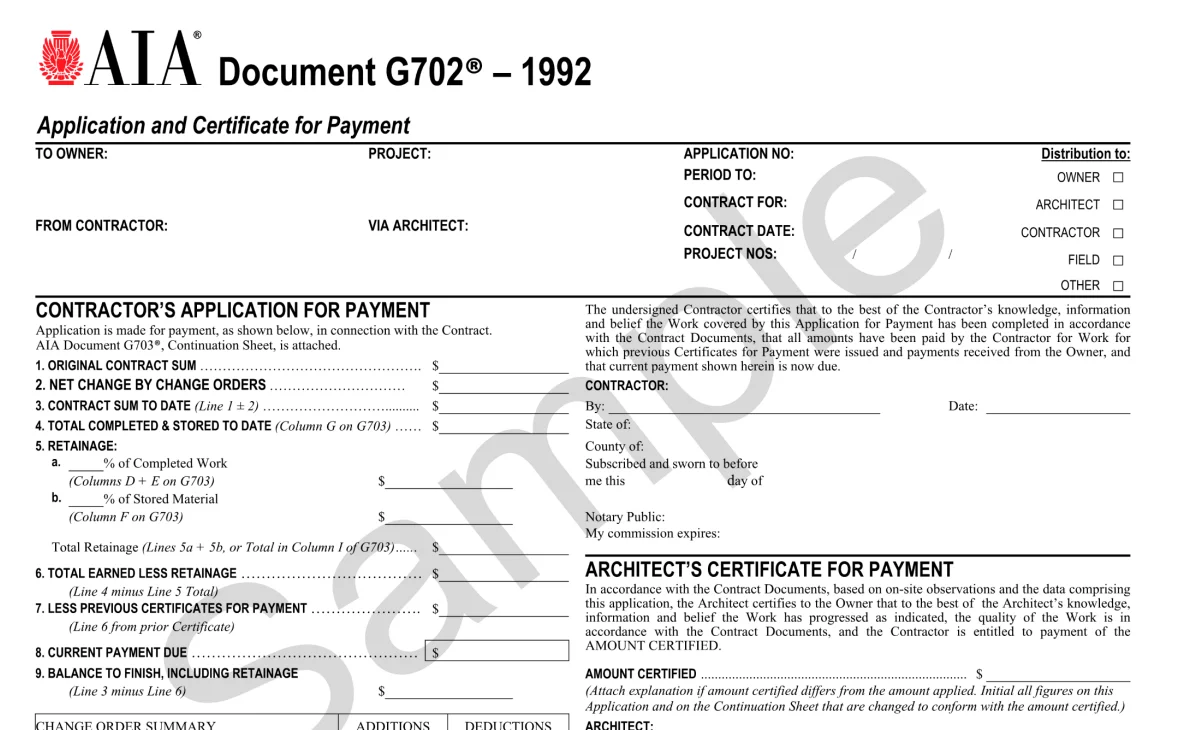
The G702 form, created by the American Institute of Architects (AIA), is a standard application and certification document used in construction pay applications. Contractors use the G702 to formally request payment by summarizing the value of work completed, the amount previously billed, the current amount requested, and any retainage held. The form requires signatures from both the contractor and the architect or project manager, certifying the accuracy of the information and approval for payment.
This document is widely recognized in the industry and often required for projects using AIA contracts. Its standardized format streamlines the review process, ensuring all necessary information is presented clearly and consistently. The G702’s certification section provides legal assurance to owners and lenders that work has been performed as described, reducing the risk of payment disputes or fraudulent claims.
Learn more in our detailed guide to AIA G702
2. G703: Continuation Sheet
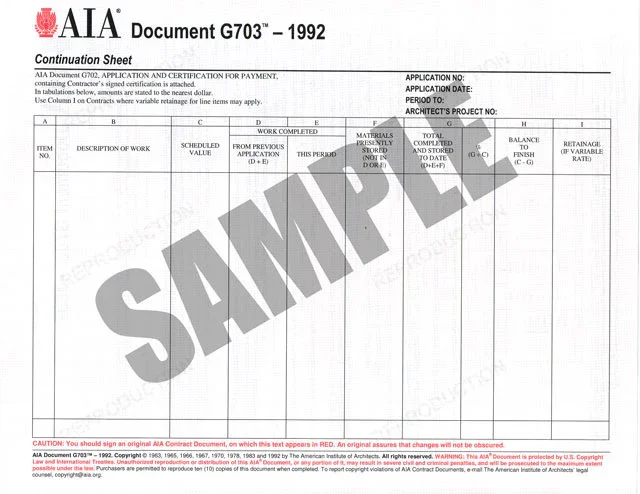
The G703 Continuation Sheet accompanies the G702 and provides a detailed breakdown of the work performed. It lists each line item from the schedule of values, showing the original contract amount, work completed to date, materials stored, and the percentage of completion for each category. This granular detail allows for precise tracking of project progress and ensures transparency in billing.
Using the G703 helps project stakeholders verify that payments align with actual work performed. It supports clear communication between contractors, owners, and architects, reducing the likelihood of misunderstandings or disputes over payment amounts. The G703 also serves as a valuable record for future reference, audits, or project closeout documentation.
Learn more in our detailed guide to AIA G703
3. G701: Change Order
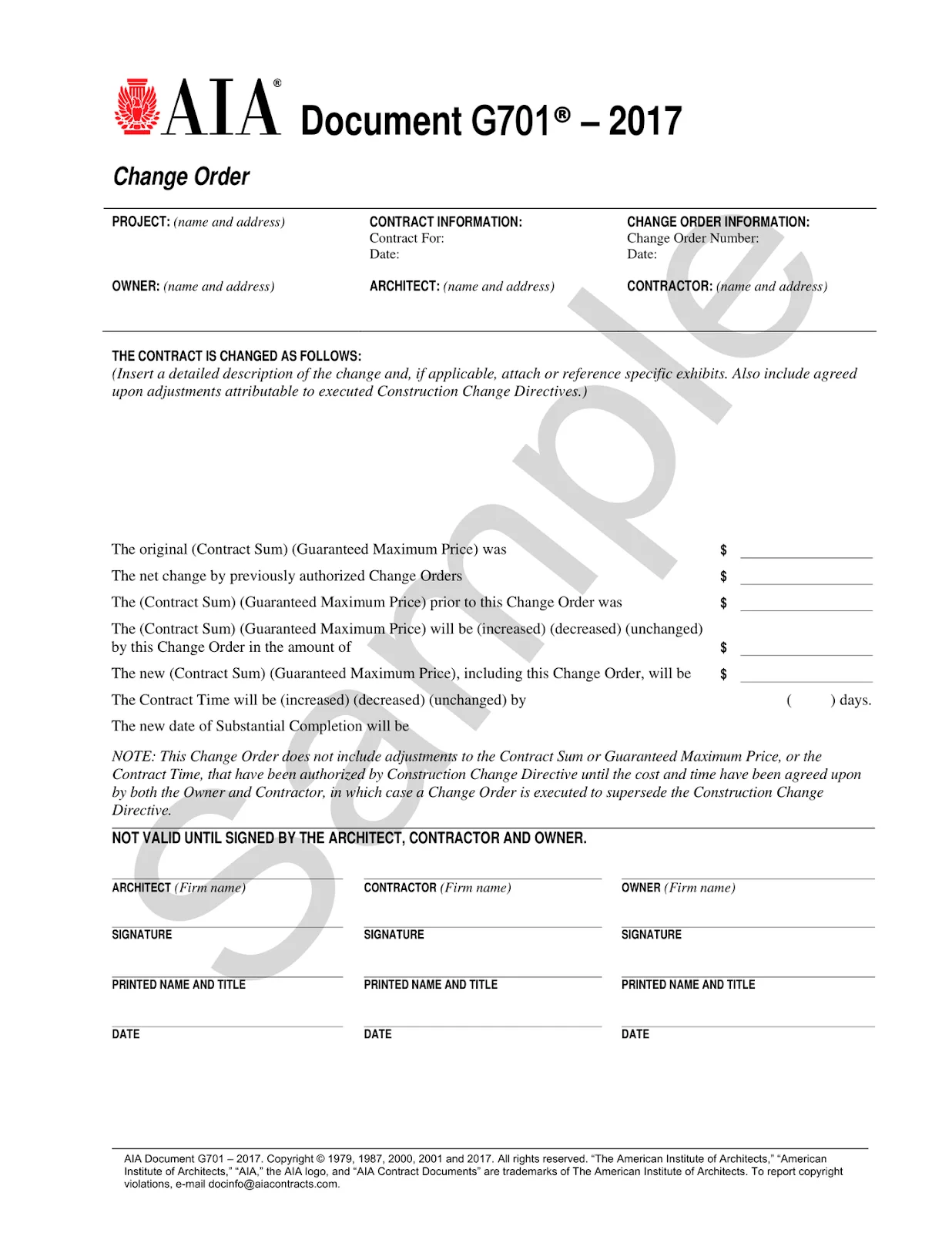
The G701 form, also developed by the AIA, documents approved changes to the original construction contract. Change orders may involve adjustments to the scope of work, contract price, or project schedule due to unforeseen conditions, client requests, or design modifications. The G701 captures the details of each change, including the reason, description, and impact on the contract amount and completion date.
Submitting the G701 with pay applications ensures that all stakeholders are aware of and have agreed to contract modifications before payment is processed. This helps prevent disputes over unapproved work or payment amounts and provides an official record of project changes for reference throughout the construction lifecycle.
4. G702/G703 Variants
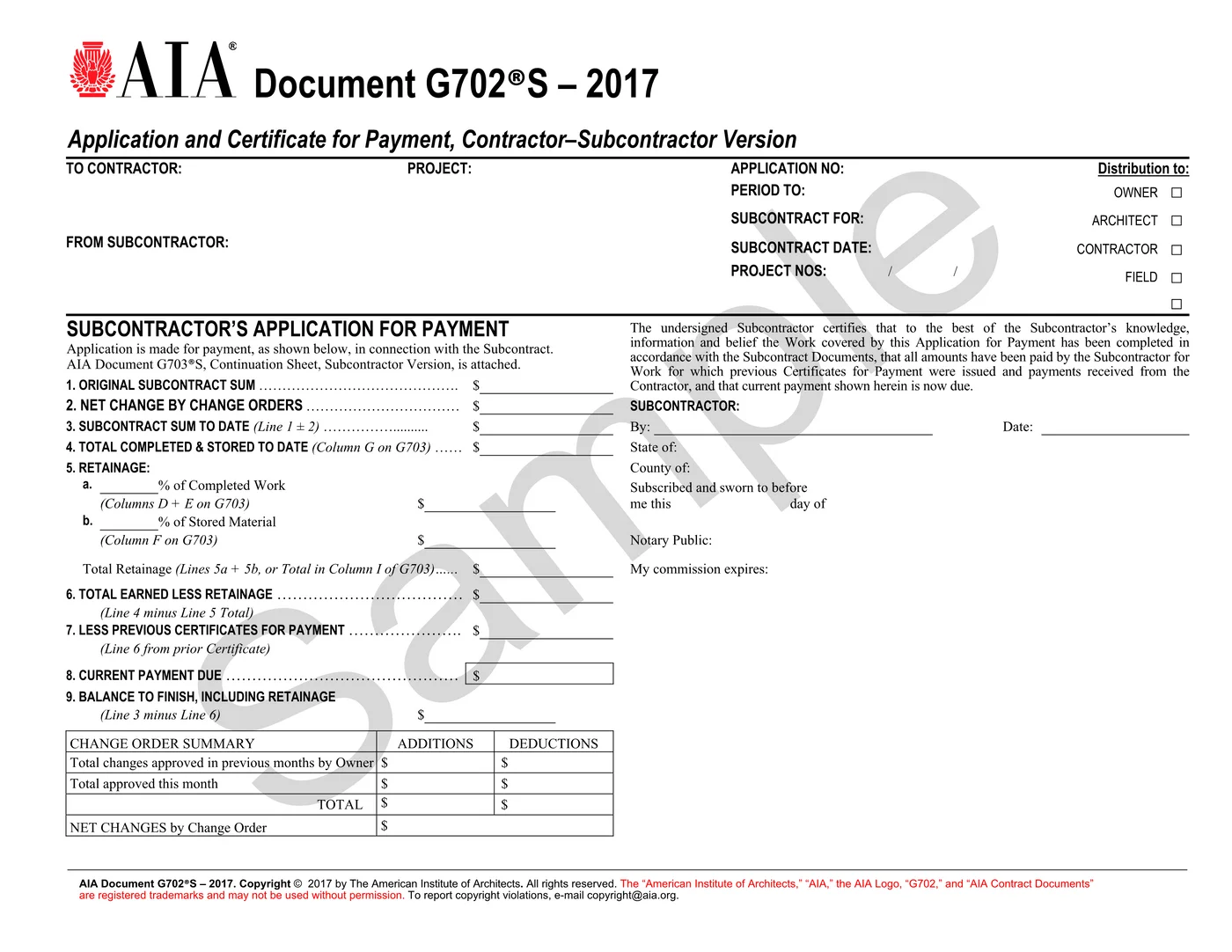
Some projects use modified versions of the G702 and G703 forms to accommodate specific contractual or regulatory requirements. These variants may include additional sections for compliance with funding agency rules, insurance requirements, or unique project conditions. Customizations can range from extra certification statements to alternative line-item structures or reporting formats.
While variants offer flexibility, they must be carefully managed to ensure all necessary information is captured and that the forms remain compliant with industry standards and contract terms. Clear communication about any changes to standard forms is essential to avoid confusion during the pay application review and approval process.
5. G704: Certificate of Substantial Completion
The G704 form is issued by the architect to formally document that the project, or a designated portion of it, has reached substantial completion. Substantial completion is the stage where the work is sufficiently complete, according to the contract documents, for the owner to occupy or use the project for its intended purpose.
The G704 identifies the date of substantial completion, outlines any remaining punch list items, and may assign responsibilities for their completion. It also typically marks the point when the warranty period begins and when the owner assumes responsibility for utilities, insurance, and maintenance. This certificate is critical for triggering retainage release and setting the timeline for final payment processes.
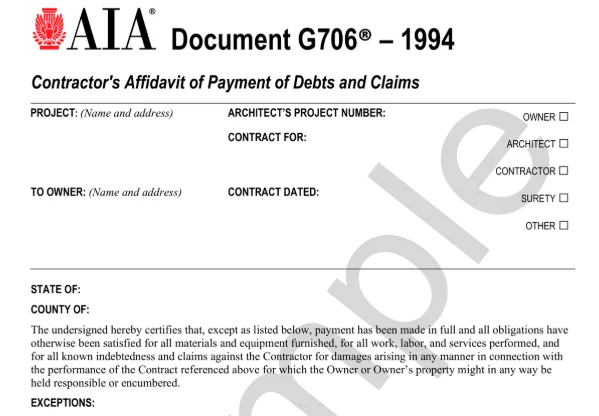
6. G706: Contractor’s Affidavit of Payment of Debts and Claims
The G706 is a sworn affidavit submitted by the contractor confirming that all payments have been made for labor, materials, equipment, and subcontractor services associated with the project, except for those listed in the affidavit. It serves as a formal declaration that there are no outstanding claims that could result in liens or legal disputes.
This document is typically required as part of the final payment package to assure the owner and lender that the contractor has fulfilled all financial obligations. It provides protection to the owner by reducing the risk of post-completion claims from unpaid parties.
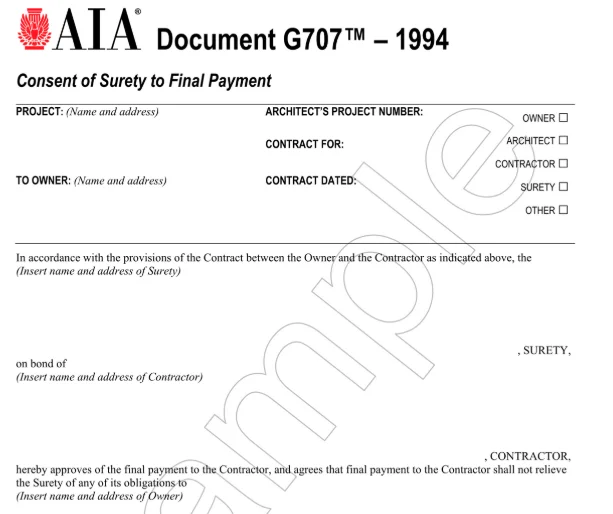
7. G707: Consent of Surety to Final Payment
The G707 form is issued by the surety company that provided the performance or payment bond for the project. It grants formal consent for the project owner to make final payment to the contractor. The surety's approval confirms that all terms of the bond have been met and that releasing final funds will not compromise the bond’s protections.
This document is often a mandatory requirement before the owner can release retainage or process the final payment. It ensures that the surety has verified the contractor’s fulfillment of contractual obligations and that no known issues would trigger a bond claim.
Construction Payment Processing with AI-Driven Automation
AI-driven automation is transforming construction payment workflows by replacing slow, manual verification with precise digital systems. These tools enable contractors and owners to handle complex documentation with greater speed and fewer errors, ensuring that project financials stay aligned with actual site progress.
How automation helps with construction payment processing
Automated data extraction: AI systems automatically pull key figures and details from standard forms like G702 and G703, eliminating the need for hours of manual data entry and reducing human error.
Consistency checks: The software runs cross-document validations to ensure that totals on continuation sheets match application summaries and that retainage calculations are mathematically sound.
Faster approval cycles: By flagging discrepancies in real-time, project teams can resolve issues immediately, maintaining a steady cash flow and preventing the weeks-long delays often caused by paperwork rejections.
Enhanced transparency: Stakeholders gain a clear audit trail that shows exactly how each payment was calculated and verified, fostering trust between owners, architects, and contractors.
Start automating PayApps with Kolena AI today!
Challenges in Construction Pay Applications and Solving Them with AI
Payment Delays and Cash Flow Gaps
Payment delays are one of the most common and damaging challenges in construction pay applications, frequently leading to significant cash flow gaps for subcontractors and suppliers. Delays can occur at multiple points in the approval chain, from initial contractor submission to architect review or final owner approval. Even seemingly small issues, such as missing signatures or unclear progress updates, can push payment timelines back by weeks, slowing overall project progress, straining relationships, and increasing financial risk across the project.
How AI can help:
AI-powered systems flag discrepancies in real-time, allowing project teams to resolve issues immediately and significantly shorten the review and approval cycles.
AI models can analyze historical payment data to identify bottlenecks and predict which applications are most likely to be delayed, enabling preemptive intervention.
Incomplete or Incorrect Documentation
One of the primary causes of pay application rejection is incomplete, outdated, or inconsistent documentation. Pay applications require a large and precise set of supporting documents, including lien waivers, change orders, and updated schedules of values. This challenge is compounded on complex projects with multiple subcontractors and frequent changes, where even minor discrepancies between a contractor's application and a subcontractor's submission can trigger immediate delays and revision requests.
How AI can help:
AI automatically extracts and validates key information from various document types (e.g., PDFs, images of waivers) and checks them against the main application forms.
AI tools run consistency checks to ensure all required supporting documents are present, complete, and that their financial totals align with the amounts claimed on the G702 and G703 forms.
Systems can flag missing lien waivers or unapproved change orders instantly upon submission, preventing the application from being routed for review until all required documentation is attached.
Manual Errors and Calculation Mistakes
The continued reliance on manual processes, often involving spreadsheets and paper forms, significantly increases the risk of calculation errors within pay applications. Mistakes in fundamental areas like percentages of completion, retainage calculations, or line-item totals often lead to rejected applications and incorrect billing amounts. Beyond delaying payments, these repeated manual errors reduce trust among project stakeholders and can trigger closer scrutiny and significantly longer review cycles in the future.
How AI can help:
AI-driven software automatically performs complex calculations, such as retainage and line-item totals, eliminating common spreadsheet and manual entry errors.
By integrating with accounting and project management systems, AI ensures that data is transferred accurately across documents without re-keying, minimizing data transcription errors.
Automated systems create a clear, documented audit trail for every calculation and data point, simplifying reconciliation and trust among all parties.
Using Kolena AI for PayApp Automation
Construction pay applications are complex, document-heavy, and prone to delays when handled manually. Kolena AI simplifies this process by automating data extraction, validation, and review across AIA forms and supporting documents.
Kolena automatically pulls key fields from G702, G703, and related files, then cross-checks values for consistency—flagging discrepancies before submission. It also ensures all required documentation, such as lien waivers and change orders, is complete, reducing rejection risk.
By replacing manual reviews with AI-driven workflows, teams can accelerate approvals, improve accuracy, and maintain steady cash flow across projects.