The complexity of managing commercial real estate (CRE) portfolios has exploded. With mounting lease obligations, fragmented data, evolving compliance rules, and rising tenant expectations, traditional tools simply can’t keep up. That’s why industry leaders are embracing commercial real estate property management software powered by AI to stay competitive.
According to Ascendix Tech, the market for AI in commercial real estate is expected to grow from $2.9 billion in 2023 to $41.5 billion by 2033—a 30.5% compound annual growth rate (CAGR). This shift reflects how critical automation and machine learning have become in lease management, financial planning, and risk analysis.
What Is Commercial Real Estate Property Management Software?
Commercial real estate property management software helps property owners and asset managers oversee leases, track payments, manage maintenance, and produce reports. It differs from residential solutions by handling complex lease terms, industrial workflows, and multi-tenant commercial environments.
With AI and automation embedded, these systems offer far more than basic data tracking—they interpret documents, flag risks, and deliver business insights in real time.
According to BPM, AI adoption in property management has helped CRE firms unlock new efficiencies in document analysis, tenant screening, and building operations.
Top AI Use Cases in CRE Property Management
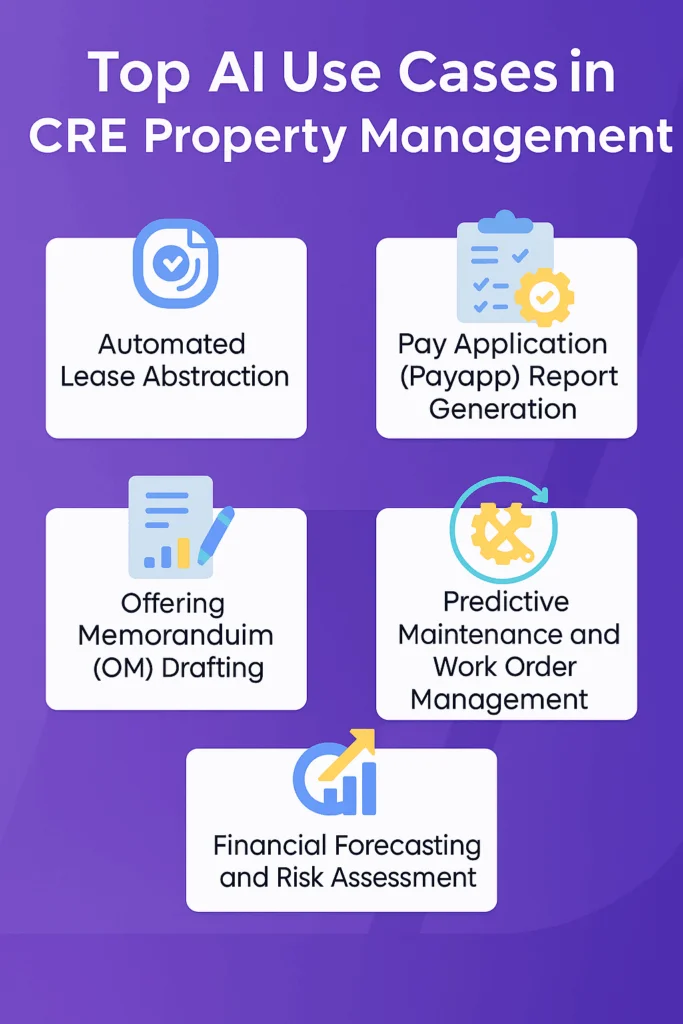
1. Automated Lease Abstraction
Lease abstraction is a labor-intensive task that requires extracting terms such as renewal options, rent escalations, and termination clauses. AI tools like those from Prophia and LeaseLens now automate this process with 90–95% accuracy, delivering structured summaries from PDFs and scans in minutes.
For example, Prophia’s platform has abstracted data from over 15,000 tenants across 400+ million square feet, highlighting how AI is scaling lease review for large portfolios.
➡️ Kolena offers free lease abstraction tools that generate abstracts in real time—trusted by top CRE professionals for their speed and precision.
2. Pay Application (Payapp) Report Generation
AI can also streamline construction payment applications, such as G702/G703 forms. According to Kolena’s blog, firms using automation have reduced draw processing times from days to hours while increasing compliance.
Instead of manually pulling data for each line item, AI pulls values directly from contracts and change orders, ensures alignment with billing cycles, and flags anomalies—resulting in faster approvals and fewer disputes.
3. Offering Memorandum (OM) Drafting
Offering memorandums are critical for marketing CRE properties but can take days to prepare. AI-powered tools generate OMs using existing lease data, market comps, and tenant profiles in minutes.
According to SmartDev, platforms that generate OMs automatically reduce broker workload by up to 70%, allowing teams to focus on high-touch investor outreach.
4. Predictive Maintenance and Work Order Management
AI’s impact extends beyond leasing and into facilities management. By analyzing IoT data, repair logs, and usage patterns, AI predicts equipment failures before they occur.
A Matterport report notes that predictive maintenance models can reduce equipment downtime by 20% and maintenance costs by up to 30%, transforming how CRE firms manage capital assets.
5. Financial Forecasting and Risk Assessment
AI can analyze rent rolls, historical income, tenant payment patterns, and market data to forecast future income streams and flag potential financial risks. As reported by Ascendix, 43% of CRE firms use AI for financial planning, helping them optimize portfolio performance and reduce exposure.
Why AI-Driven CRE Software Matters
- Operational Efficiency
- Automation reduces repetitive tasks like data entry and document review, freeing up time for high-value work.
- Risk Reduction
- AI helps avoid missed clauses, payment errors, and compliance issues—reducing legal exposure.
- Faster Decisions
- Dashboards fed by AI insights allow real-time tracking of occupancy, cash flow, and lease expirations.
- Smarter Maintenance
- Machine learning helps shift from reactive to predictive operations—saving money and reducing tenant disruptions.
Selecting the Right Commercial Property Management Software
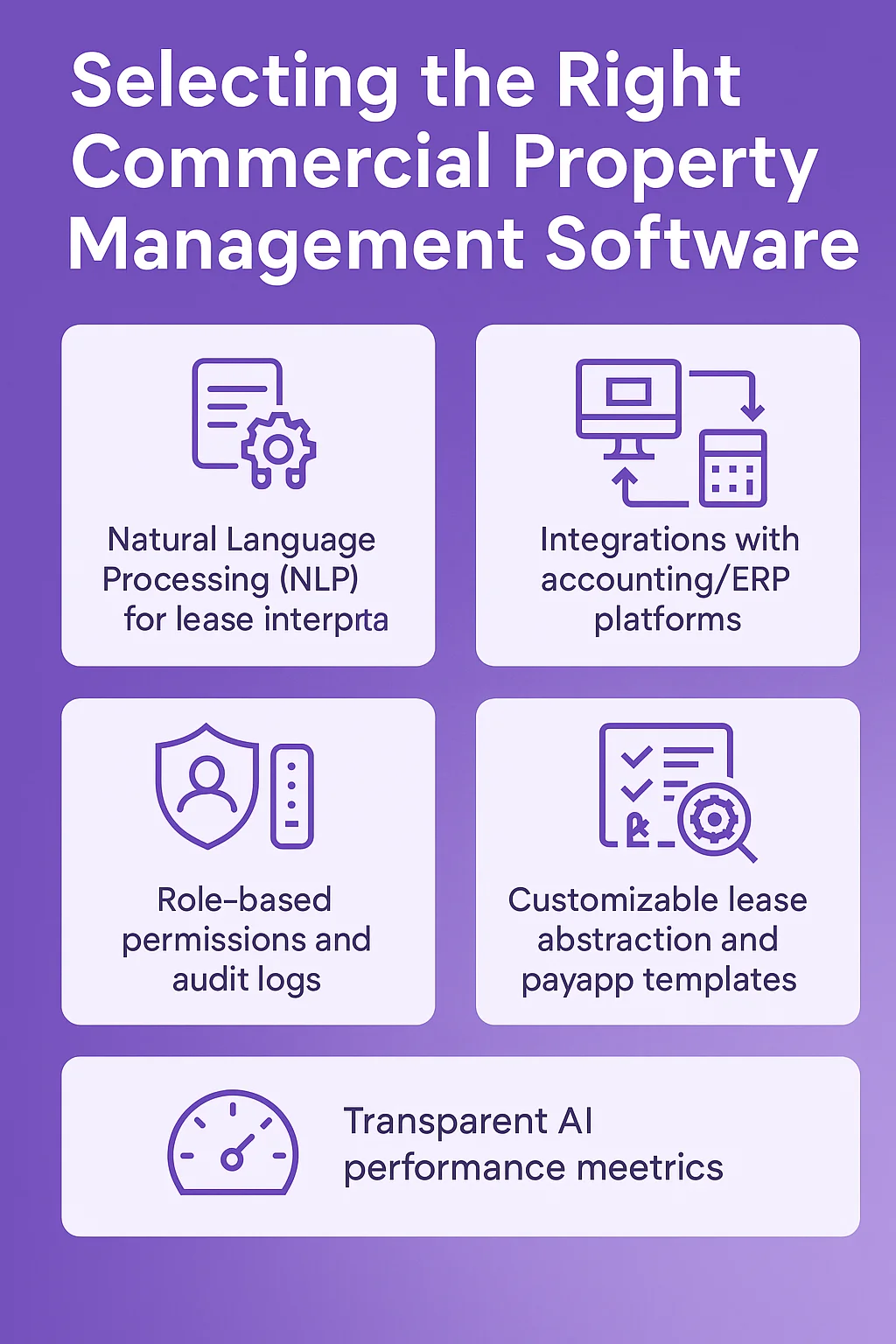
When evaluating platforms, look for features such as:
- Natural Language Processing (NLP) for lease interpretation
- Integrations with accounting/ERP platforms
- Role-based permissions and audit logs
- Customizable lease abstraction and payapp templates
- Transparent AI performance metrics
According to Baselane, the best AI solutions are those that allow human-in-the-loop (HITL) reviews, so analysts can validate AI-extracted data when necessary.
Final Thoughts
AI-enabled commercial real estate property management software is changing how CRE professionals manage leases, tenants, maintenance, and financials. With automation and machine learning, firms can reduce costs, enhance compliance, and scale operations without scaling headcount.
As the market continues to shift toward tech-driven property operations, platforms like Kolena are helping firms stay ahead—without sacrificing control or oversight.
📈 According to industry reports, firms embracing AI today are saving 30–60% in operational costs over traditional methods. The future is automated and it’s already here.
Explore how Kolena’s AI platform can simplify your commercial real estate operations.
Visit www.kolena.com or book a personalized demo today.